
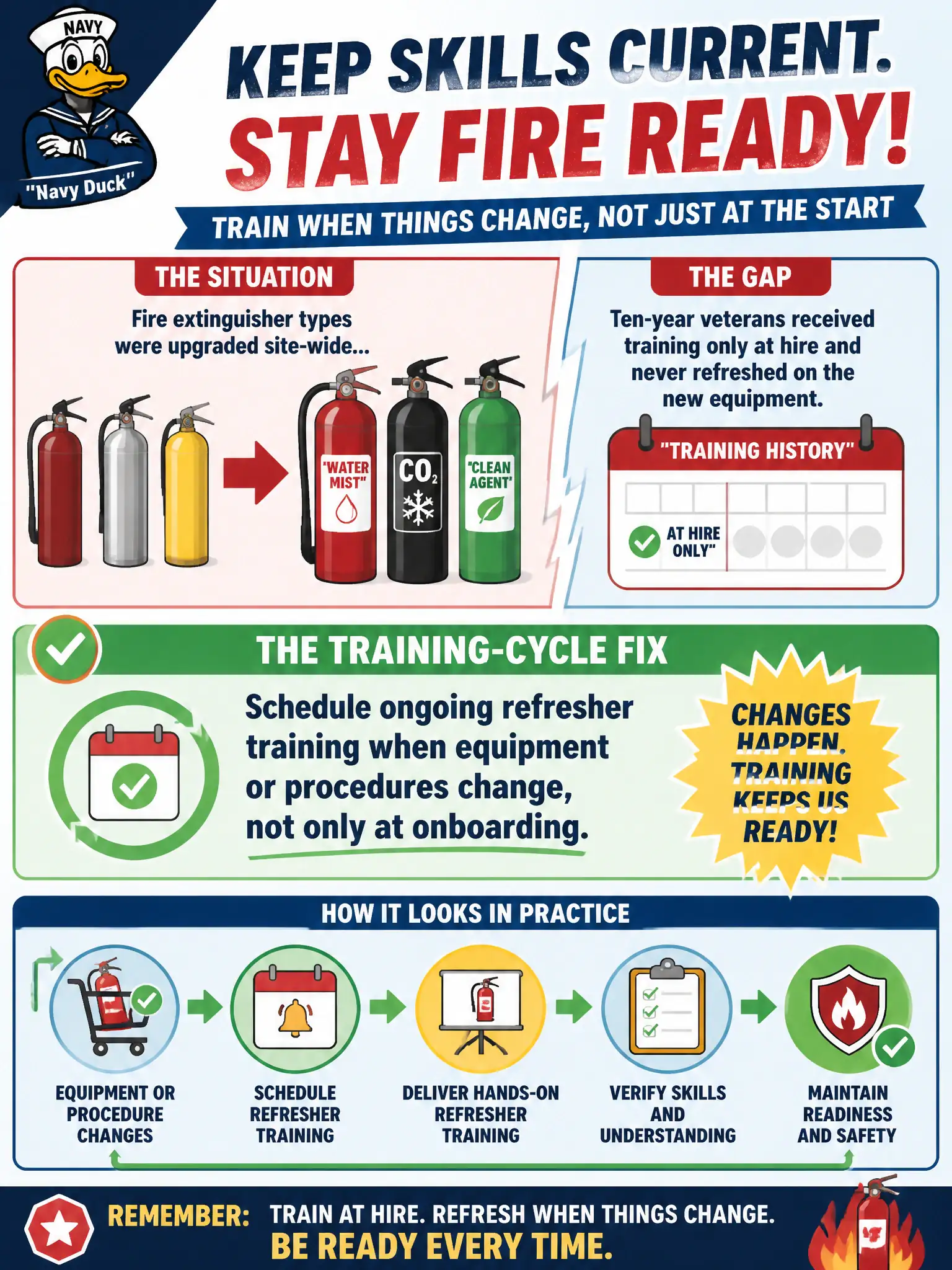
Fire extinguisher types were upgraded site-wide, but ten-year veterans received training only at hire and never refreshed on the new equipment. What training-cycle fix is needed?
Select an answer to reveal the explanation.
Short Explanation
Learning the old extinguisher in 2014 doesn’t magically teach the new nozzle in 2026. Veterans still need a refresh when gear changes. Training cycles are living—onboarding alone isn’t enough.
Full Explanation
Scheduling ongoing refresher training when equipment or procedures change—not only at onboarding—is correct because competence must track the control environment. Site-wide extinguisher upgrades change operating methods; veterans trained only at hire retain obsolete muscle memory. Civic sites (schools, libraries, depots) rely on those veterans during first response, so refreshers after material change are a risk treatment, not optional courtesy.
Assuming long tenure automatically transfers skill to new extinguisher models fails by concept because tenure reflects experience with prior equipment, not automatic transfer to new hardware. Limiting refreshers to new hires so veterans are never interrupted fails because excluding the largest experienced cohort leaves the highest-frequency responders untrained on the new control. Replacing hands-on drills with a one-time poster campaign that never repeats fails because posters raise awareness at best and do not build or verify psychomotor skill under alarm conditions.
Exam caveat: CRMC training adequacy links refresher triggers to change events as well as periodic cycles. Onboarding-only training models fail when equipment or procedures evolve after hire.
Operational check: After extinguisher or similar life-safety equipment upgrades, roster all staff including long-tenure employees for hands-on refresher, record completion before declaring the upgrade closed, and spot-check that veterans can demonstrate the new unit’s operation.