
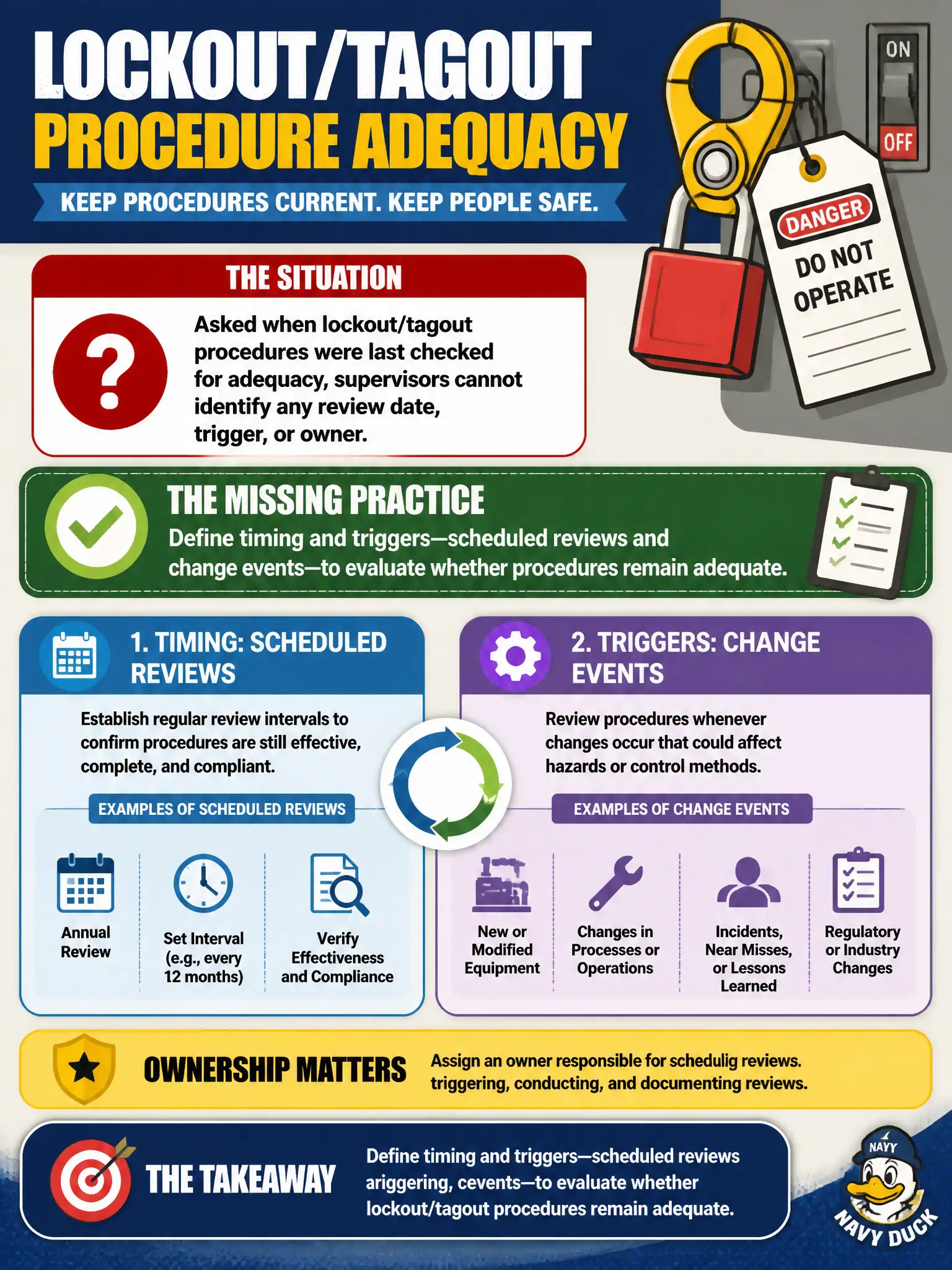
Asked when lockout/tagout procedures were last checked for adequacy, supervisors cannot identify any review date, trigger, or owner. What practice is missing?
Select an answer to reveal the explanation.
Short Explanation
If nobody can say when lockout was last sanity-checked, you’re flying on faith. Procedures age—equipment, staffing, and tricks of the trade shift. Put review dates and triggers on the calendar so adequacy isn’t a shrug.
Full Explanation
Defining timing and triggers—scheduled reviews and change events—to evaluate whether procedures remain adequate is correct because adequacy is time-bounded, not a one-time signature event. Lockout/tagout (and similar high-energy controls) drift as equipment, staffing, and contractors change; without named owners, review dates, and change triggers, supervisors cannot demonstrate the procedure still fits reality. Civic facilities and transit shops need that cadence for both safety and auditability.
Treating procedure adequacy as permanent once the first draft is signed fails by concept because static approval ignores subsequent equipment and process change. Evaluating procedures only after a fatality fails because reactive post-catastrophe review is lagging indicator management and rejects preventive scheduled and change-driven review. Outsourcing lockout rules to informal peer tips on sticky notes fails because informal tips are uncontrolled, inconsistent, and invisible to training and inspection programs.
Exam caveat: CRMC procedure maintenance expects both calendar review and event-driven review (new equipment, incidents, process change). Absence of any identifiable review date or owner is itself an adequacy failure.
Operational check: Assign a lockout procedure owner for each city shop, set annual review plus change triggers (new machine, contractor model, near miss), record the last review date on the controlled copy, and sample whether supervisors can state that date and trigger set.