
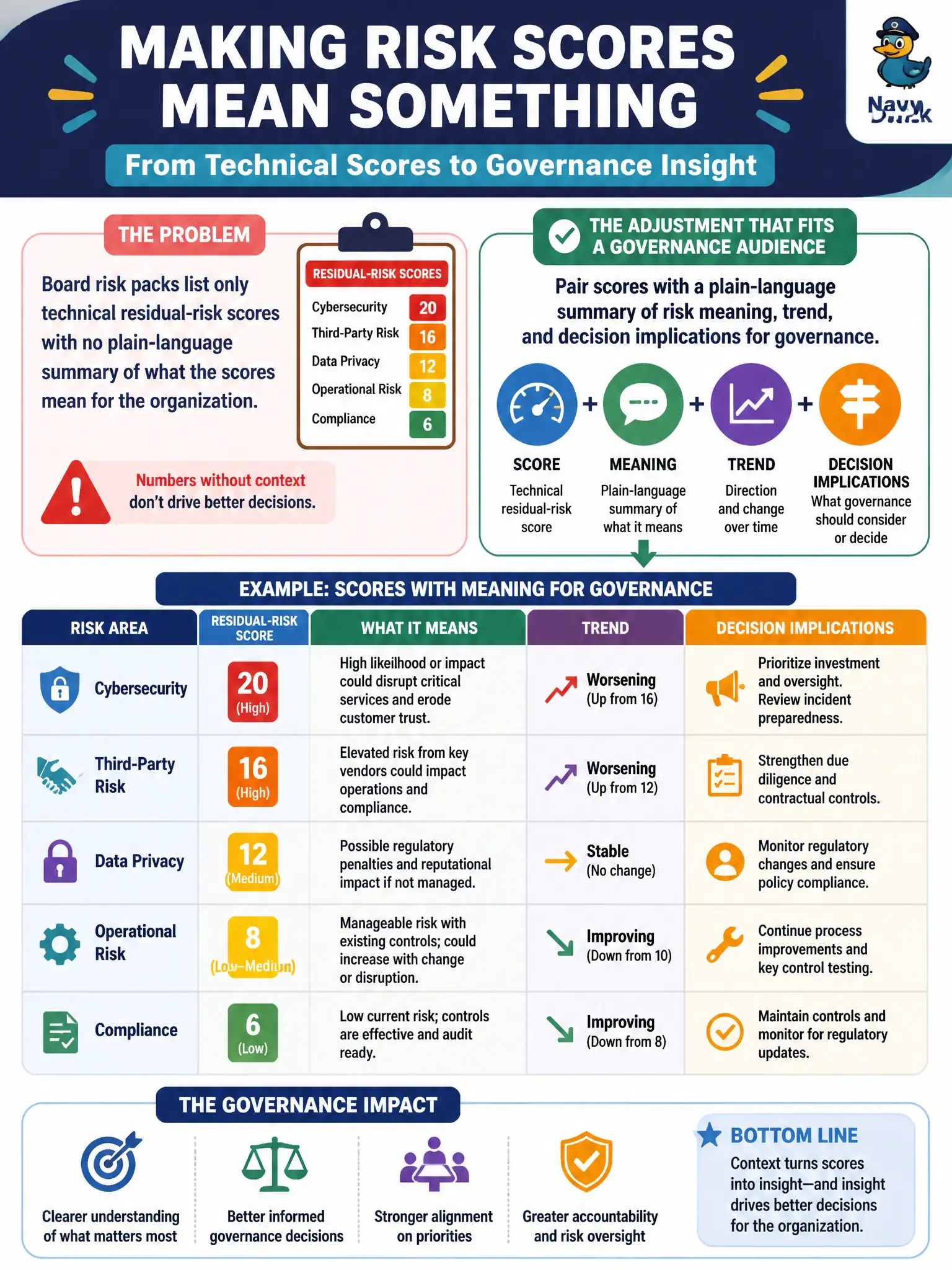
Board risk packs list only technical residual-risk scores with no plain-language summary of what the scores mean for the organization. What adjustment fits a governance audience?
Select an answer to reveal the explanation.
Short Explanation
Boards don’t live in heat-map land every day—raw residual scores without a translation are like handing them a lab printout in Greek. Give the number and the "so what" in plain English. Governance needs meaning beside the metric.
Full Explanation
Pairing residual-risk scores with a plain-language summary of meaning, trend, and decision implications is correct for governance audiences because directors oversee prioritization and resource allocation rather than operate heat-map software daily. Civic boards need translation: what the score means for service continuity, public safety, and budget choices, whether risk is rising or falling, and what decision is requested. Technical scores without that bridge produce either rubber-stamping or misplaced alarm.
Stripping all scores and giving only motivational resilience posters fails by concept because governance without comparative residual data cannot triage treatments or challenge management assumptions. Requiring directors to complete operator-level hazard certification before reading reports fails because board literacy is built through executive translation, not by converting directors into frontline technicians as a precondition of oversight. Moving board reporting exclusively to encrypted chat snippets without context or history fails because ephemeral fragments destroy continuity, auditability, and trend visibility required for municipal oversight.
Exam caveat: CRMC board reporting expects both quantitative residual indicators and narrative decision support. Neither raw numbers alone nor slogan-only packets satisfy governance communication duty.
Operational check: For the next city risk committee pack, place a three-sentence plain-language box beside each key score covering meaning, trend, and ask-of-the-board; confirm directors can restate the decision implication without decoding the scoring model.