
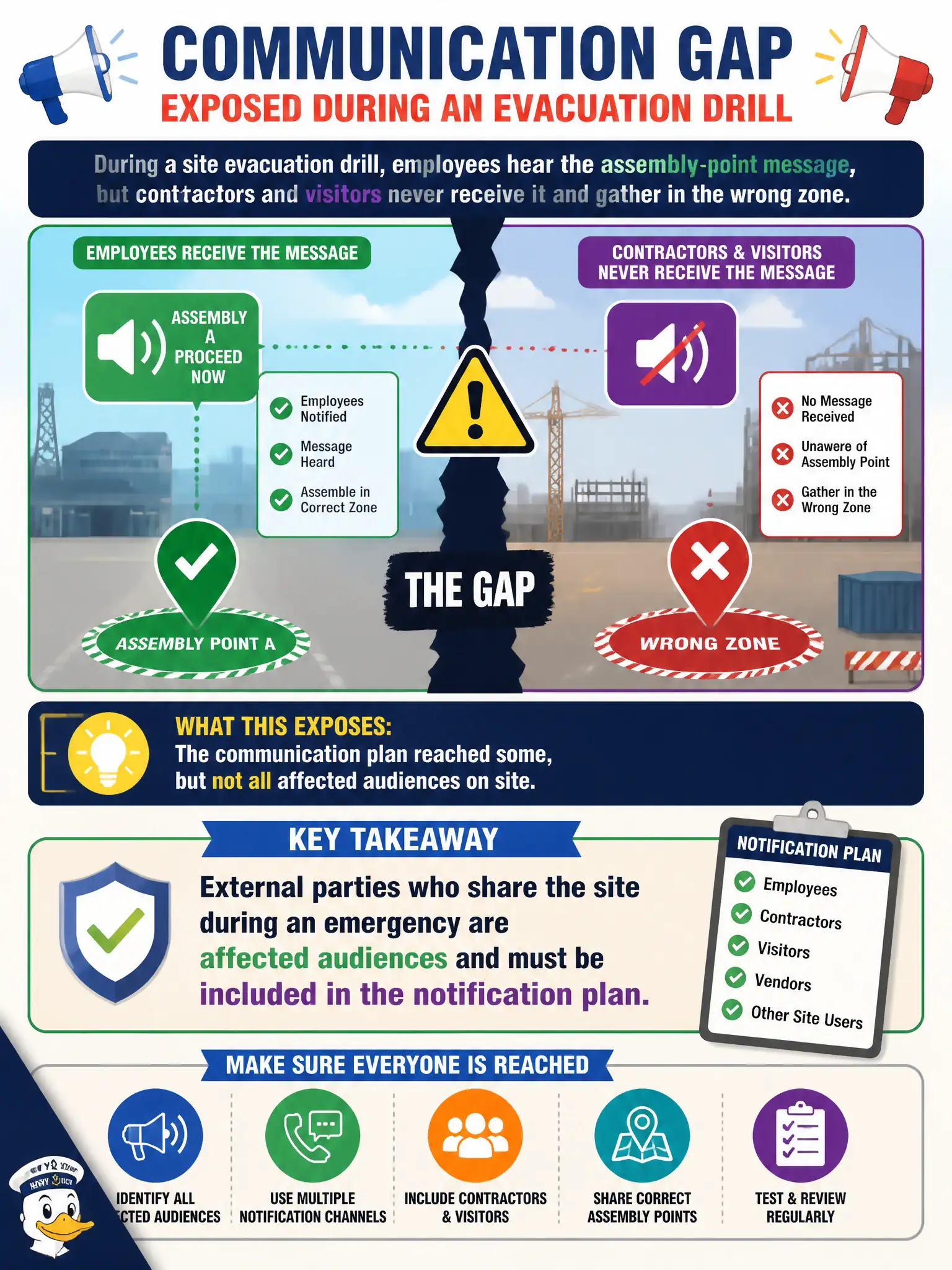
During a site evacuation drill, employees hear the assembly-point message, but contractors and visitors never receive it and gather in the wrong zone. What communication gap does this expose?
Select an answer to reveal the explanation.
Short Explanation
If the building’s on fire, the painter on the scaffold and the courier in the lobby need the same assembly cue as payroll. Leaving contractors and visitors off the blast list is like locking the exit signs inside the employee handbook. Emergency audiences include everyone on site—not just badge holders on payroll.
Full Explanation
Including external parties who share the site during an emergency is correct because contractors, visitors, vendors, and temporary workers occupy the same hazard space as employees during an evacuation. Civic facilities such as city halls, transit depots, and libraries routinely host non-employees; a notification plan that reaches only payroll staff leaves life-safety gaps at the assembly point. Effective emergency communication strategy maps every affected audience and ensures the assembly message reaches them through channels they will actually hear.
Assuming only full-time employees need emergency instructions because contractors carry their own plans fails by concept because host-site assembly points, routes, and alarms are site-specific and cannot be inferred from a contractor’s home-office plan. Treating visitor badges as eliminating the need to communicate assembly points fails because a badge identifies presence; it does not broadcast shelter or exit instructions when alarms sound. Keeping assembly messaging only on the intranet so outsiders cannot overhear routes fails because intranet reach excludes visitors and many contractors, and secrecy about assembly points is not a valid reason to withhold life-safety cues.
Exam caveat: CRMC emergency communication expects inclusion of affected audiences present on site—not a payroll-only broadcast model. Channel choice must still deliver consistent content; excluding non-employees is a coverage failure, not a confidentiality control.
Operational check: During the next municipal site drill, account for badges and contractor check-ins at assembly, verify PA/SMS/radio reach to visitor and contractor groups, and update the notification annex until those audiences arrive in the correct zone without employee escorts improvising.