
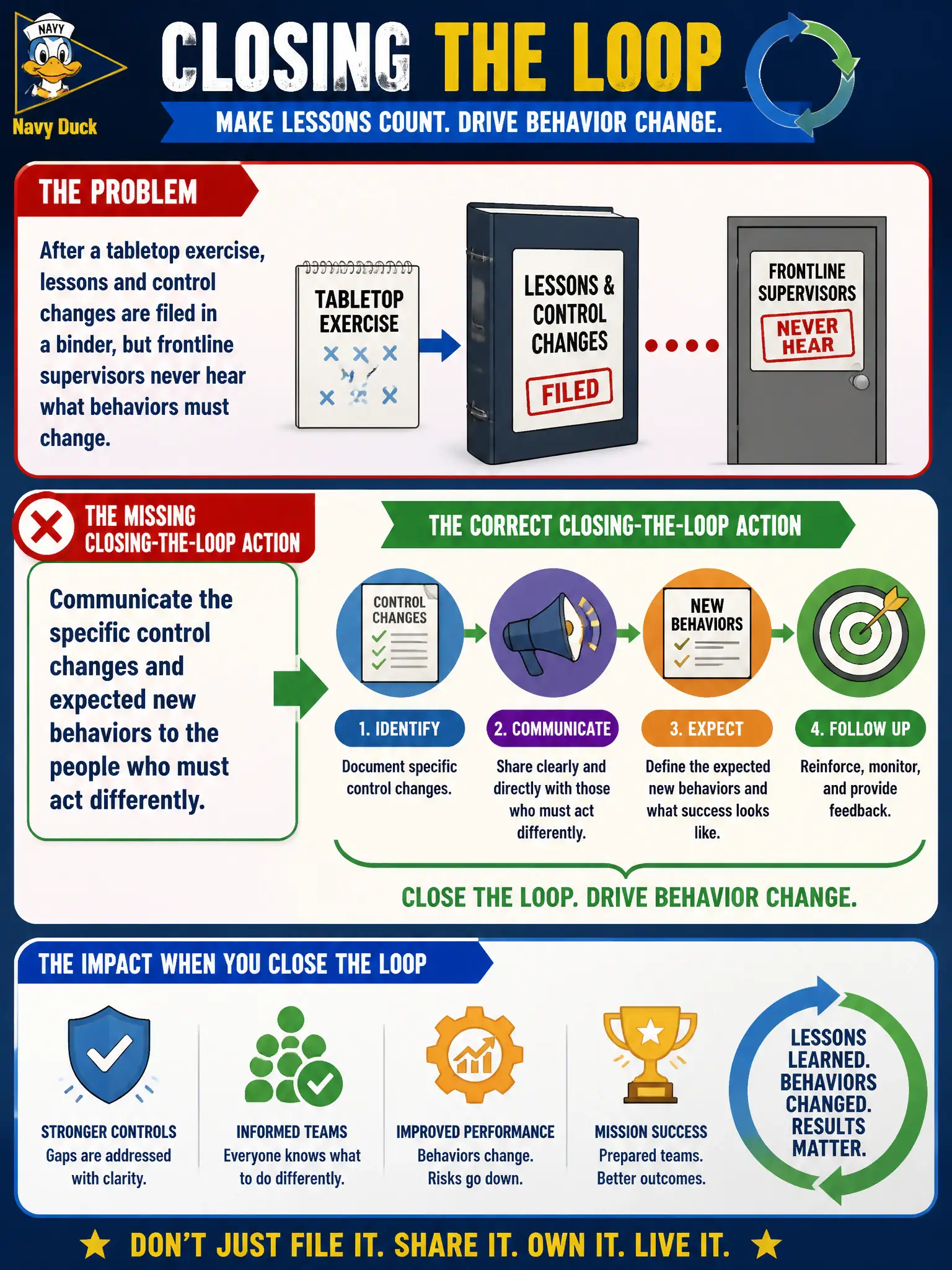
After a tabletop exercise, lessons and control changes are filed in a binder, but frontline supervisors never hear what behaviors must change. What closing-the-loop action is missing?
Select an answer to reveal the explanation.
Short Explanation
Lessons locked in a binder are like a recipe stuck in a safe—nobody’s cooking changes. If supervisors don’t hear what to do differently, the exercise was just theater. Close the loop by telling the people who must change how they work.
Full Explanation
Communicating specific control changes and expected new behaviors to the people who must act differently is the correct close-the-loop step after a tabletop. Lessons archived without operational translation leave residual risk unchanged: supervisors continue old escalations, outdated checklists, and prior thresholds. In civic operations—parks maintenance, transit yards, utility plants—exercise value appears only when frontline leaders know what to do differently on Monday morning.
Archiving lessons only with auditors so frontline staff are not distracted fails by concept because auditors verify; they do not execute daily controls—withholding change messages from operators preserves the gap the exercise found. Waiting until the next annual report before mentioning outcomes fails because annual reporting cadence is too slow for corrective action after an identified control weakness and confuses transparency reporting with operational briefing. Converting all lessons into confidential legal memos operations cannot access fails because privilege and limited distribution, when over-applied, block the very behavior change risk treatment requires.
Exam caveat: CRMC treats exercise learning as incomplete until control owners and performers receive actionable updates. Documentation for audit trails is necessary but not sufficient; communication of changed expectations is part of closing the risk-management loop.
Operational check: After each county tabletop, publish a short change bulletin naming the procedure/section edited, the new expected behavior, the effective date, and the supervisor owner—then spot-check that two frontline teams can describe the change without opening the exercise binder.