
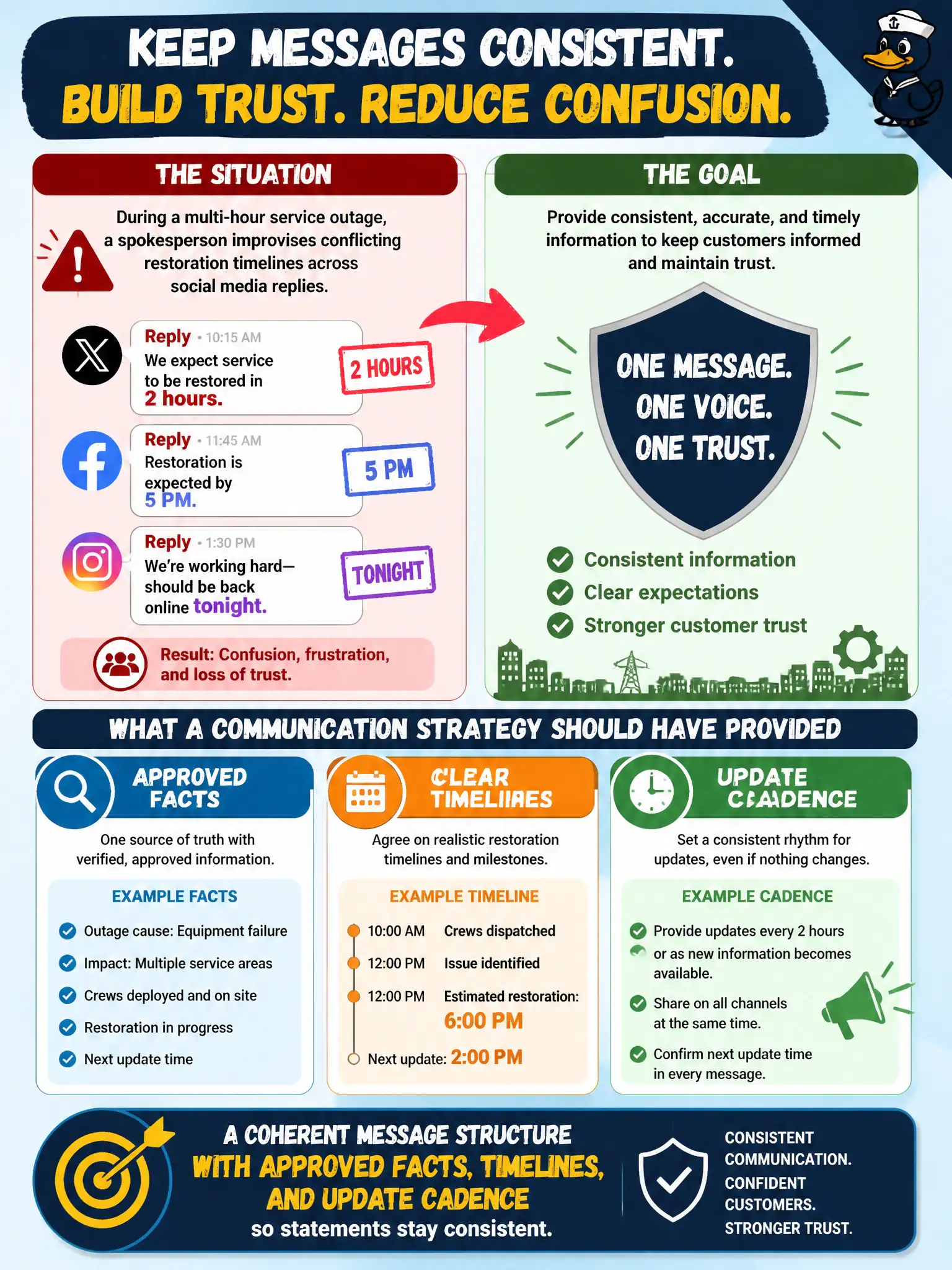
During a multi-hour service outage, a spokesperson improvises conflicting restoration timelines across social media replies. What should a communication strategy have provided?
Select an answer to reveal the explanation.
Short Explanation
Conflicting ETAs on social are trust acid. One playbook—approved facts, same clock, steady updates—beats freestyle reassurance.
Full Explanation
During a multi-hour civic service outage, a communication strategy should provide a coherent message structure with approved facts, timelines, and update cadence so spokespersons remain consistent across social media replies and other channels. Permission for each spokesperson to invent reassuring timelines in the moment manufactures conflicting promises and deep trust damage when restoration slips past improvised estimates. Banning all external updates until full restoration is complete creates an information vacuum that rumor fills and may breach reasonable citizen expectations for municipal service status during prolonged disruption. Publishing separate unrelated timelines on each platform so audiences can choose a favorite story institutionalizes inconsistency and invites comparison that exposes the lack of a single source of truth. Consistency, cadence, and approved facts are the operational backbone of incident communications under uncertainty. Uncertainty should be stated honestly with a next-update time rather than fabricated precision. Exam caveat: technical root-cause ownership differs from public status messaging, but both need discipline. Operational check: appoint a communications lead, approve a fact sheet and update schedule, route external statements through that structure, correct conflicting posts quickly, and after-action whether public timelines matched actual restoration milestones.