
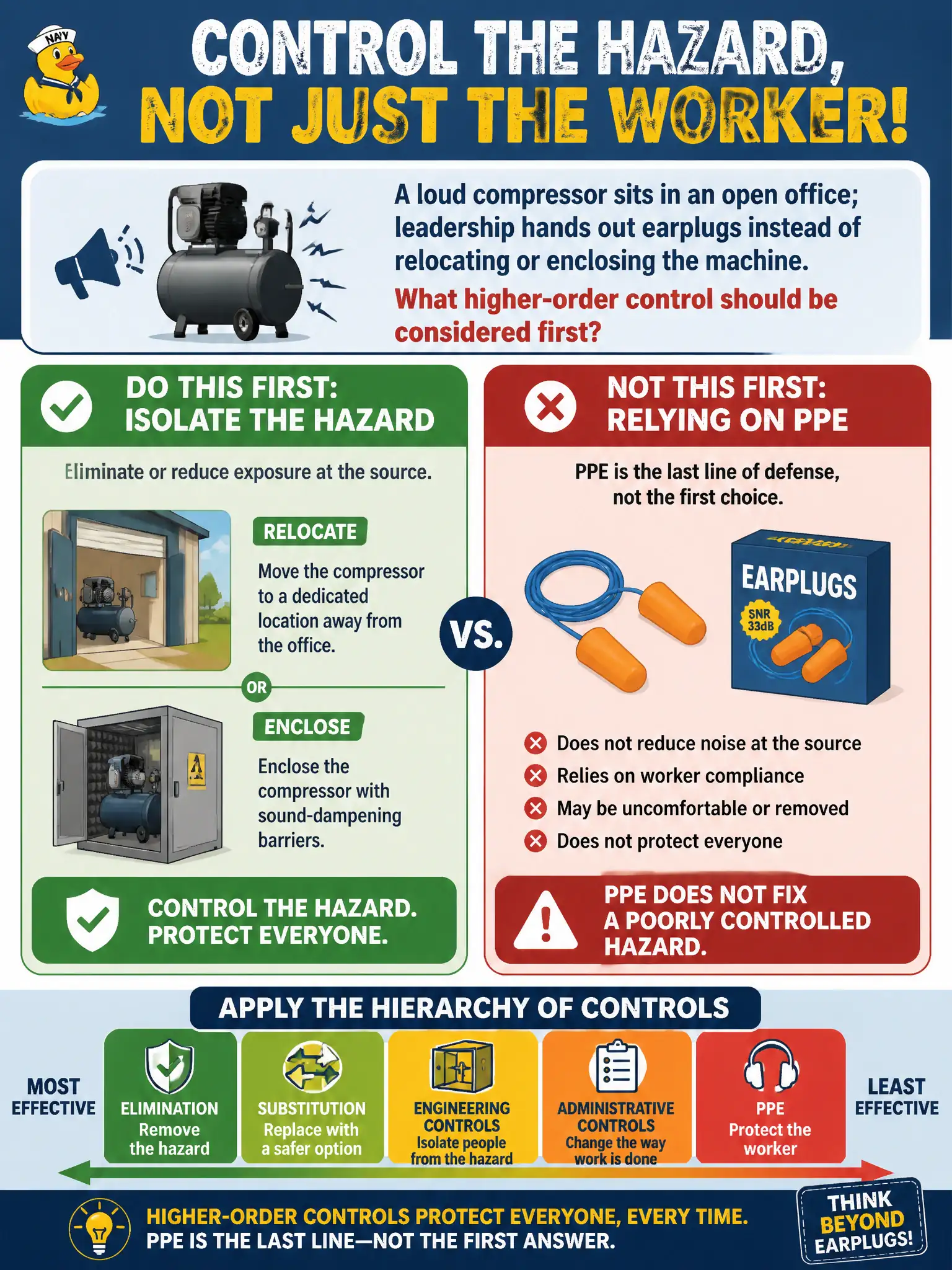
A loud compressor sits in an open office; leadership hands out earplugs instead of relocating or enclosing the machine. What higher-order control should be considered first?
Select an answer to reveal the explanation.
Short Explanation
Earplugs ask every person to be the control. Moving or boxing in the compressor asks the environment to carry the load—and that is higher on the hierarchy. Isolate the racket when you can; PPE is the backup singer, not the headliner.
Full Explanation
A loud compressor sitting in an open office should be addressed first with higher-order controls that isolate the hazard—relocate or enclose the machine—rather than relying mainly on PPE earplugs handed out by leadership. Increasing playlist volume so compressor noise is masked does not remove the hazard and may increase overall sound dose while creating a false sense that the problem is solved. Requiring staff to sign waivers that redefine noise as a team-building soundtrack is paperwork avoidance, not risk treatment, and does not protect hearing. Removing all acoustic options and relying solely on annual hearing tests after damage occurs accepts preventable occupational illness as the detection method. Isolation and engineering reduce dose for everyone in the area, including visitors and new hires who will not wear earplugs consistently. Administrative scheduling and PPE can complement isolation but should not be the first strategic choice when relocation or enclosure is feasible. Exam caveat: hierarchy prefers controlling the source or path before the receiver. Operational check: evaluate enclosure or relocation against office layout and fire code, measure noise before and after isolation, use earplugs only for residual exposure, update the risk assessment, and confirm occupant complaints and dosimetry improve after the higher-order control is in place.