
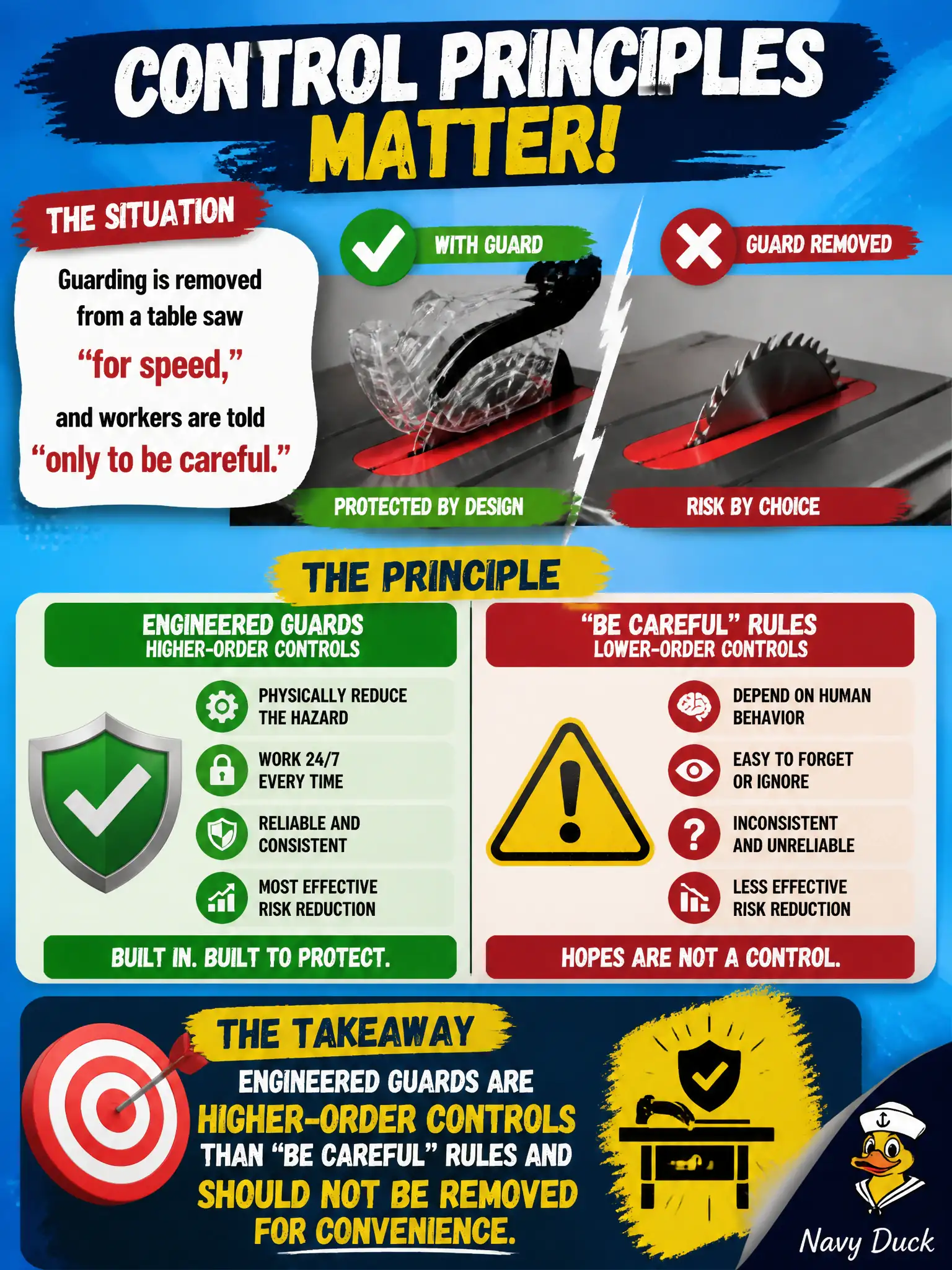
Guarding is removed from a table saw “for speed,” and workers are told only to be careful. What control principle does this violate?
Select an answer to reveal the explanation.
Short Explanation
“Be careful” is not a machine guard. Yanking the shield for speed trades an engineered control for a wish. Put the guard back—carefulness is a nice speech, not a substitute for hardware that keeps fingers out of the blade.
Full Explanation
Removing guarding from a table saw for speed and telling workers only to be careful violates the principle that engineered guards are higher-order controls than administrative be-careful rules and must not be removed for convenience. Administrative reminders do not supersede engineered safeguards once production quotas rise; quotas do not rewrite the hierarchy of controls. Repeating verbal cautions at every shift huddle cannot replace a physical guard that prevents contact with the blade during a moment of inattention. Speed improvements do not automatically reclassify amputation hazards as acceptable residual risk without a rigorous, informed acceptance process—and production convenience rarely justifies defeating engineering. Guarding is a classic engineered control; defeating it restores the original hazardous motion and energy. Temporary removal for maintenance must follow lockout and immediate restoration rules, not informal speed workarounds. Exam caveat: CRMC items frequently test engineered versus administrative preference when both appear in a scenario. Operational check: restore the guard before any production cut, prohibit convenience bypasses in writing, treat unauthorized removals as safety violations, verify interlocks if present, retrain on why carefully alone fails, and document the restored engineered control on the equipment checklist with supervisor verification.