
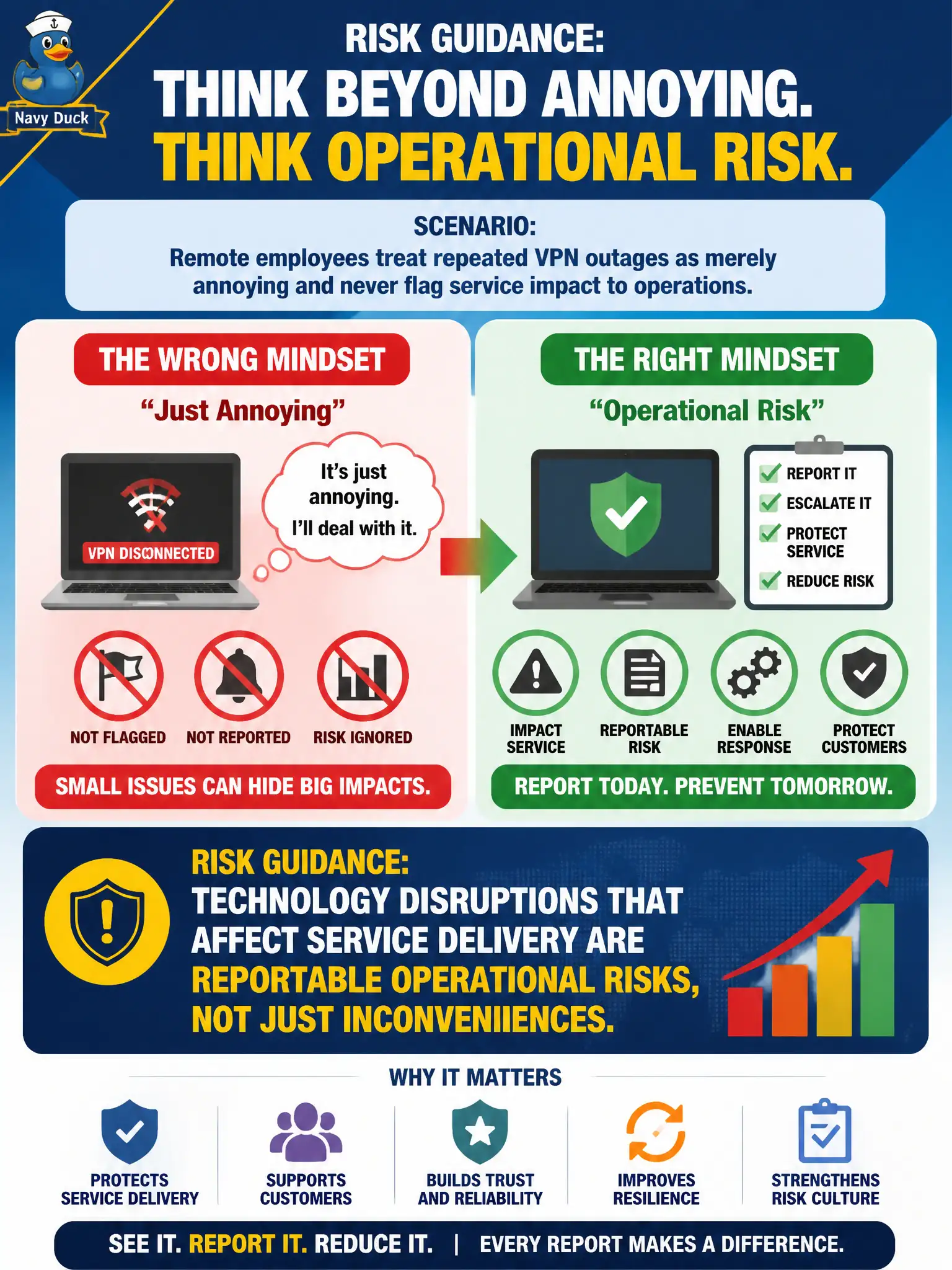
Remote employees treat repeated VPN outages as merely annoying and never flag service impact to operations. What should risk guidance emphasize?
Select an answer to reveal the explanation.
Short Explanation
If the VPN dying stops the work, that is not “just annoying”—that is operational risk wearing a modem. Flag the business impact so capacity, vendors, or failover can get fixed. Silence turns a tech glitch into a quiet outage.
Full Explanation
Technology disruptions that affect service delivery—such as repeated VPN outages for remote employees supporting municipal operations—are reportable operational risks, not merely inconveniences to shrug off. Treating VPN issues as personal home-network hobbies ignores employer-provided access dependencies for official records, casework, and citizen services. Claiming only multi-day data-center fires qualify as technology risks worth a ticket sets an absurd severity floor and misses chronic availability failures that degrade service quality. Waiting until customers complain on social media before opening an internal report outsources detection to reputational harm and delays capacity fixes. Service impact, recurrence, and dependency on remote access justify inclusion in operational risk reporting, problem management, and continuity workarounds. Not every transient blip is strategic, yet repeated outages affecting delivery should enter tickets and trend analysis with owners. Exam caveat: classify by operational impact on objectives, not by how annoying the tool feels to an individual user. Operational check: direct remote staff to log VPN outages with impact notes, trend duration and frequency against service targets, assign IT ownership for root cause and resilience, define escalation when outages breach thresholds, and verify continuity workarounds for critical civic functions during access loss.