
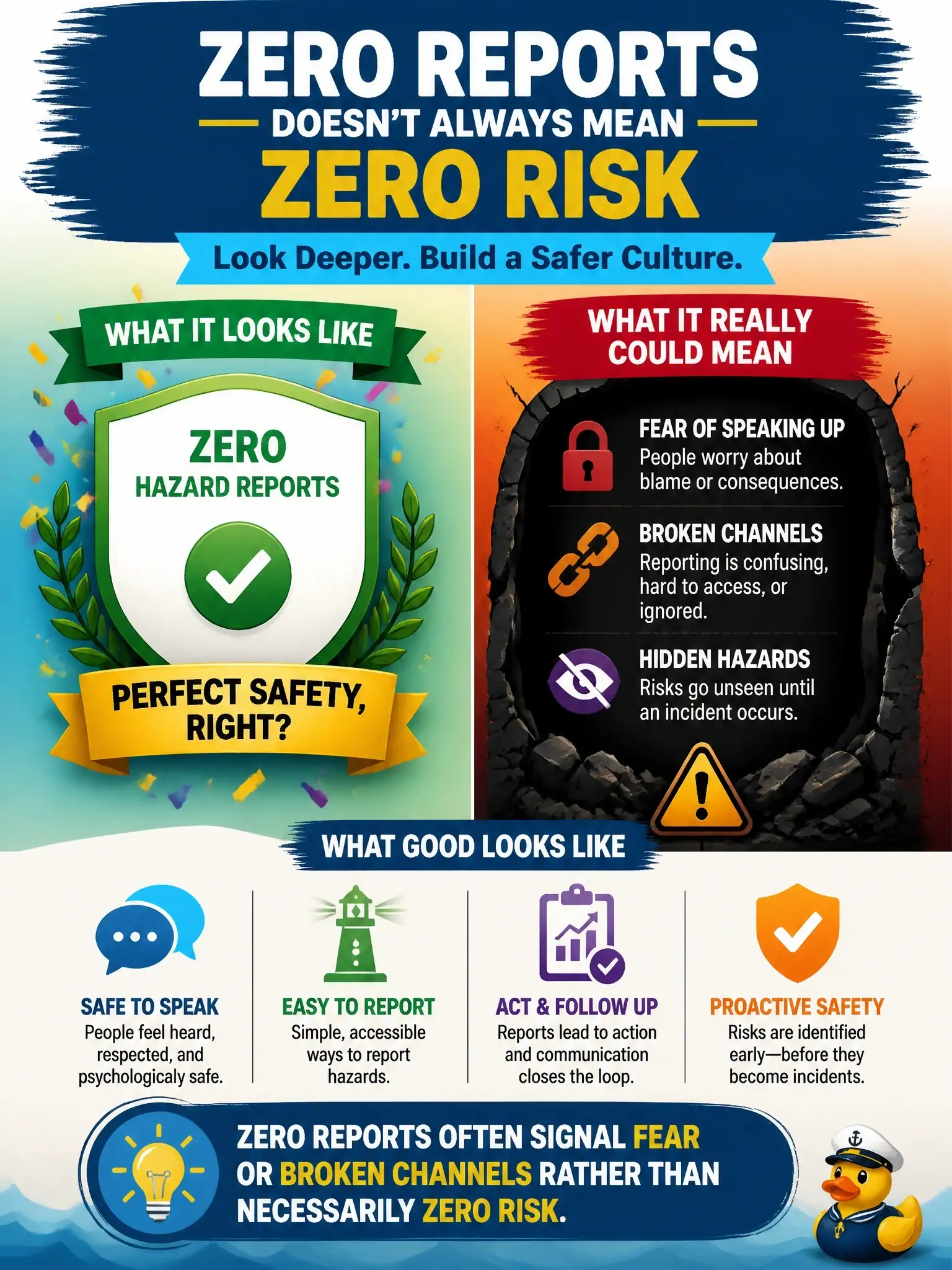
Leadership celebrates a quarter with zero hazard reports as proof of perfect safety. What point should the risk manager raise with leadership?
Select an answer to reveal the explanation.
Short Explanation
An empty inbox can mean everything's fine, or that the doorbell's broken. When leaders high-five zero reports, you'd want to remind them that silence often means fear or a dead channel, not zero risk. Check that people can and will speak up before anyone calls it perfect safety.
Full Explanation
The risk manager should point out that zero hazard reports often signal fear, confusion or broken reporting channels rather than an absence of risk. Hazard reporting is a leading indicator only when people are able and willing to use it; a sudden drop to zero is more often a symptom of blame culture, an unfamiliar or broken reporting tool, or reporting fatigue than proof that hazards disappeared. Claiming that zero reports prove likelihood and consequence scales can be retired confuses an input to the risk process with the process itself; the assessment framework is still needed whether or not reports arrive. Describing celebrated silence as the strongest leading indicator of a mature culture inverts the concept, since mature safety cultures typically show steady reporting of near misses and minor hazards. Treating an empty inbox as confirmation of perfect safety for any reason ignores the possibility that the channel simply failed. On the exam, watch for answers that treat the absence of data as evidence of good performance. As an operational check, the risk manager can test the channel end to end, compare report volume with prior quarters and peer sites, review incident and near-miss data from other sources, and run a short anonymous pulse survey on psychological safety before accepting the zero at face value.