
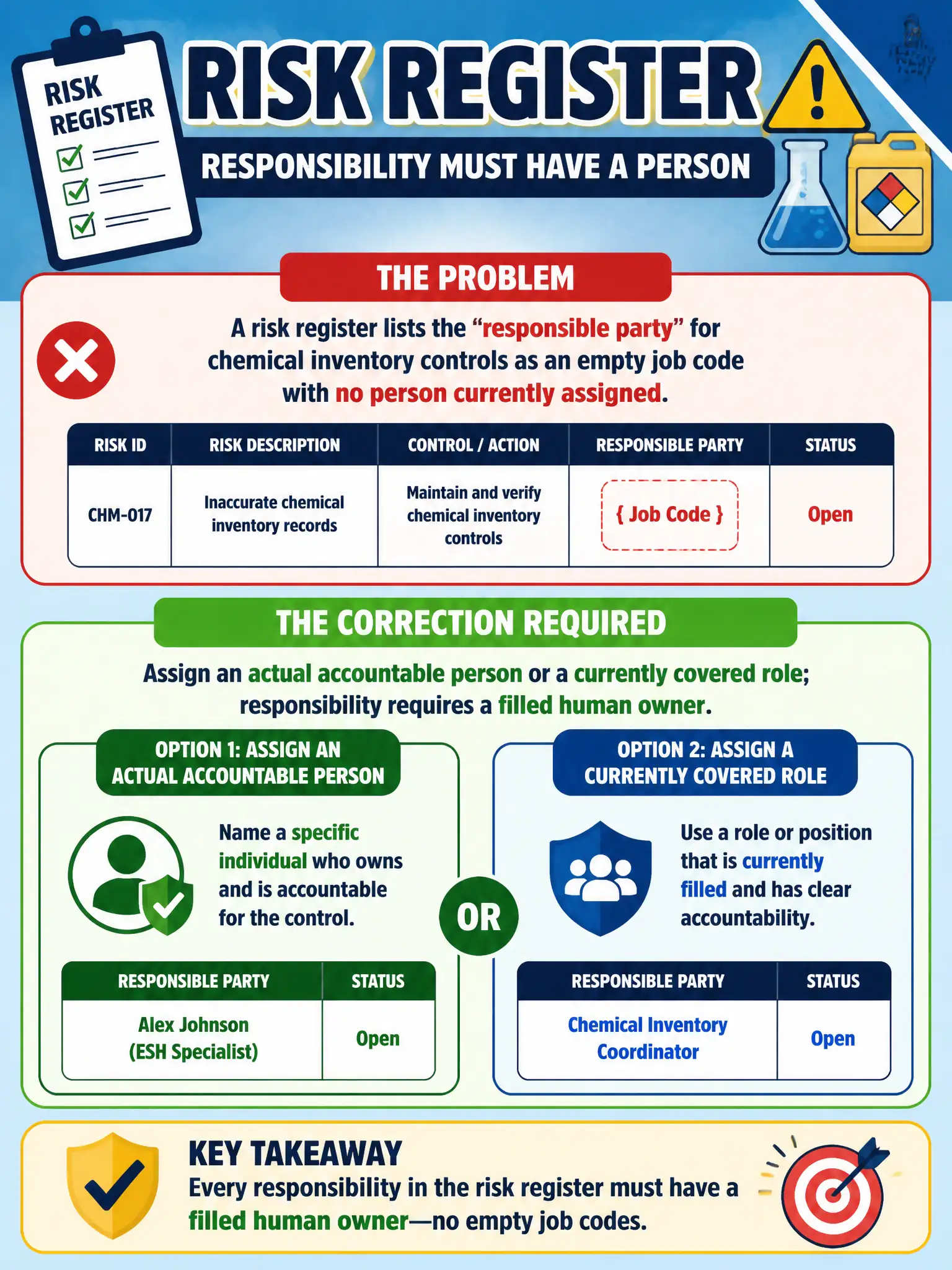
A risk register lists the “responsible party” for chemical inventory controls as an empty job code with no person currently assigned. What correction is required?
Select an answer to reveal the explanation.
Short Explanation
An empty job code cannot grab a fire extinguisher. If the box on the chart is vacant, the control is orphaned. Put a real, covered human on the line—acting owner included—until the seat is filled for good.
Full Explanation
A risk register that lists the responsible party for chemical inventory controls as an empty job code with no person currently assigned must be corrected by assigning an actual accountable person or a currently covered role; responsibility requires a filled human owner who can act on inventory accuracy, segregation, and emergencies. Keeping the empty code because vacant roles supposedly prove the control is theoretical and therefore low priority turns vacancy into an excuse for unmanaged chemical risk in a civic facility. Replacing the human owner with a shared inbox that no one monitors after hours creates the appearance of a channel without accountability. Treating the empty code as acceptable until the next budget cycle fills the position leaves labeling, incompatible storage, and responder information unmanaged through the entire vacancy. Acting owners or deputies can cover temporarily, but blank ownership is not a control state. Exam caveat: role-based assignment works only when the role is filled or explicitly covered by a named deputy with dates. Operational check: name a current chemical-inventory owner and backup the same week, verify inventory accuracy and SDS access, update the register, escalate prolonged vacancy as its own risk item, and test whether emergency responders can reach a human who knows the storage layout after hours.