
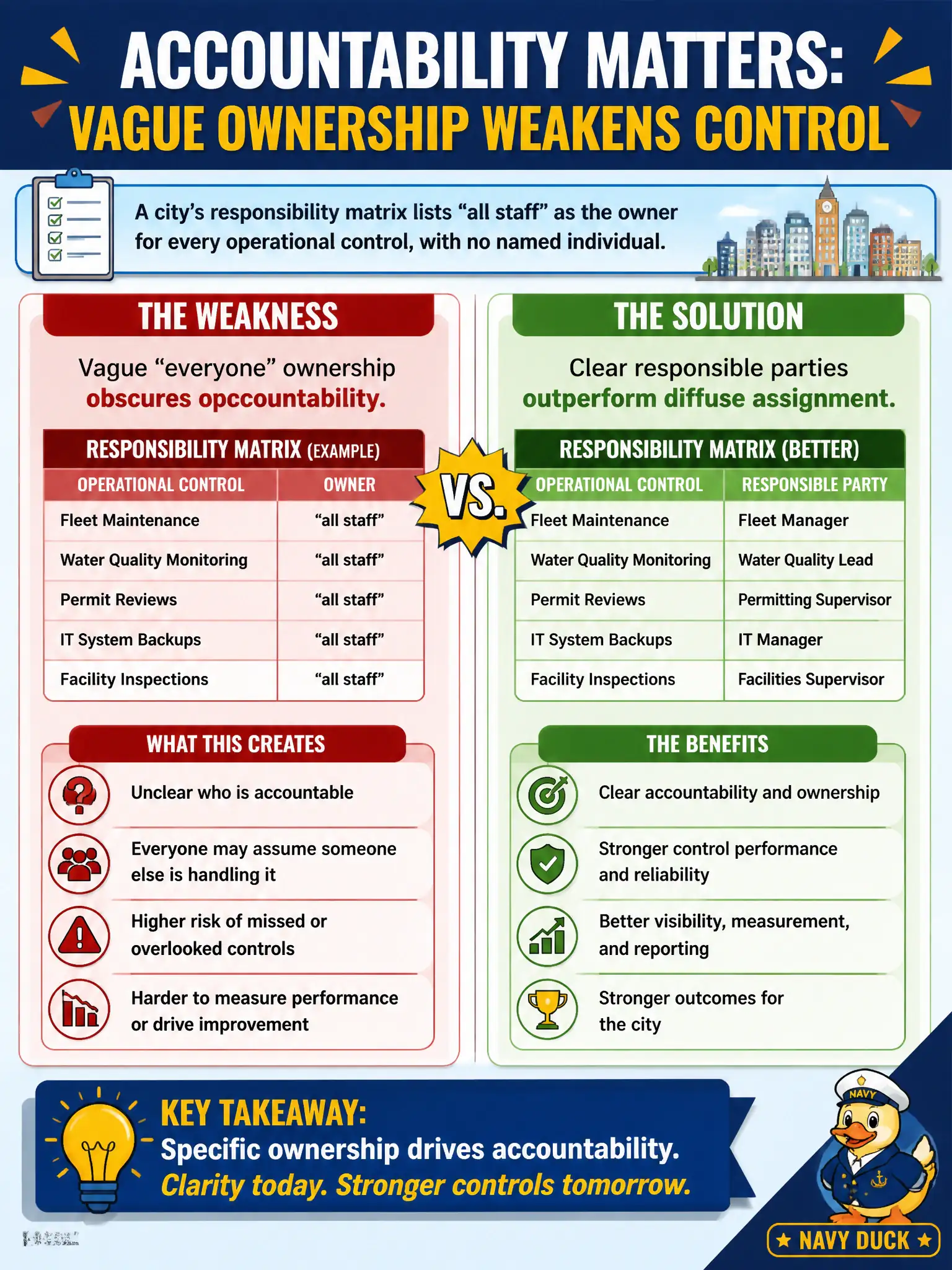
A city’s responsibility matrix lists “all staff” as the owner for every operational control, with no named individual. What weakness does this create?
Select an answer to reveal the explanation.
Short Explanation
When everyone owns it, nobody owns it—classic. “All staff” on every line looks collaborative and plays terribly in a real incident. Put a name or filled role on the control so someone actually wakes up responsible.
Full Explanation
Vague everyone ownership on a city’s responsibility matrix obscures accountability; clear responsible parties outperform diffuse assignment because when all staff own every operational control, in practice no one is sure who must act, fund, or escalate. Collective ownership slogans rarely produce timely maintenance of flood pumps, chemical inventories, or alarm testing. Claiming collective ownership always outperforms single owners ignores coordination failures and diffusion of responsibility documented across operations. Satisfying auditors with universal engagement language without names creates paperwork comfort without operational clarity. Automatic payroll-cycle rotation without handoff discipline can increase fatigue and lost context rather than solve ownership. RACI-style clarity still allows supporting roles; the error is exclusive reliance on all staff as the named owner for critical controls. Exam caveat: enterprise culture of shared vigilance complements, but does not replace, named accountability for specific controls. Operational check: replace all-staff owner lines with named primary owners and deputies for each critical control, publish the matrix where operators can find it, test a control failure scenario to see who actually responds, and update names after reorganizations within a defined number of days.