
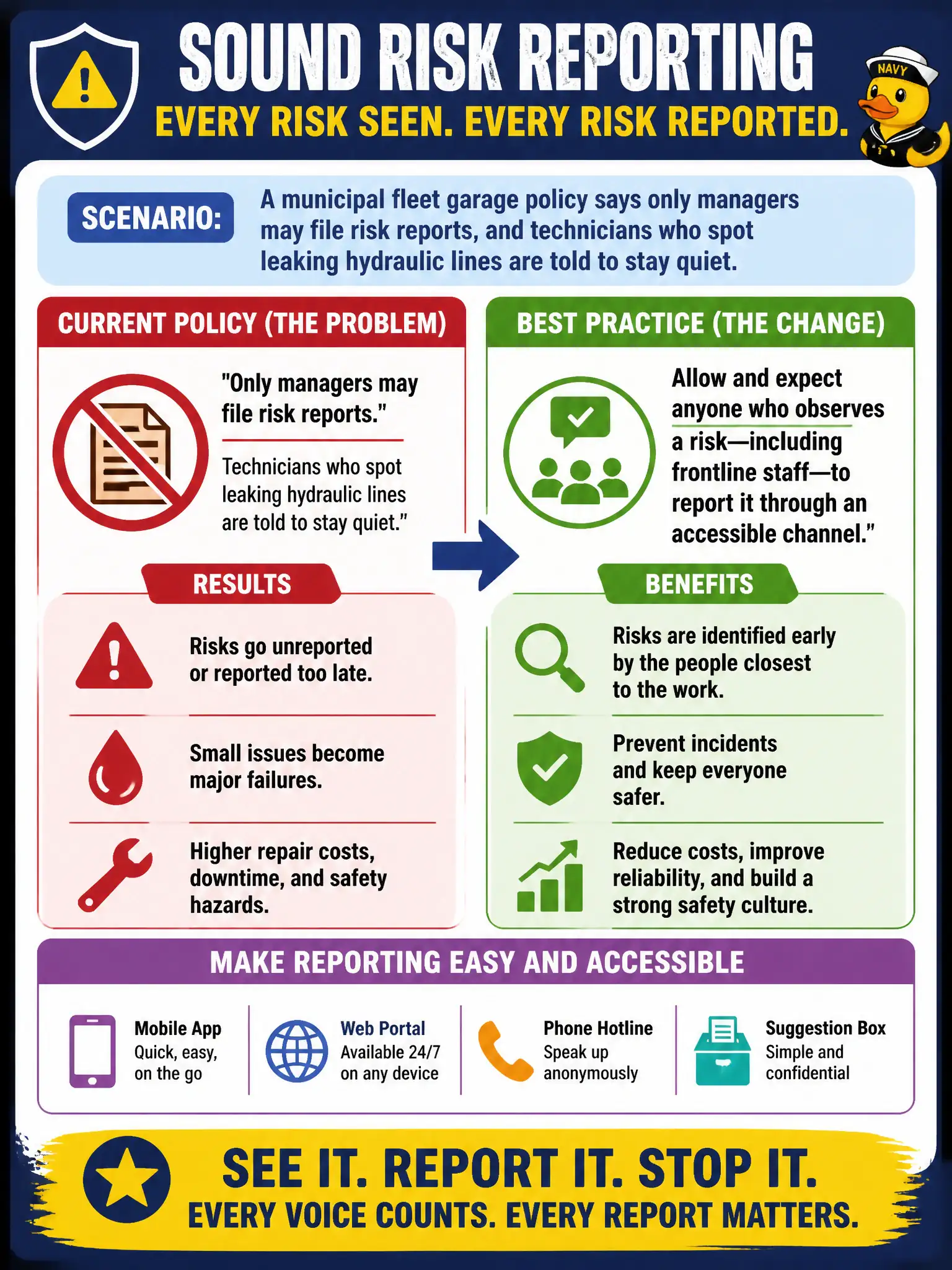
A municipal fleet garage policy says only managers may file risk reports, and technicians who spot leaking hydraulic lines are told to stay quiet. What change best aligns with sound risk reporting practice?
Select an answer to reveal the explanation.
Short Explanation
The people closest to the work usually see the drip first. Locking reporting to managers only bottlenecks the truth and trains technicians to look the other way. Give every observer a clear path—and an expectation—to speak up.
Full Explanation
Sound risk reporting practice allows and expects anyone who observes a risk—including frontline technicians who see leaking hydraulic lines—to report through an accessible channel rather than reserving filing rights to managers alone. Manager-only policies create blind spots on nights, weekends, and busy bays where supervisors are not present when leaks begin. Keeping the rule but fining technicians who discuss hazards with coworkers worsens fear and suppresses both formal and informal learning. Replacing technician observations with annual third-party audits alone leaves long intervals without eyes on live garage conditions. Requiring technicians to wait until a manager personally witnesses the leak delays containment and evidence of recurrence. Frontline reporting is a leading indicator system, not a challenge to managerial authority; managers still prioritize and resource responses. Exam caveat: accessibility includes language, literacy, and shift coverage—not merely a policy sentence that theoretically permits reporting. Operational check: revise the municipal fleet garage policy to authorize technician reports, publish a simple channel that works on all shifts, brief crews that retaliation for good-faith reports is prohibited, and sample recent hydraulic leak responses to confirm frontline-originated reports reach a named owner.