
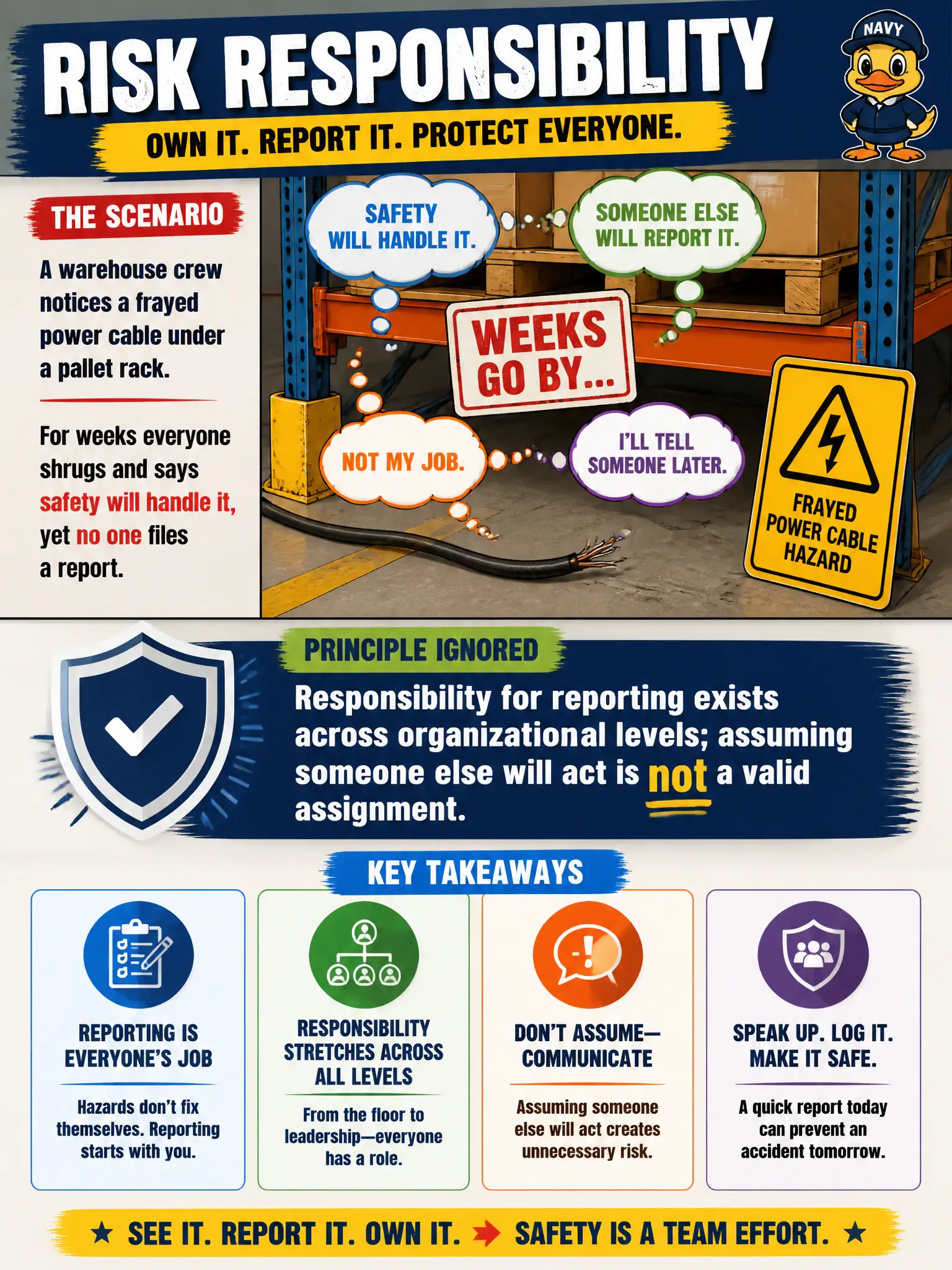
A warehouse crew notices a frayed power cable under a pallet rack. For weeks everyone shrugs and says safety will handle it, yet no one files a report. What principle of risk responsibility is being ignored?
Select an answer to reveal the explanation.
Short Explanation
Risk ownership is not a game of hot potato. If you see a hazard, you report it—period—because “safety will handle it” is not a named assignment. Silence leaves the cable live while everyone assumes the other guy already called it in.
Full Explanation
Responsibility for reporting risks exists across organizational levels; when a warehouse crew notices a frayed power cable and assumes safety will handle it without filing a report, the principle being ignored is that observation creates a duty to escalate through defined channels rather than diffuse hope that someone else acts. Assuming another department will notice is not a valid assignment of responsibility and allows energized electrical hazards to persist under pallet racks. Claiming only the safety department may observe hazards forces the organization to wait for calendar inspections and silences the people closest to the work. Treating frayed cables as pure maintenance that need not be reported until injury occurs confuses work-order routing with risk reporting and accepts preventable harm as a trigger. Verbal hallway comments do not fully satisfy reporting duty because they create no durable record, owner, or corrective-action trail. Exam caveat: shared culture of vigilance still requires a usable reporting mechanism; culture without a channel still fails. Operational check: reinforce that any employee who observes a hazard must submit a report or equivalent escalation, verify the cable is de-energized and repaired under lockout practices as applicable, assign an owner with a due date, and audit whether informal shrug patterns appear in other areas of the warehouse.