
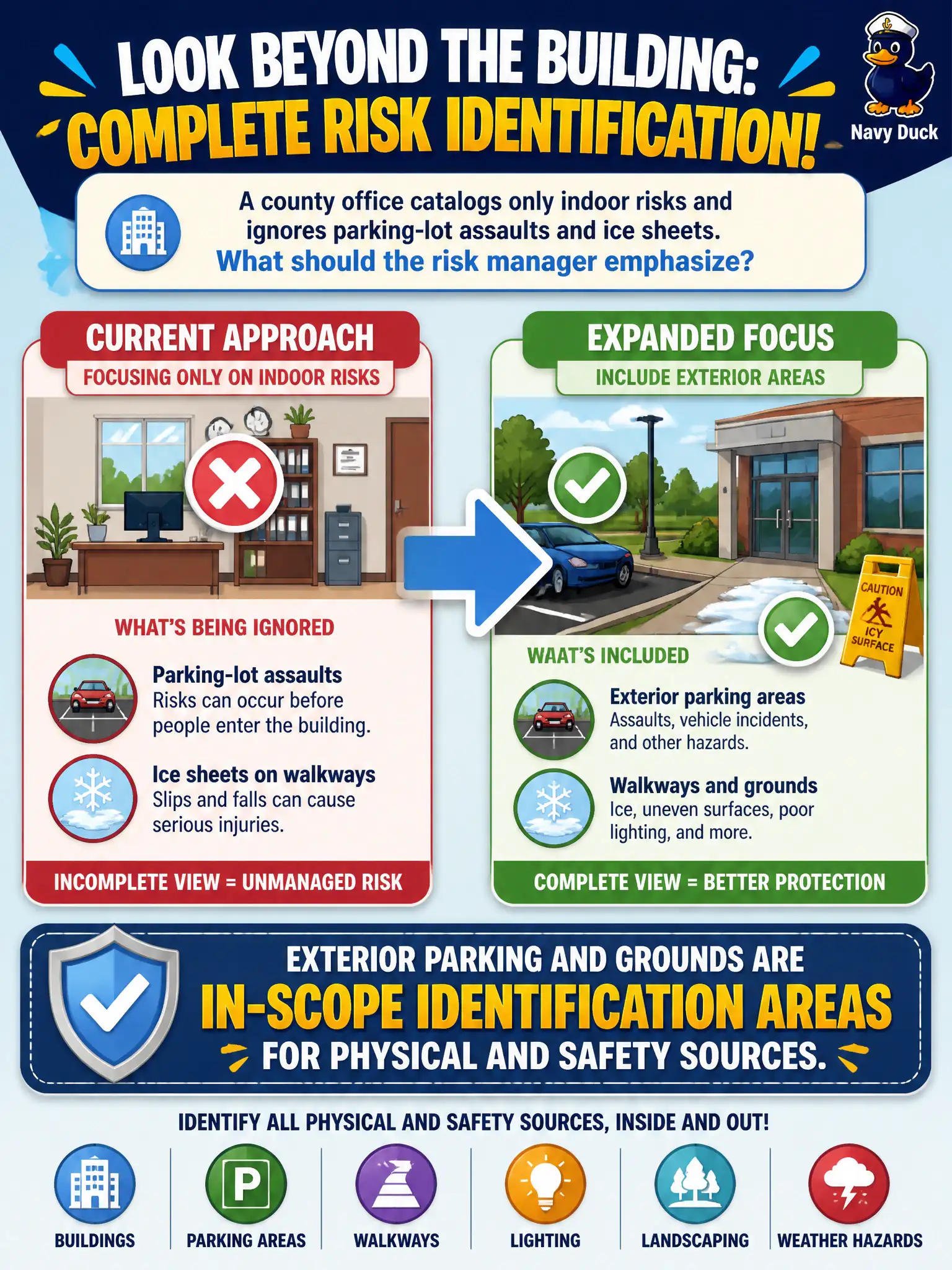
A county office catalogs only indoor risks and ignores parking-lot assaults and ice sheets. What should the risk manager emphasize?
Select an answer to reveal the explanation.
Short Explanation
Risk does not stop at the front door—parking lots and ice sheets are still your yard. Exterior grounds belong on the identification list. Indoor-only catalogs leave people unprotected before they even badge in.
Full Explanation
Exterior parking and grounds are in-scope identification areas for physical and safety sources at a county office because ice sheets, poor lighting, assaults, and vehicle-pedestrian conflicts affect employees and visitors before they ever enter the building. Cataloging only indoor risks creates a false boundary at the drywall line and understates premises exposure. Declaring exterior areas out of scope for corporate risk programs by definition contradicts ordinary duty-of-care and facilities risk practice. Tying ice sheets only to indoor carpet warranties confuses product warranty language with site safety management. Treating outdoor assault risk as solely a city-police budgeting topic denies the facility’s role in lighting, cameras, landscaping design, after-hours procedures, and visitor management. Corporate risk boundaries follow where the organization owes care and where incidents affect objectives, not merely indoor square footage. Exam caveat: shared public sidewalks may involve partners, yet parking and grounds under organizational control still require identification. Operational check: extend inspections to lots and walkways, log seasonal ice and lighting findings, assign owners for mitigation, ensure exterior incidents feed the same risk register used indoors, and verify emergency phones or cameras cover high-risk exterior zones.