
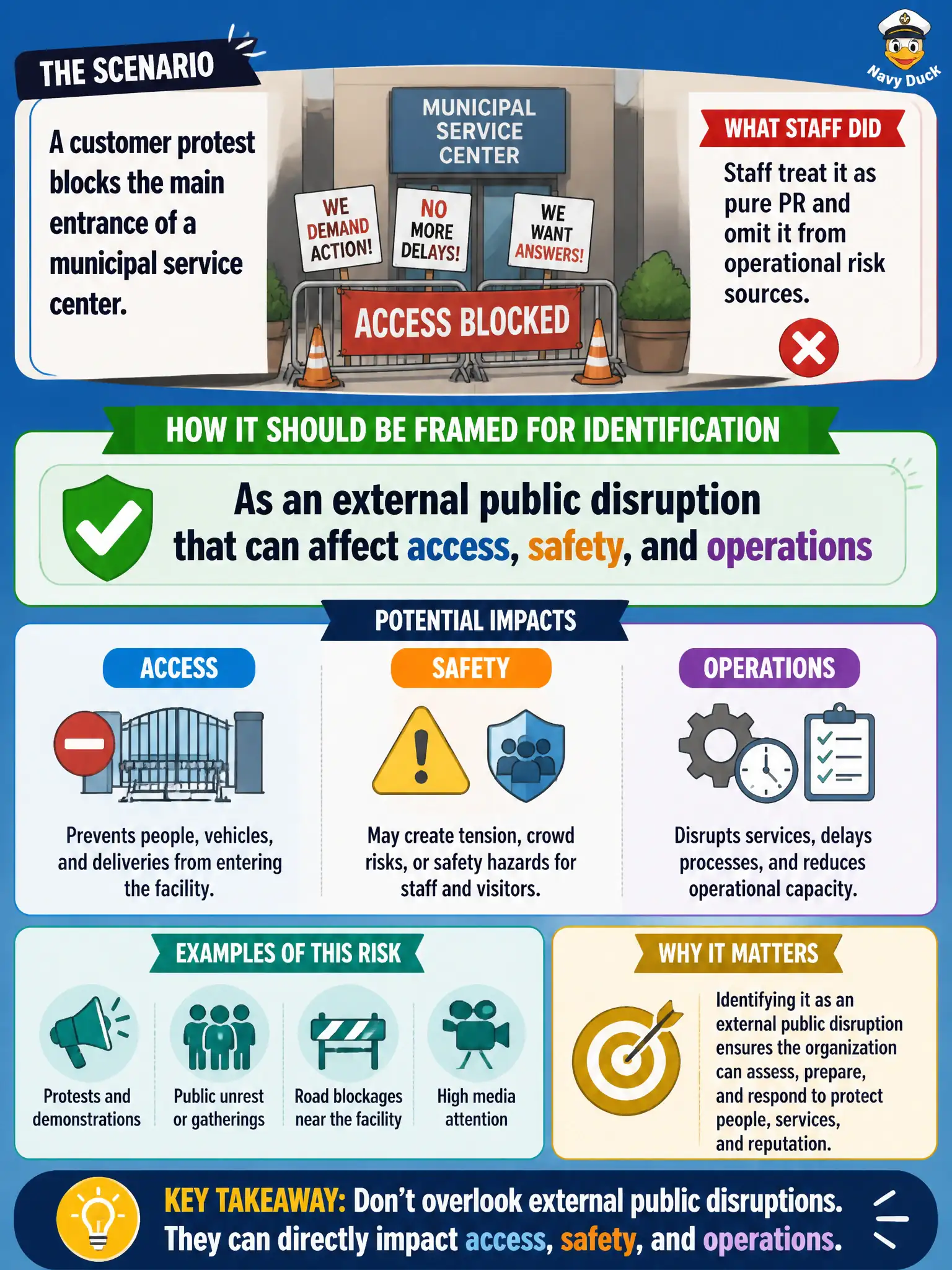
A customer protest blocks the main entrance of a municipal service center. Staff treat it as pure PR and omit it from operational risk sources. How should it be framed for identification?
Select an answer to reveal the explanation.
Short Explanation
A blocked doorway is not just a headline—it is people who cannot get in or out safely. Public disruptions are operational risk sources. PR messaging helps, but access and safety still need the register.
Full Explanation
A customer protest that blocks the main entrance of a municipal service center is an external public disruption that can affect access, safety, and operations, and therefore belongs in operational risk source identification rather than being filed as pure public relations. Blocking ingress and egress can delay citizen services, impede emergency access, create crowd-management hazards, and stress staff who must continue essential work. Font-choice issues for a customer newsletter are communications aesthetics, not site-access interruption. Indoor humidity risk in archive rooms is an environmental facilities topic unrelated to entrance blockage. Payroll calendar quirks have no site-access impact and misdirect identification. Reputation management may run in parallel, but identification must still capture operational and safety consequences of public disruption at civic facilities. Exam caveat: PR consequences do not reclassify a physical access disruption as communications-only under corporate risk typing. Operational check: add protest and blockade scenarios to the operational risk register, pre-define alternate entrances and remote service options, coordinate with facilities and public-safety partners, brief staff on escalation contacts when access is impeded, and test the alternate access path before peak service days.