
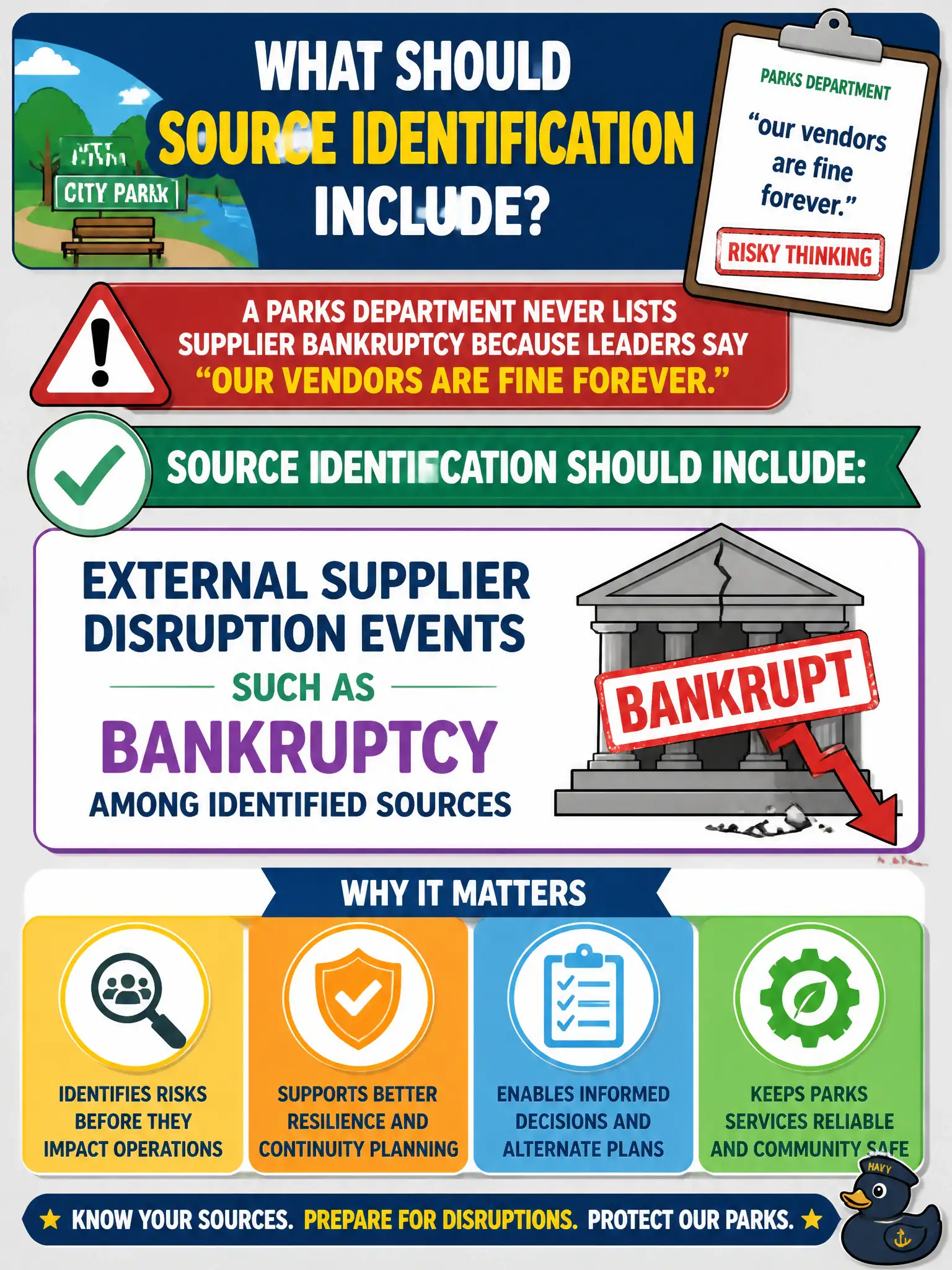
A parks department never lists supplier bankruptcy because leaders say 'our vendors are fine forever.' What should source identification include?
Select an answer to reveal the explanation.
Short Explanation
Vendors are not immortal—bankruptcy can strand you like a tow truck that sells the truck. External supplier events belong on the source list. Optimism is not a control.
Full Explanation
Source identification for a parks department must include external supplier disruption events such as vendor bankruptcy because civic recreation and maintenance depend on contractors for chemicals, equipment, mowing, and seasonal services. Assuming vendors are fine forever is optimism rather than identification and leaves single-threaded suppliers invisible until delivery stops mid-season. Indoor lighting preferences for an admin annex, badge color schemes for seasonal interns, and cafeteria dessert rotations are trivial or unrelated topics that cannot substitute for third-party continuity analysis. External sources remain organizational risks whenever service delivery depends on them; origin outside the municipal payroll does not equal out-of-scope. Concentration risk rises when one vendor uniquely supplies a peak-season need with no alternate. Exam caveat: CRMC items often test whether candidates exclude third-party failure because it feels external or contractual rather than operational. Operational check: inventory critical suppliers, flag single-sourced essentials, document bankruptcy and insolvency as risk sources with early-warning indicators such as missed deliveries or deteriorating performance, and identify alternate vendors or stock buffers before peak season with named procurement and operations owners.