
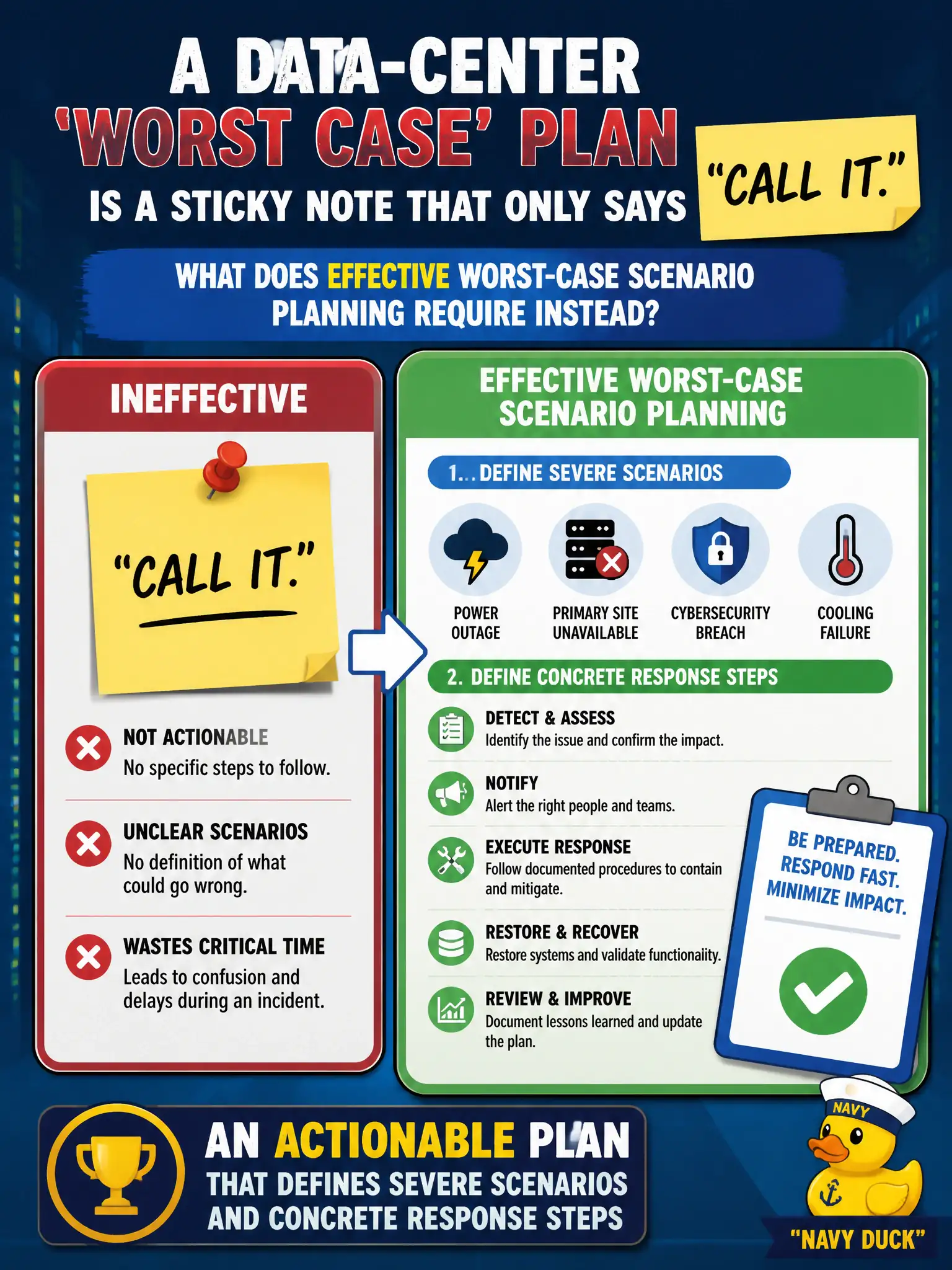
A data-center 'worst case' plan is a sticky note that only says 'call IT.' What does effective worst-case scenario planning require instead?
Select an answer to reveal the explanation.
Short Explanation
A sticky note that says 'call IT' is a wish, not a plan—like writing 'swim' on a life jacket tag and calling it done. Worst-case work needs real scenarios and steps. Slogans do not restore systems.
Full Explanation
Effective worst-case scenario planning for a civic data center requires an actionable plan that defines severe scenarios and concrete response steps—failover order, restore priorities, decision thresholds, and contacts—not a sticky note that only says call IT. Vague slogans fail under time pressure because they omit who does what, with which systems, and in what sequence when cooling, power, or ransomware events hit. A slogan contest judged by marketing does not produce technical recovery capability. Deleting backup procedures to keep a plan short destroys the assets planning should protect. Verbal folklore known only to night-shift volunteers creates fragile single points of knowledge and fails when those people are unavailable. Worst-case planning is structured severity analysis tied to operable responses and continuity objectives, not pessimism for its own sake or minimalist slogans. Exam caveat: brevity is valuable only when essential actions, roles, and dependencies remain explicit; sticky-note plans fail that test. Operational check: document named severe scenarios such as ransomware, cooling failure, and prolonged power loss; map each to recovery-time objectives and steps; store the plan where on-call staff can reach it offline; and run a tabletop that proves a call-IT note is insufficient.