
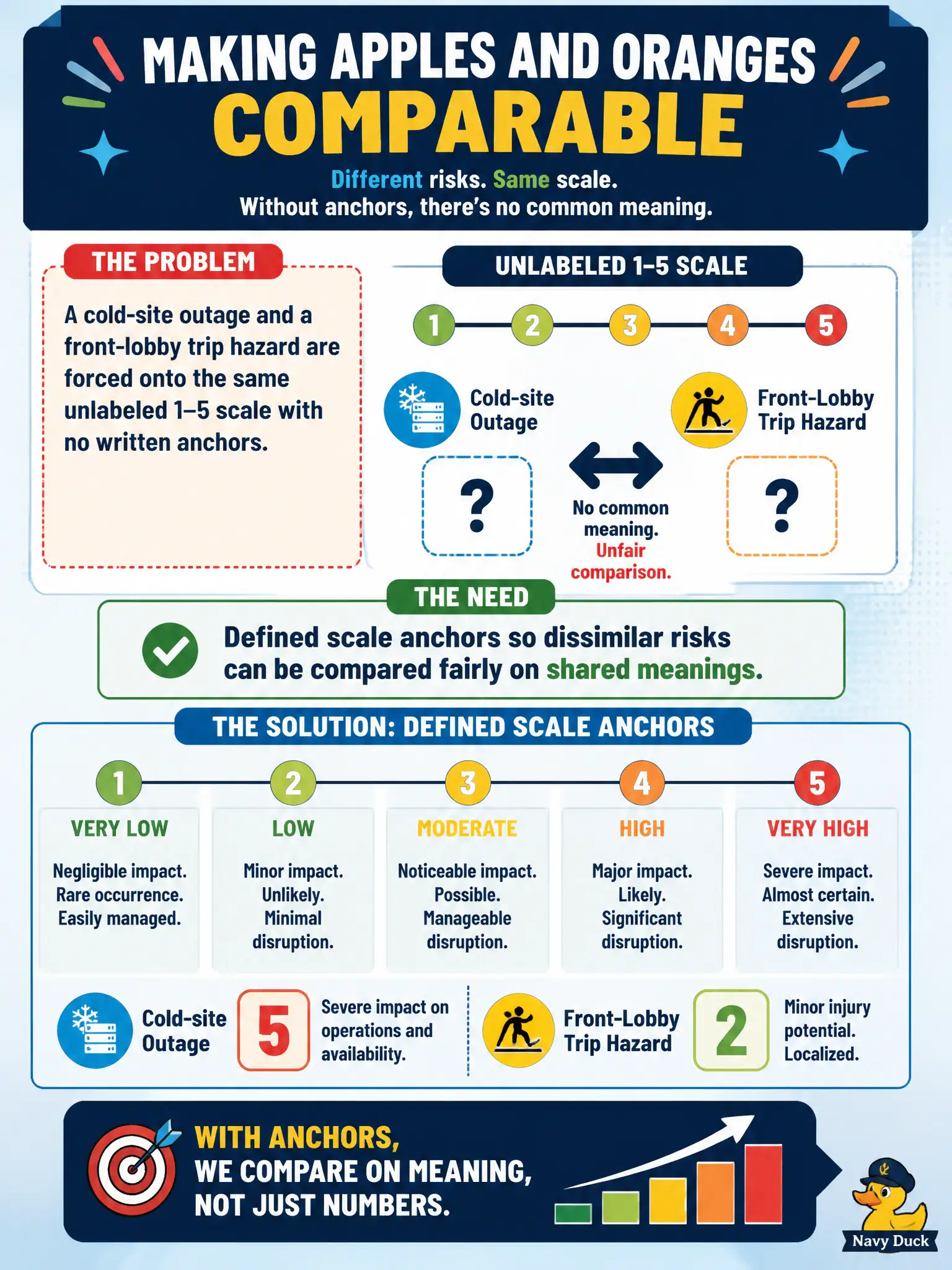
A cold-site outage and a front-lobby trip hazard are forced onto the same unlabeled 1–5 scale with no written anchors. What does the organization need?
Select an answer to reveal the explanation.
Short Explanation
A naked 1–5 scale is like a ruler with no inch marks—everyone invents their own. Anchors spell out what a '3' means so a trip hazard and an outage can be compared without arguing dialects.
Full Explanation
Shared numeric scales need defined anchors so dissimilar risks—a cold-site outage and a front-lobby trip—can be compared fairly. An unlabeled 1–5 scale without written meanings produces inconsistent municipal ratings. Separate secret departmental scales that never share definitions block enterprise view. Allowing only financial losses to use numeric scores excludes safety and service dimensions the city must govern. Automatically elevating every facilities item to the maximum score abandons discrimination. Exam caveat: anchored shared scales enable fair comparison across risk types. Operational check: publish anchors for each 1–5 level covering safety, service, and financial examples, rescore the cold-site and lobby trip against those anchors, and archive the legend with the enterprise register. Calibrate raters from facilities and IT together on the same worksheet. In municipal practice, record the rationale in the risk procedure or committee minutes so future staff apply the same rule under budget pressure. Re-validate after the next seasonal peak or org-chart change to confirm the civic control still holds as designed for residents and staff. In municipal practice, record the rationale in the risk procedure or committee minutes so future staff apply the same rule under budget pressure. Re-validate after the next seasonal peak or org-chart change to confirm the civic control still holds as designed for residents and staff.