
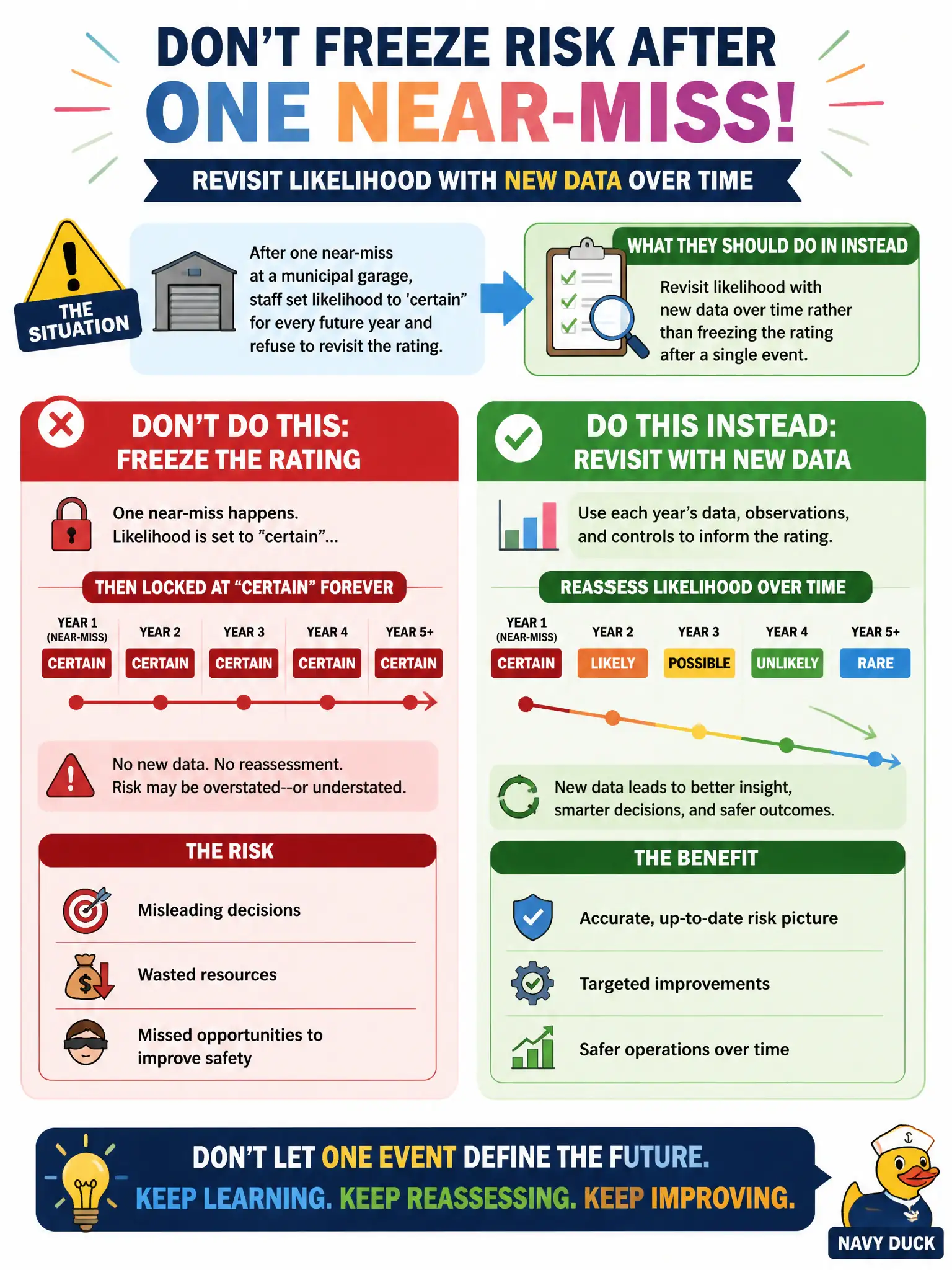
After one near-miss at a municipal garage, staff set likelihood to 'certain' for every future year and refuse to revisit the rating. What should they do instead?
Select an answer to reveal the explanation.
Short Explanation
One scare does not make forever-certain. Near-misses matter, but likelihood should move when controls, conditions, or data change. Park the panic, keep the review cycle.
Full Explanation
Likelihood should be revisited with new data over time rather than frozen after a single near-miss. Setting every future year to "certain" after one municipal garage event ignores whether controls improved, exposure changed, or the event was anomalous. Locking "certain" permanently so auditors never see a lower score prioritizes optics over truth. Deleting the risk until another near-miss occurs hides ongoing exposure. Replacing likelihood with consequence-only scoring for all garage hazards discards half the evaluation model. Exam caveat: dynamic reassessment beats one-event permanence. Operational check: schedule a 90-day and annual reassessment of the garage risk, update likelihood with inspection results, training completion, and near-miss trends, and record residual after controls. Show auditors the change history rather than a frozen maximum. In municipal practice, record the rationale in the risk procedure or committee minutes so future staff apply the same rule under budget pressure. Re-validate after the next seasonal peak or org-chart change to confirm the civic control still holds as designed for residents and staff. In municipal practice, record the rationale in the risk procedure or committee minutes so future staff apply the same rule under budget pressure. Re-validate after the next seasonal peak or org-chart change to confirm the civic control still holds as designed for residents and staff.