
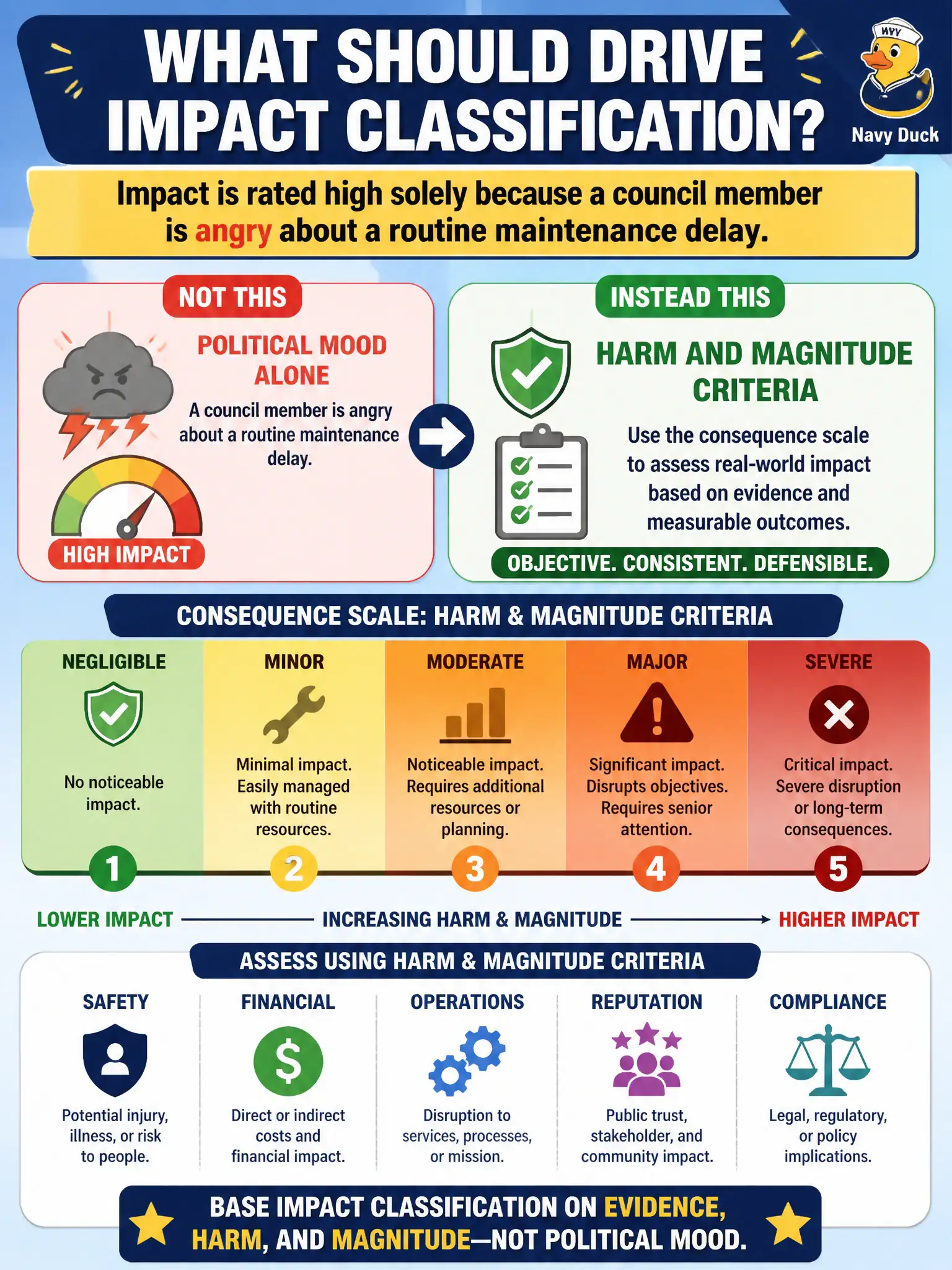
Impact is rated high solely because a council member is angry about a routine maintenance delay. What should drive impact classification instead?
Select an answer to reveal the explanation.
Short Explanation
Anger is a signal to listen, not an automatic 'high impact' stamp. Impact should track real harm and magnitude on the scale. Political heat can matter as a separate stakeholder issue, but mood alone is not the yardstick.
Full Explanation
Impact classification should follow harm and magnitude criteria on the consequence scale, not political mood alone. Rating impact high solely because a council member is angry about a routine maintenance delay confuses stakeholder emotion with assessed consequence for residents and assets. Using political email volume, budget-committee seating, or social-media loudness as the driver replaces the scale with optics. Exam caveat: consequence criteria are evidence of harm/magnitude; political heat may trigger communication plans but does not by itself redefine impact levels. Operational check: rescore the maintenance delay against written consequence anchors (service delay duration, safety, cost), document the rating, and separately note a stakeholder-communication task if council concern is high. Keep both in the file so civic staff see the distinction between impact scoring and political response. In municipal practice, record the rationale in the risk procedure or committee minutes so future staff apply the same rule under budget pressure. Re-validate after the next seasonal peak or org-chart change to confirm the civic control still holds as designed for residents and staff. In municipal practice, record the rationale in the risk procedure or committee minutes so future staff apply the same rule under budget pressure. Re-validate after the next seasonal peak or org-chart change to confirm the civic control still holds as designed for residents and staff.