
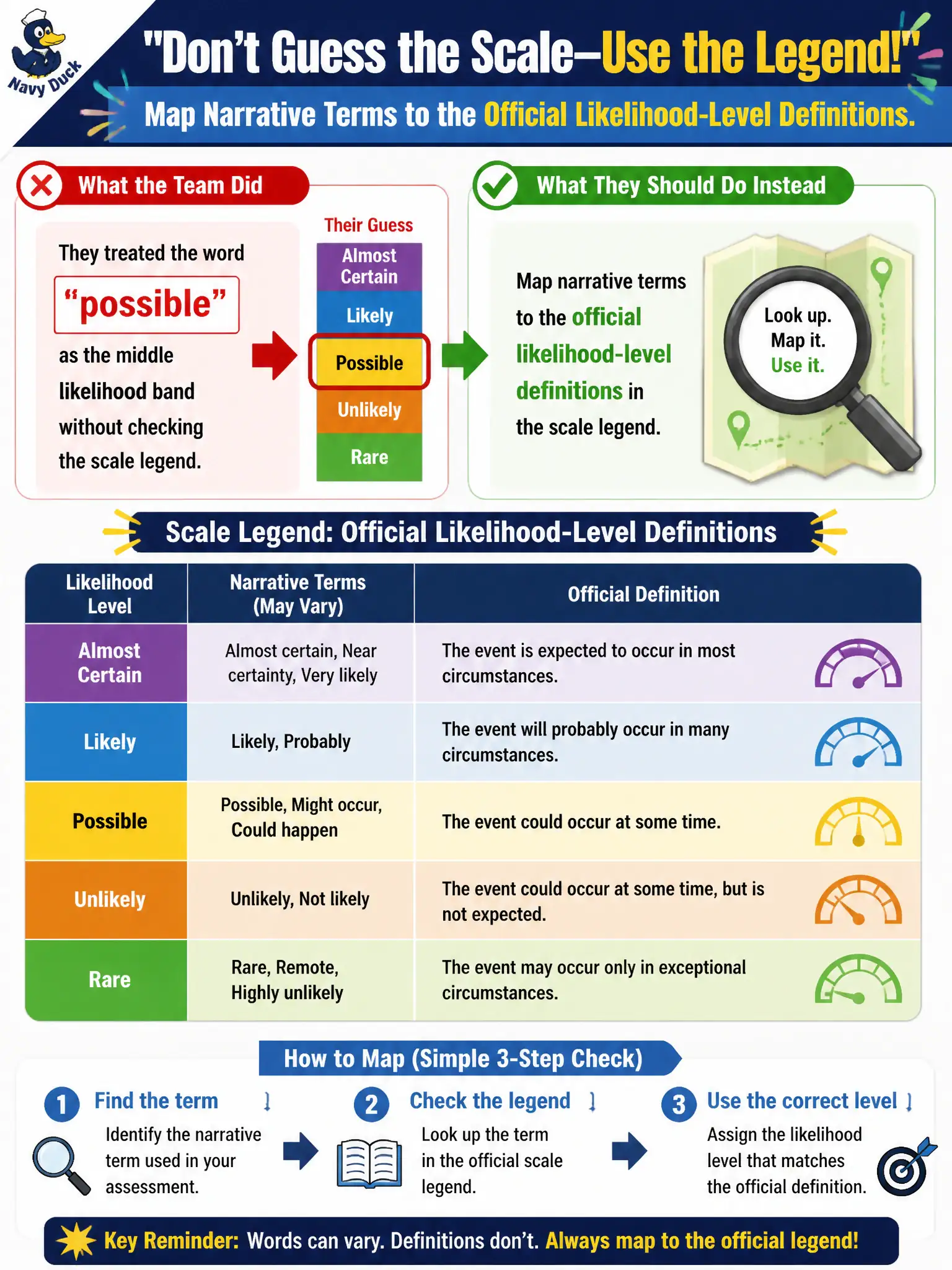
A team treats the word 'possible' as the middle likelihood band without checking the scale legend. What should they do instead?
Select an answer to reveal the explanation.
Short Explanation
In plain English, 'possible' is a huge umbrella. On your scale, it might mean something very specific. Check the legend before you park a risk in the middle band by vibe.
Full Explanation
Narrative words such as "possible" must be mapped to the official likelihood-level definitions in the scale legend rather than assumed to sit in the middle band by everyday English. Matrix labels are controlled vocabulary for the organization. Assuming everyday English always matches matrix labels exactly creates silent drift across departments. Skipping legends because intuition feels authentic defeats calibration. Replacing the official scale with dictionary synonyms each quarter destroys trendability. Exam caveat: legend mapping beats colloquial assumption. Operational check: during the next transit or facilities scoring session, force each narrative term through the legend table before a cell is chosen, initial the mapping on the worksheet, and sample prior "possible" entries to see whether they truly match the middle band. Correct mismatches on the live civic register. In municipal practice, record the rationale in the risk procedure or committee minutes so future staff apply the same rule under budget pressure. Re-validate after the next seasonal peak or org-chart change to confirm the civic control still holds as designed for residents and staff. In municipal practice, record the rationale in the risk procedure or committee minutes so future staff apply the same rule under budget pressure. Re-validate after the next seasonal peak or org-chart change to confirm the civic control still holds as designed for residents and staff.