
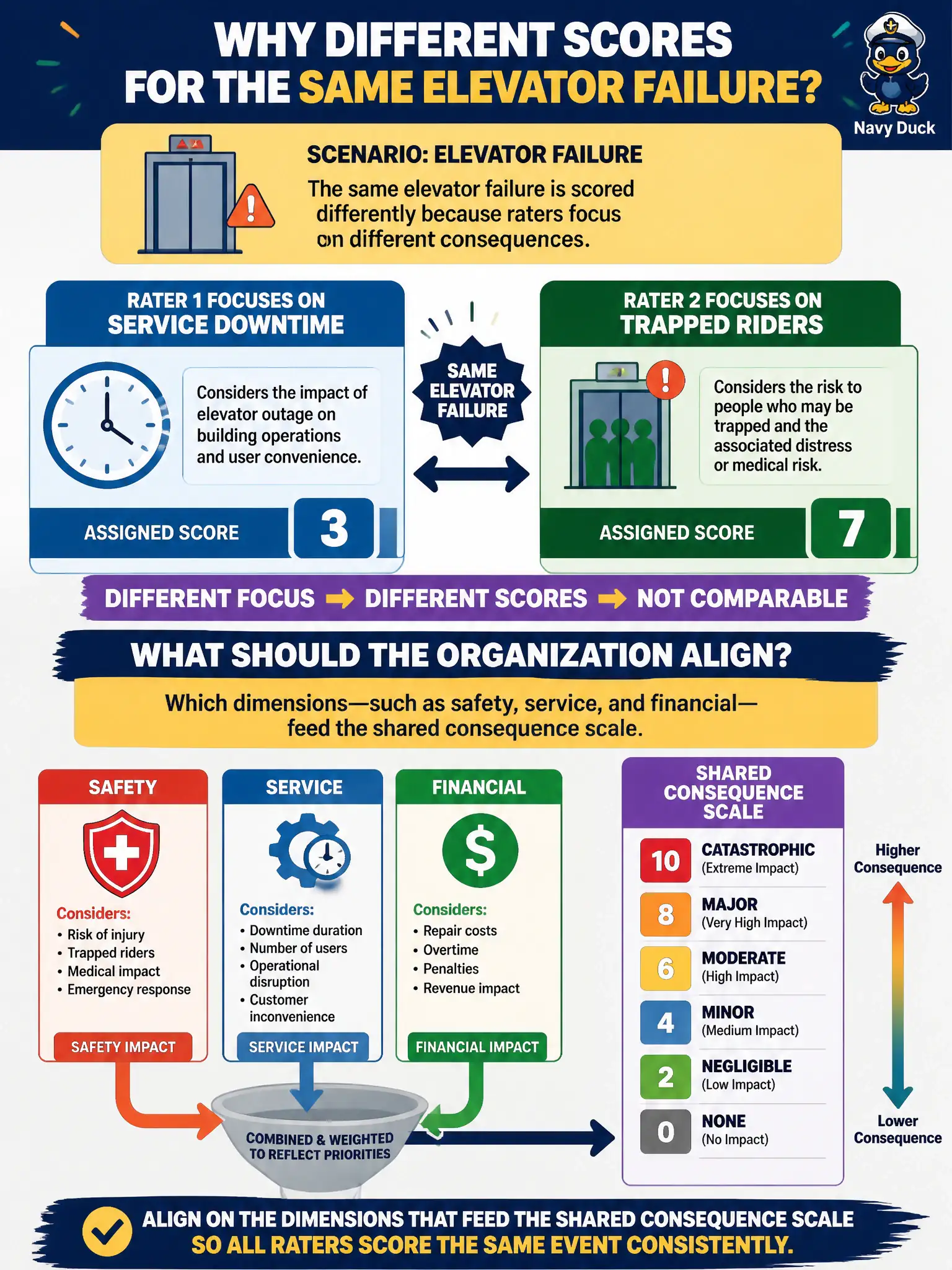
Two raters score the same elevator failure differently because one focuses only on service downtime and the other only on trapped riders. What should the organization align?
Select an answer to reveal the explanation.
Short Explanation
One person scores a stalled elevator as 'annoying delay' and another as 'people trapped'—same event, different movies. Align what dimensions feed consequence so scores land on the same page.
Full Explanation
When two raters score the same elevator failure differently because one sees only downtime and the other only trapped riders, the organization must align which dimensions—safety, service, financial, and others—feed the shared consequence scale. Without that alignment, municipal comparisons are apples-to-oranges. A rule that only downtime counts and safety is out of scope endangers people. Separate matrices that never let safety and service appear together fragment governance. Requiring each rater to pick one personal favorite dimension forever hard-wires bias. Exam caveat: define multi-dimensional consequence inputs for shared scoring. Operational check: publish a consequence rubric listing safety, service continuity, financial, and other civic dimensions with level anchors; rescore the elevator scenario jointly; and require raters to note which dimensions drove the chosen level. Recalibrate when a new service line joins the enterprise register. In municipal practice, record the rationale in the risk procedure or committee minutes so future staff apply the same rule under budget pressure. Re-validate after the next seasonal peak or org-chart change to confirm the civic control still holds as designed for residents and staff.