
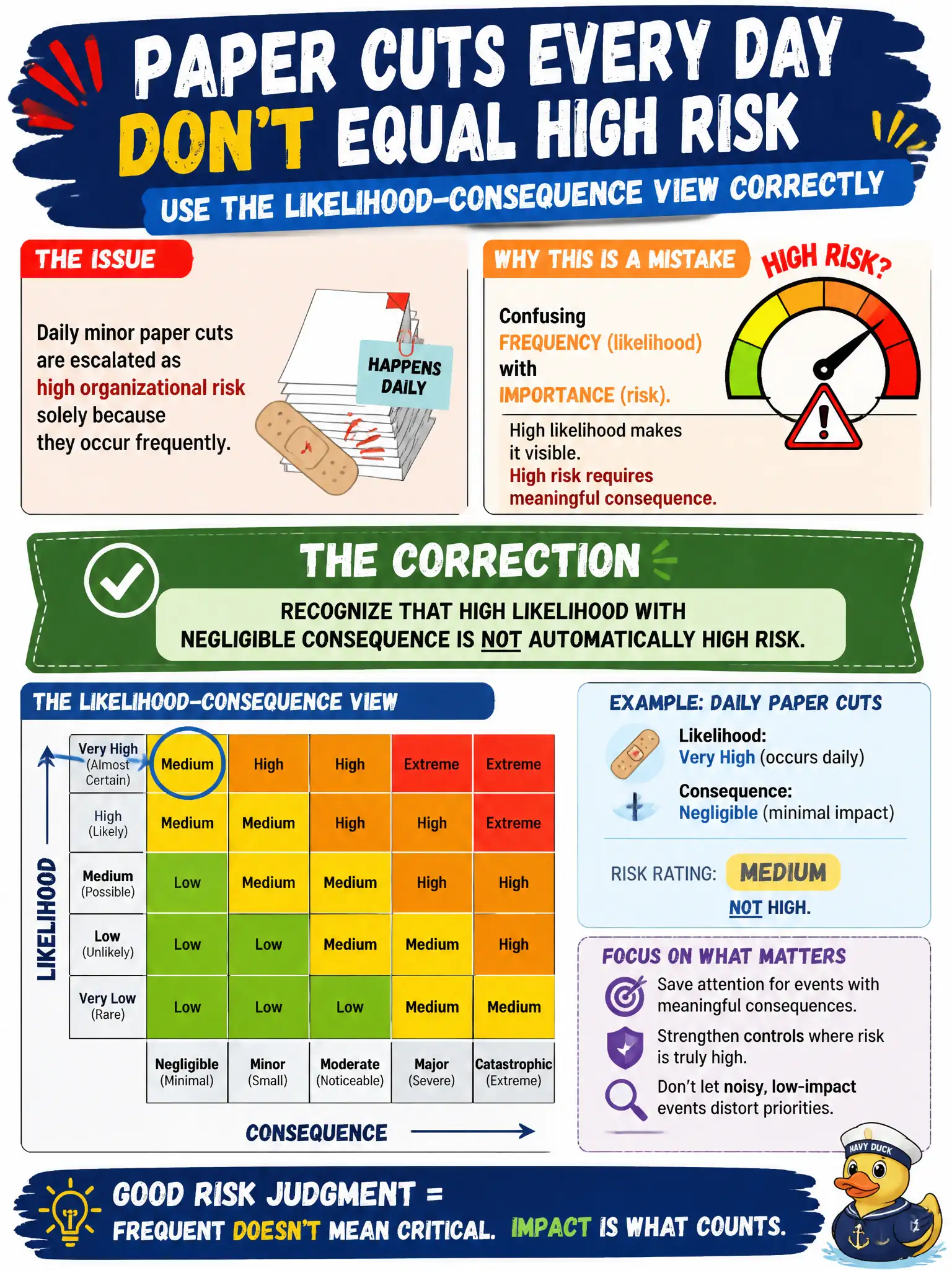
Daily minor paper cuts are escalated as high organizational risk solely because they occur frequently. What correction does the likelihood-consequence view require?
Select an answer to reveal the explanation.
Short Explanation
Lots of tiny paper cuts does not equal a warehouse fire. Frequency without severity is noisy, not automatically 'high risk.' Weigh how often and how bad together.
Full Explanation
High likelihood with negligible consequence is not automatically high organizational risk. Daily minor paper cuts may be frequent yet remain low on a likelihood-consequence view if harm stays trivial, though local first-aid tracking can still be useful. Treating any frequent event as high risk regardless of slight harm inflates the register and crowds true priorities. Ignoring frequency completely and ranking only by unusual stories discards useful likelihood data. Stopping all tracking of minor injuries because frequency never informs controls overcorrects; frequency can still guide housekeeping and PPE without elevating enterprise priority. Exam caveat: both axes matter—frequency alone does not equal high risk. Operational check: score paper-cut frequency against a negligible consequence band on the municipal scale, keep a local first-aid log if needed, and reserve high enterprise priority for items with material consequence. Show supervisors the difference in the next safety huddle. In municipal practice, record the rationale in the risk procedure or committee minutes so future staff apply the same rule under budget pressure. Re-validate after the next seasonal peak or org-chart change to confirm the civic control still holds as designed for residents and staff.