
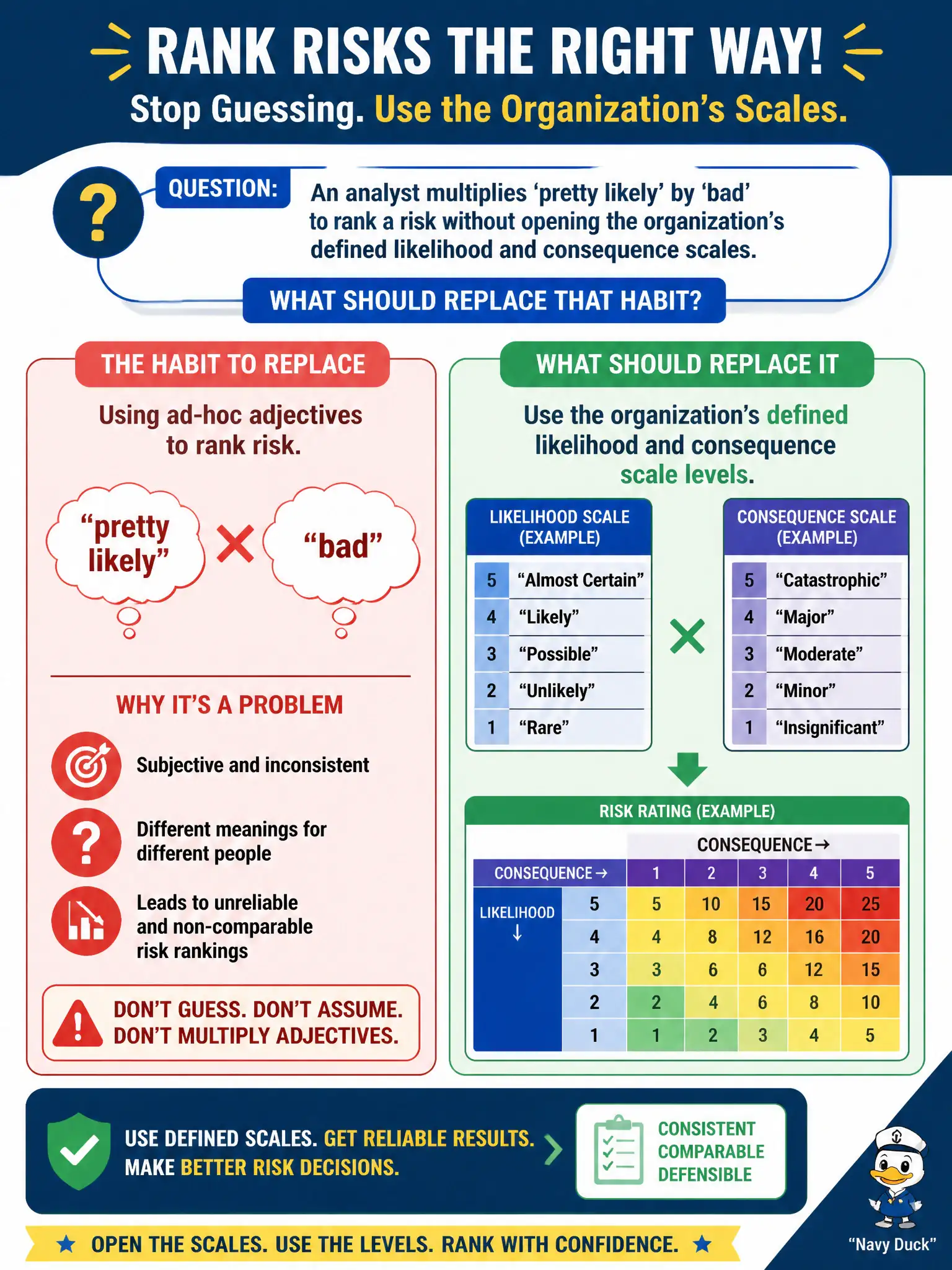
An analyst multiplies 'pretty likely' by 'bad' to rank a risk without opening the organization's defined likelihood and consequence scales. What should replace that habit?
Select an answer to reveal the explanation.
Short Explanation
'Pretty likely' times 'bad' is cafeteria math, not a risk scale. Your org already defined the bands—use them. Ad-hoc adjectives do not travel well across teams.
Full Explanation
Risk ranking must use the organization's defined likelihood and consequence scale levels rather than ad-hoc adjectives such as multiplying "pretty likely" by "bad." Undefined slang prevents comparison, auditability, and consistent treatment across municipal departments. Replacing all scales with gut feel to speed meetings trades speed for ungoverned prioritization. Scoring only with hallway emojis fails professional documentation. Borrowing another city's slang while ignoring local definitions breaks the local legend and appetite link. Exam caveat: official scale levels beat improvised adjectives on evaluation items. Operational check: open the approved likelihood and consequence legends during scoring, require each register row to cite the chosen level names or numbers from those legends, and reject worksheet entries that use only colloquial phrases. Retrain analysts who still default to informal multipliers in civic workshops. In municipal practice, record the rationale in the risk procedure or committee minutes so future staff apply the same rule under budget pressure. Re-validate after the next seasonal peak or org-chart change to confirm the civic control still holds as designed for residents and staff.