
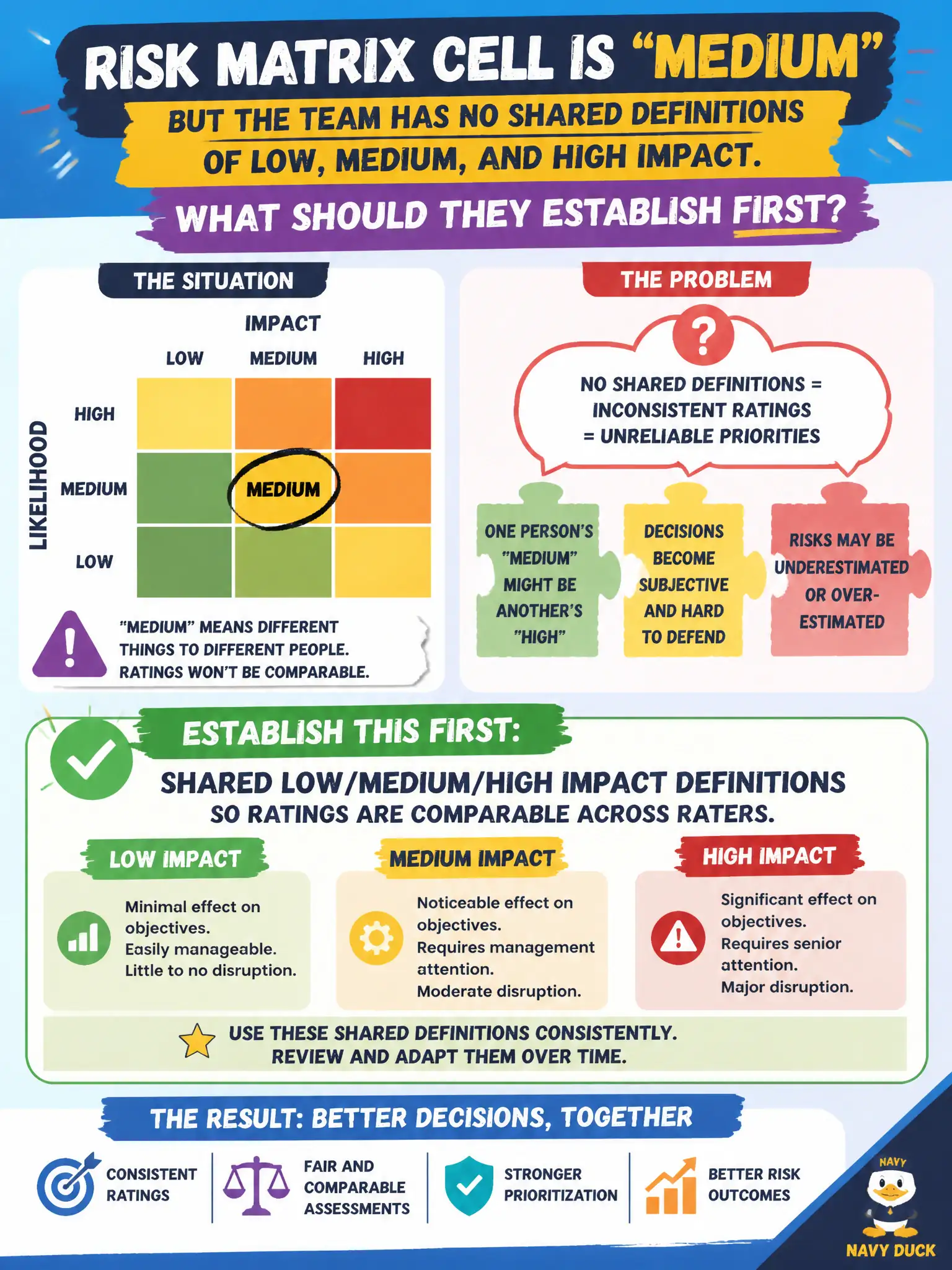
A risk matrix cell is labeled 'medium' but the team has no shared definitions of low, medium, and high impact. What should they establish first?
Select an answer to reveal the explanation.
Short Explanation
Calling something 'medium' without a shared yardstick is like saying 'warm' with no thermometer. Everyone hears a different temperature. Lock shared impact definitions before you trust the labels.
Full Explanation
Shared definitions of low, medium, and high impact must exist before matrix cells are meaningful. A "medium" label without common criteria cannot be compared across raters or departments in a municipal enterprise register. Letting medium mean "ask the loudest manager" replaces analysis with politics. Allowing each rater a private definition destroys consistency. Issuing numeric scores with no word definitions attached still leaves ambiguity about what the numbers represent. Exam caveat: calibrated shared impact definitions precede reliable matrix use. Operational check: workshop and publish low/medium/high or five-level impact definitions with civic examples, attach them to the matrix legend, train raters, and run a calibration set of five scenarios until inter-rater agreement improves. Revisit definitions when services or risk appetite change. In municipal practice, record the rationale in the risk procedure or committee minutes so future staff apply the same rule under budget pressure. Re-validate after the next seasonal peak or org-chart change to confirm the civic control still holds as designed for residents and staff. In municipal practice, record the rationale in the risk procedure or committee minutes so future staff apply the same rule under budget pressure. Re-validate after the next seasonal peak or org-chart change to confirm the civic control still holds as designed for residents and staff.