
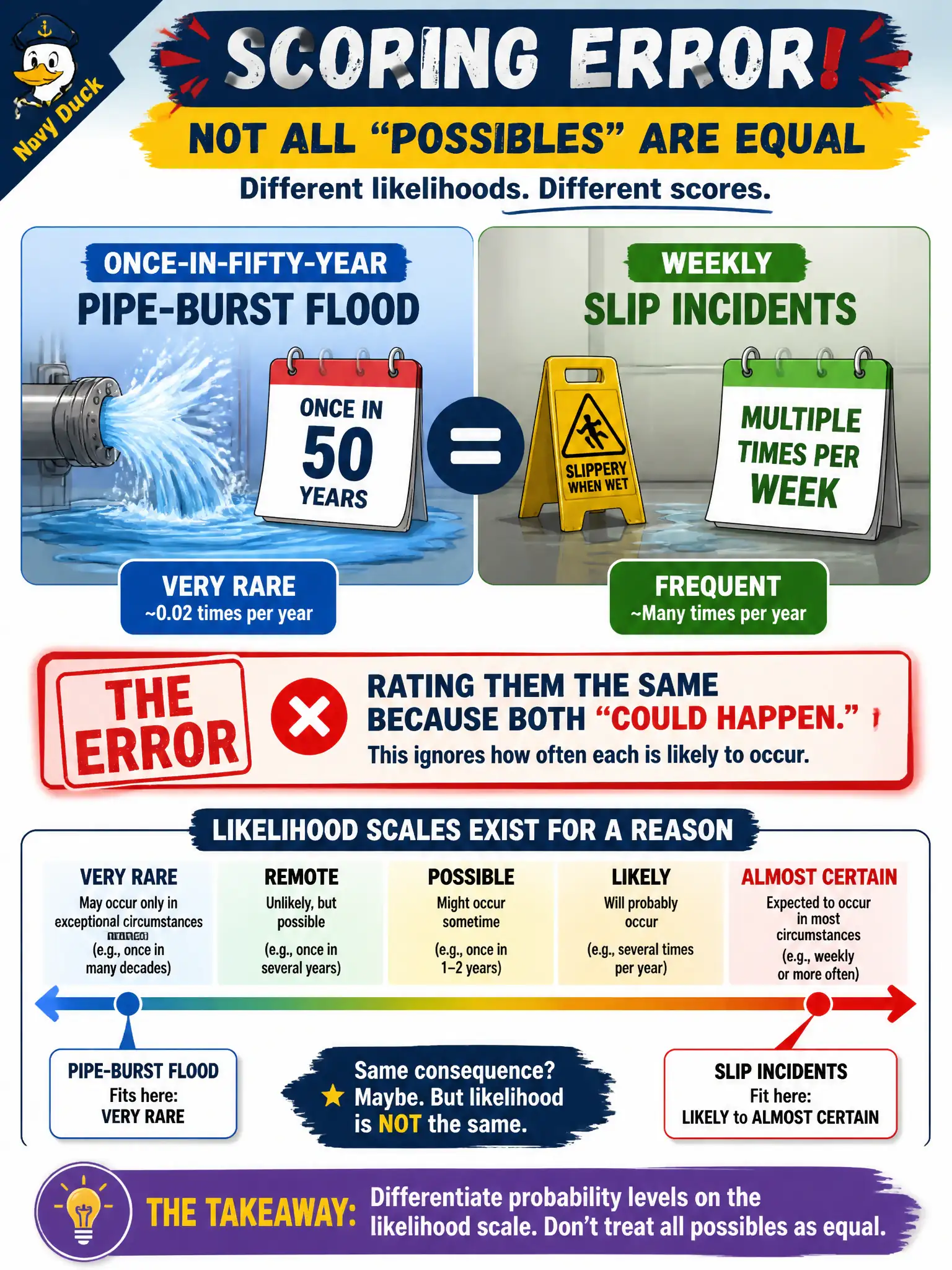
A supervisor rates a once-in-fifty-year pipe-burst flood the same likelihood as weekly slip incidents because both 'could happen.' What scoring error is this?
Select an answer to reveal the explanation.
Short Explanation
Sure, both 'could happen'—so could winning the lottery and spilling coffee. Likelihood scales exist to separate rare from routine. Do not flatten every possibility into the same bucket.
Full Explanation
Likelihood scales exist to differentiate probability. Rating a once-in-fifty-year pipe-burst flood the same as weekly slip incidents because both "could happen" fails to use probability bands and distorts prioritization for capital versus housekeeping controls in civic assets. Using separate incompatible bands so floods and slips can never be compared removes portfolio value; the stem's error is equalizing all possibles, not forbidding shared scales. Always scoring rare events as maximum likelihood to stay "conservative" collapses the scale. Ignoring consequence and scoring only by drama is a different failure mode than undifferentiating likelihood. Exam caveat: distinct likelihood levels are required; treating every possible event as equal probability is wrong. Operational check: adopt defined likelihood bands with plain-language civic anchors such as weekly, annually, once-per-decade, and rare; rescore the flood and slip examples; and show leadership how treatment urgency differs. Calibrate raters with two worked examples before the next register workshop. In municipal practice, record the rationale in the risk procedure or committee minutes so future staff apply the same rule under budget pressure. Re-validate after the next seasonal peak or org-chart change to confirm the civic control still holds as designed for residents and staff.