
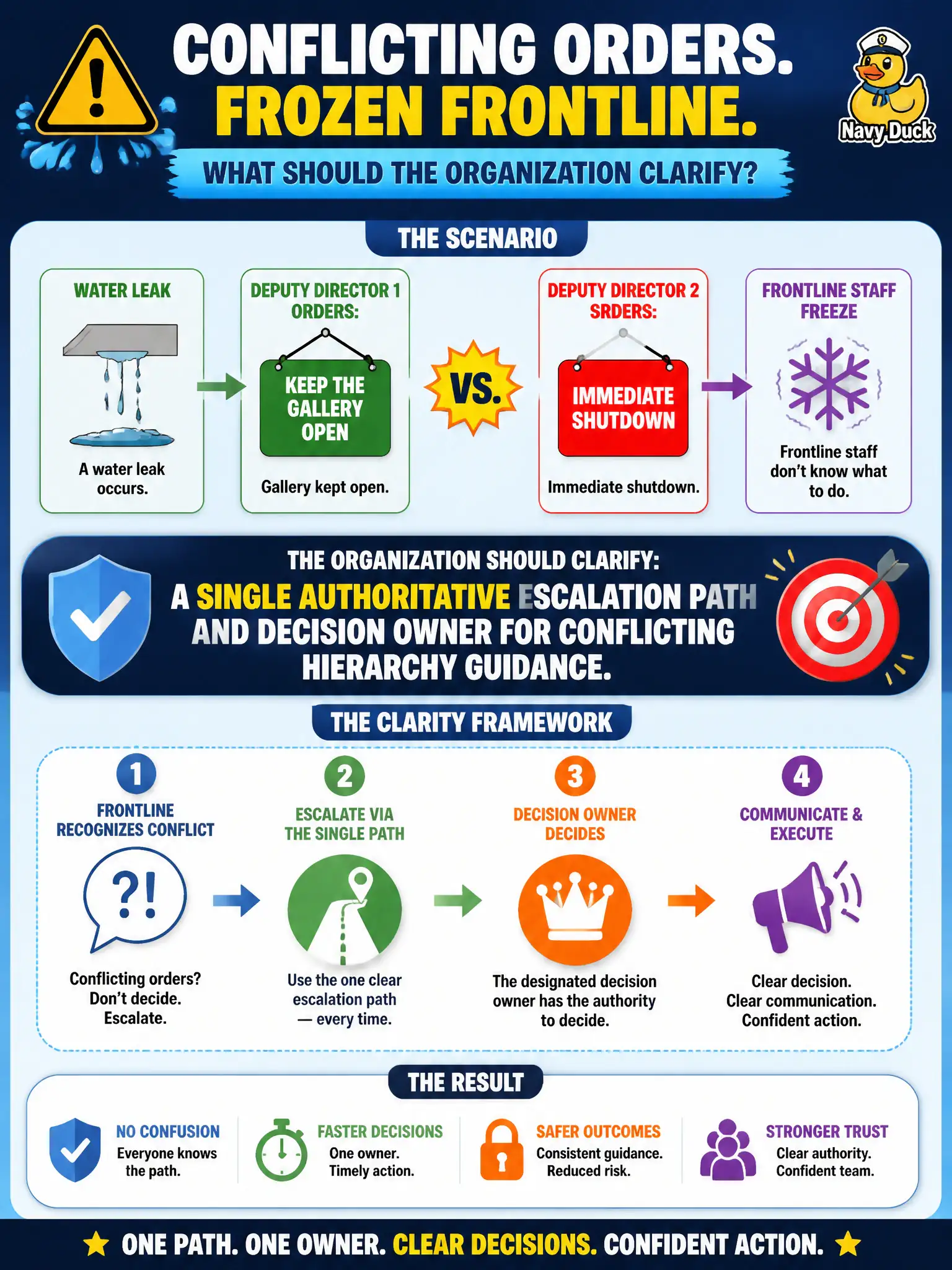
After a water leak, one deputy director orders the gallery kept open while another orders an immediate shutdown, and frontline staff freeze. What should the organization clarify?
Select an answer to reveal the explanation.
Short Explanation
Two bosses yelling opposite orders is a recipe for standing still in a puddle. Emergencies need one clear authority path. Clarify who decides so the crew is not stuck in the middle.
Full Explanation
Conflicting hierarchy orders—one deputy keeping a gallery open, another ordering shutdown after a water leak—freeze frontline staff and elevate life-safety ambiguity. The organization must clarify a single authoritative escalation path and decision owner for such conflicts so public-facing spaces are controlled consistently. Averaging two orders into a half-closure is not a control strategy. Letting the newest email win regardless of role authority rewards volume over mandate. Treating conflicting guidance as healthy debate during emergencies prolongs exposure. Exam caveat: unity of command and a clear decision owner under conflict is the communication fix, not creative averaging. Operational check: name the incident decision owner for facility emergencies by role, publish the conflict-resolution step for who breaks ties, run a tabletop with two opposing directives, and confirm frontline staff can identify whom to obey. Log the authoritative decision in the incident record for the civic site. In municipal practice, record the rationale in the risk procedure or committee minutes so future staff apply the same rule under budget pressure. Re-validate the control after the next seasonal peak or org-chart change to confirm the civic pathway still works as designed.