
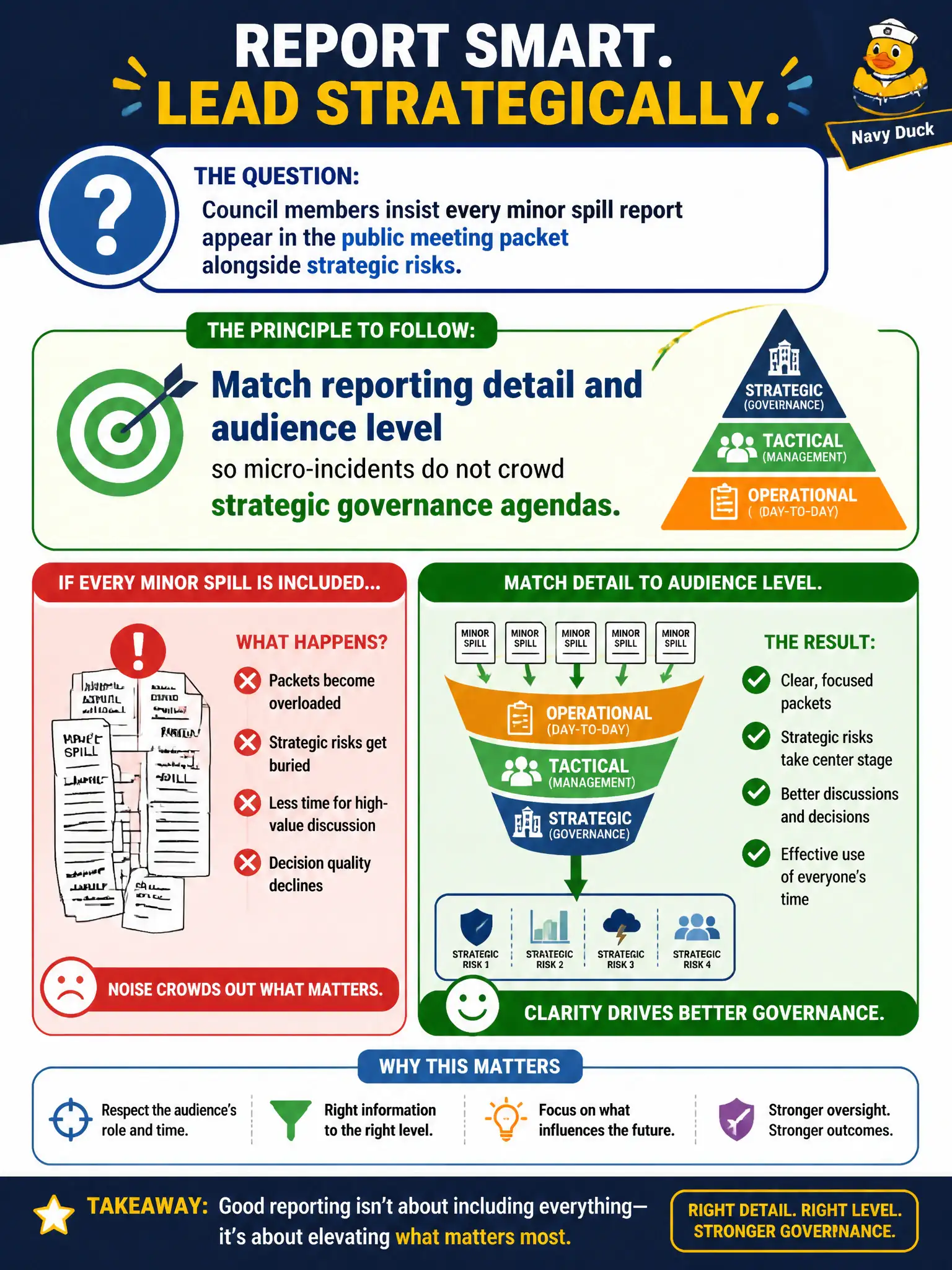
Council members insist every minor spill report appear in the public meeting packet alongside strategic risks. What reporting principle should guide the risk manager?
Select an answer to reveal the explanation.
Short Explanation
You do not brief the mayor with every stubbed toe on the sidewalk. Leaders need the right altitude of information. Match detail to the audience so real priorities still fit on the agenda.
Full Explanation
Reporting detail should match audience and decision level. Flooding the council packet with every minor spill alongside strategic risks crowds governance attention and dilutes focus on decisions only council can make. Matching detail to audience keeps micro-incidents with operational owners while summarizing trends upward. Putting every micro-incident on the top governance agenda for "transparency" creates noise without better control. Hiding all spill data from council blocks legitimate oversight of patterns and severe events. Sending minor spills only to the press and never to internal owners skips treatment. Exam caveat: audience-appropriate escalation and aggregation beat both oversharing trivia and undersharing substance. Operational check: define thresholds for council notice versus operational logs, produce a monthly spill trend summary for governance, and keep day-to-day spills in the public-works incident system with owners. Review thresholds annually with the clerk and risk lead. In municipal practice, record the rationale in the risk procedure or committee minutes so future staff apply the same rule under budget pressure. Re-validate the control after the next seasonal peak or org-chart change to confirm the civic pathway still works as designed.