
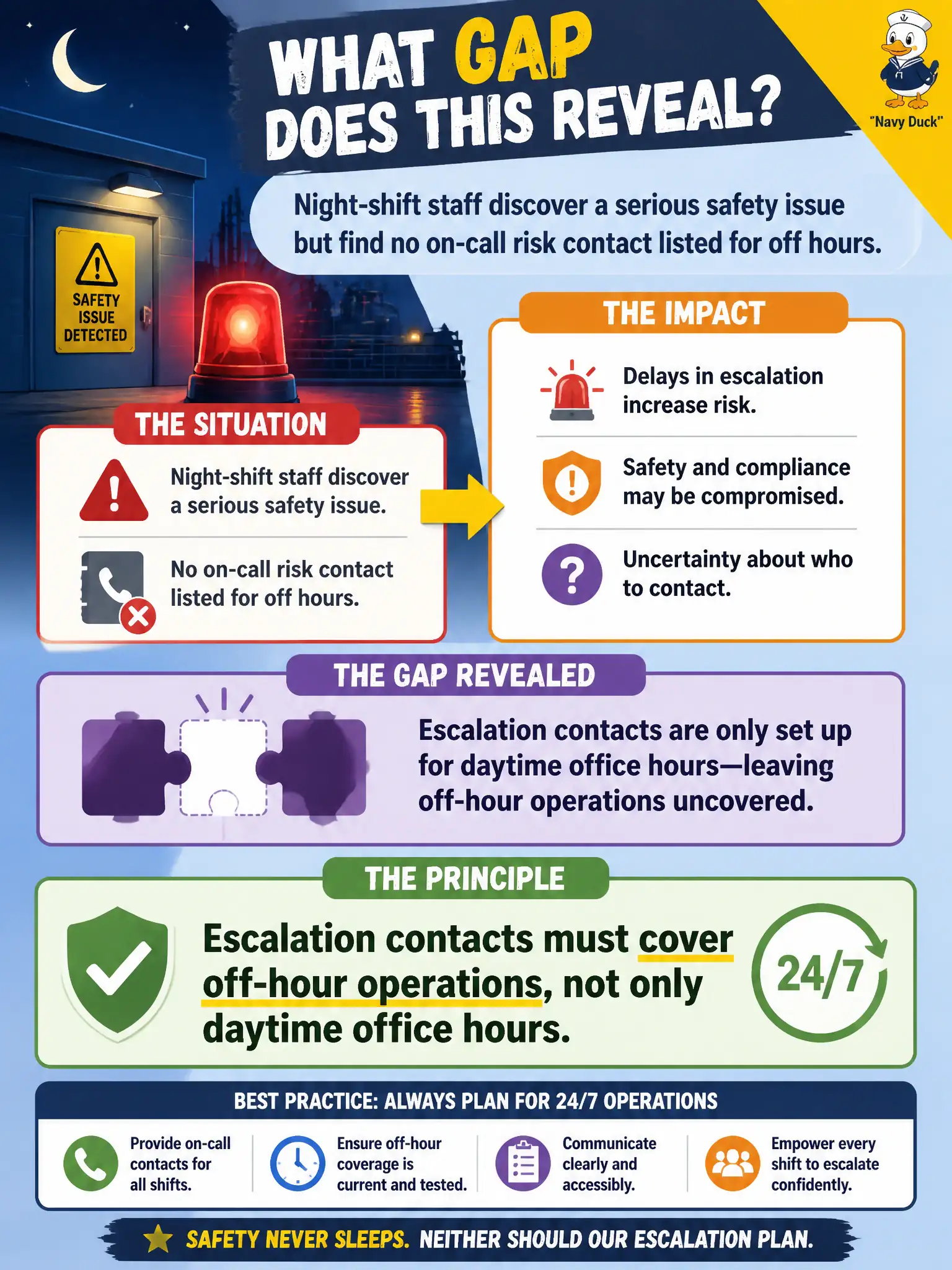
Night-shift staff discover a serious safety issue but find no on-call risk contact listed for off hours. What gap does this reveal?
Select an answer to reveal the explanation.
Short Explanation
Risks do not punch a time clock. If the night crew has nobody to call, the pathway is half-built. List on-call contacts that work when the day office is dark.
Full Explanation
Escalation contacts must cover off-hour operations. Night-shift discovery of a serious safety issue with no on-call risk or safety contact listed reveals a coverage gap that daytime org charts hide. Assuming night shifts need no escalation path because risk "only occurs" in business hours ignores 24-hour civic services. Reserving contacts for executives and never sharing them with frontline staff blocks the people who see hazards first. Telling staff to always wait until the next morning normalizes delayed response to serious conditions. Exam caveat: after-hours pathway completeness is part of communication design, not optional polish. Operational check: publish a 24/7 on-call roster for safety/risk or the designated duty manager, place it at night-shift workstations and in the digital badge app, test an after-hours call during a drill, and log response time. Update the roster whenever rotations change so municipal nights are never orphaned. In municipal practice, record the rationale in the risk procedure or committee minutes so future staff apply the same rule under budget pressure. Re-validate the control after the next seasonal peak or org-chart change to confirm the civic pathway still works as designed.