
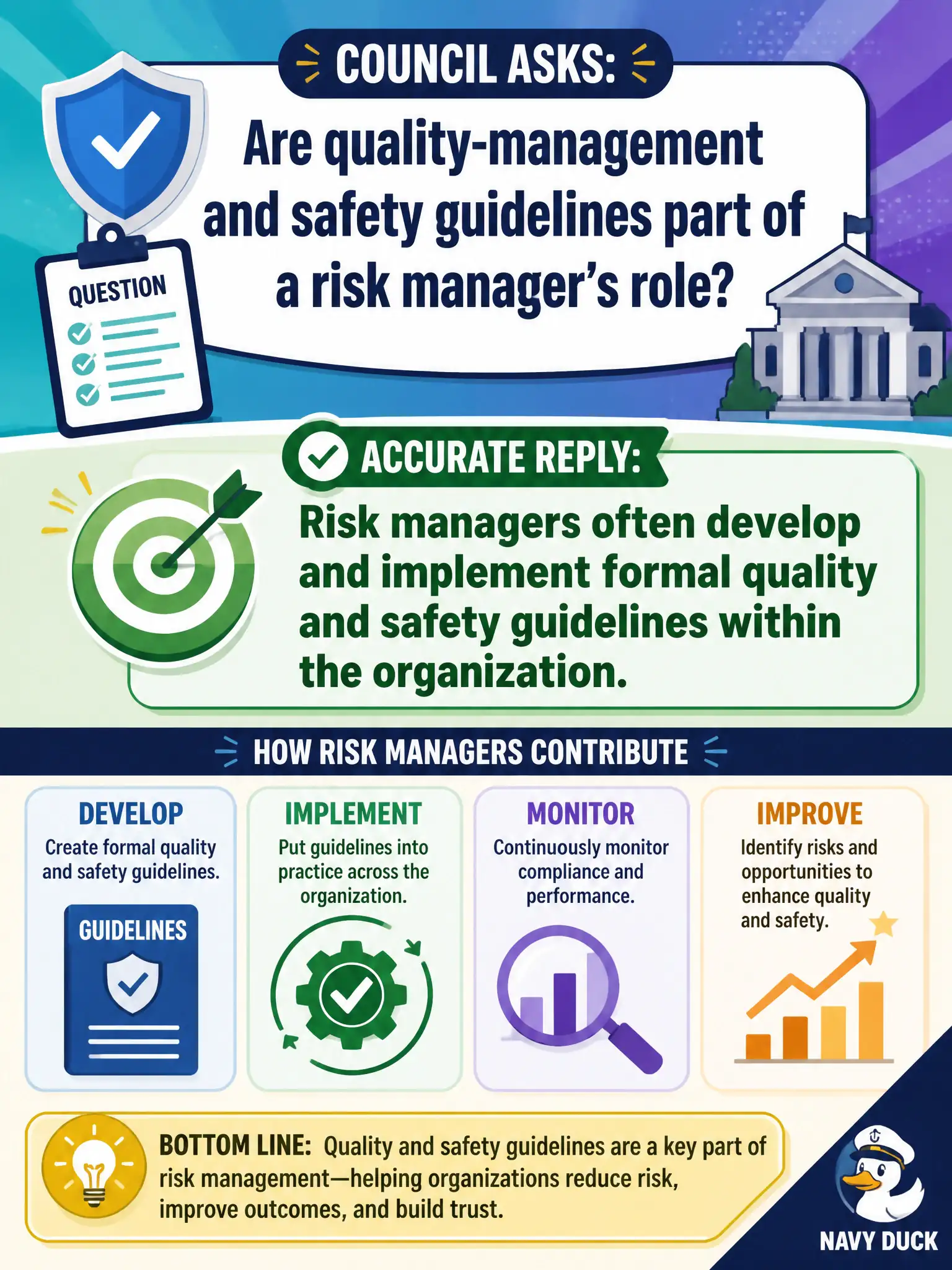
Council asks if quality-management and safety guidelines are part of a risk manager's role. What is the accurate reply?
Select an answer to reveal the explanation.
Short Explanation
Think of the risk manager as someone who helps write the playbook, not just cheer from the bleachers. Formal quality and safety guidelines are often part of that playbook. Council can expect the role to help build and put those guidelines to work.
Full Explanation
Risk managers commonly help develop and implement formal quality and safety guidelines so controls are consistent, teachable, and auditable across civic departments. That work sits inside prevention and treatment, not outside it. Assigning guidelines only to external auditors removes internal ownership and delays learning. Allowing risk managers to read guidelines but forbidding them from helping write or implement them creates a spectator role that weakens program design. Claiming only union contracts may define quality and safety rules ignores management's duty to set operational standards within labor and legal frameworks. Exam caveat: expect answers that place guideline development/implementation inside the risk manager's constructive duties. Operational check: co-author or update one short safety or quality guideline with facilities or parks, publish it on the staff portal, train supervisors, and schedule a 90-day compliance spot-check. Document how the guideline reduces a named hazard on the register so council can see the link between standards and risk treatment. In civic practice, keep the same vocabulary in board minutes, toolbox talks, and the live register so department heads do not reintroduce casual synonyms after training. Re-check the concept during the next quarterly risk review against one real municipal example so the distinction stays operational rather than slogan-only.