
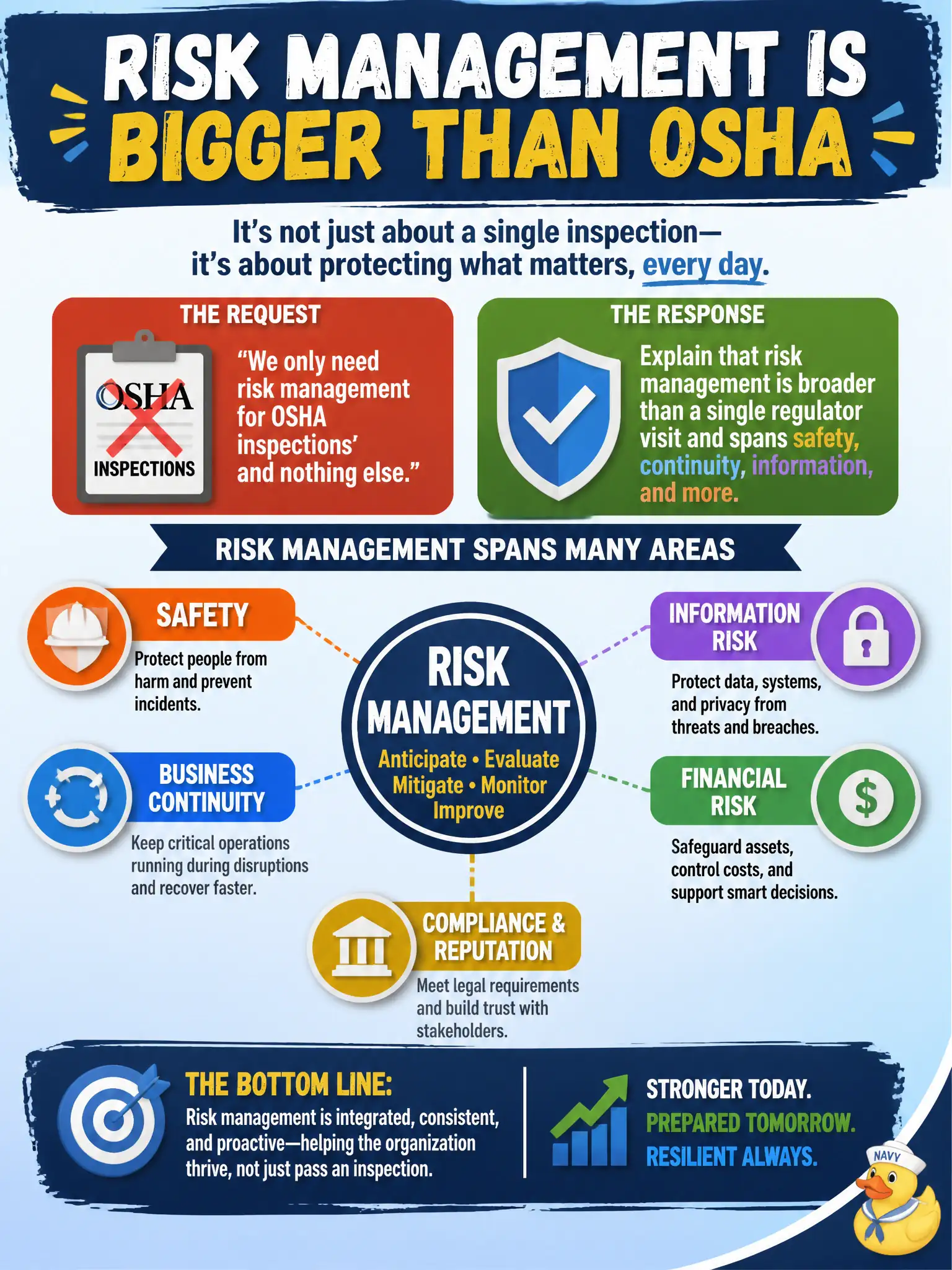
A department head wants risk management only for OSHA inspections and nothing else. How should the risk manager respond?
Select an answer to reveal the explanation.
Short Explanation
OSHA day is one checkpoint on a longer road, not the whole map. Risk management still covers day-to-day safety, keeping services running, protecting information, and other threats that never wait for an inspector. Narrowing to visit-prep alone leaves too much unwatched.
Full Explanation
Risk management is broader than preparing for a single OSHA inspection. A municipal program still spans day-to-day safety, continuity of services, information protection, environmental exposures, and other threats year-round. Pausing continuity, information, and safety work until the next OSHA visit leaves the city exposed between inspections. Converting the entire program into a pre-inspection checklist with no other activity substitutes audit theater for risk treatment. Limiting identification to citations from the prior three years anchors the register in lagging enforcement history instead of current hazards and objectives. Exam caveat: regulator-visit tunnel vision is a distractor; the correct view keeps a standing, multi-domain program. Operational check: maintain a living register that includes at least one continuity item and one information item beside safety rows, schedule quarterly reviews independent of inspection dates, and brief the department head that OSHA readiness is a subset—not the charter—of civic risk management. Spot-check whether near-misses still flow when no inspector is expected. In civic practice, keep the same vocabulary in board minutes, toolbox talks, and the live register so department heads do not reintroduce casual synonyms after training. Re-check the concept during the next quarterly risk review against one real municipal example so the distinction stays operational rather than slogan-only.