
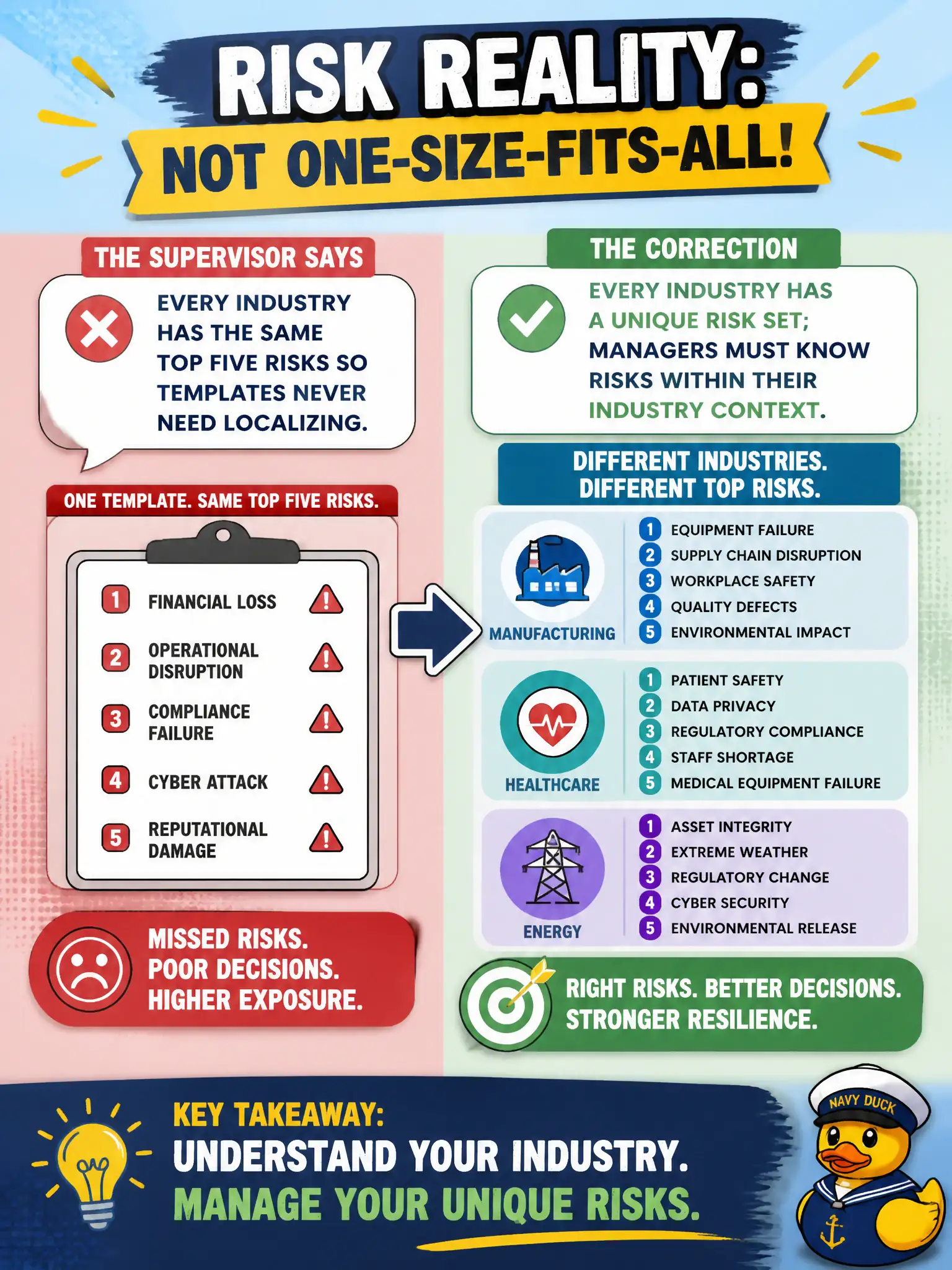
A supervisor says every industry has the same top five risks so templates never need localizing. Which correction is needed?
Select an answer to reveal the explanation.
Short Explanation
A beach town's flood worries are not the same as a data center's cooling worries, even if both use a risk matrix. Industries carry their own signature threats. Templates are a start — localizing to your sector is how they actually help.
Full Explanation
Every industry and civic service line carries a distinctive risk profile. Flood exposure for a coastal parks system is not interchangeable with cooling failure at a data center or chemical handling at a water plant. Managers must localize templates to their sector, geography, and operations rather than assuming a universal top-five list. Keeping one eternal top-five list and ignoring sector differences produces blind spots. Localizing only when insurers demand industry codes treats underwriting paperwork as the sole reason for context—an incomplete motive. Assuming public agencies share identical risks with heavy manufacturing by definition erases real differences in assets, stakeholders, and failure modes. Exam caveat: "know risks in your industry context" beats one-size template worship. Operational check: take a generic risk checklist, strike or rewrite three items that do not fit the city's actual services, add two locality-specific threats (for example freeze-thaw pavement failure or special-event crowd surge), and have the risk committee approve the localized list. Revisit seasonally so the civic context stays current. In civic practice, keep the same vocabulary in board minutes, toolbox talks, and the live register so department heads do not reintroduce casual synonyms after training. Re-check the concept during the next quarterly risk review against one real municipal example so the distinction stays operational rather than slogan-only.