
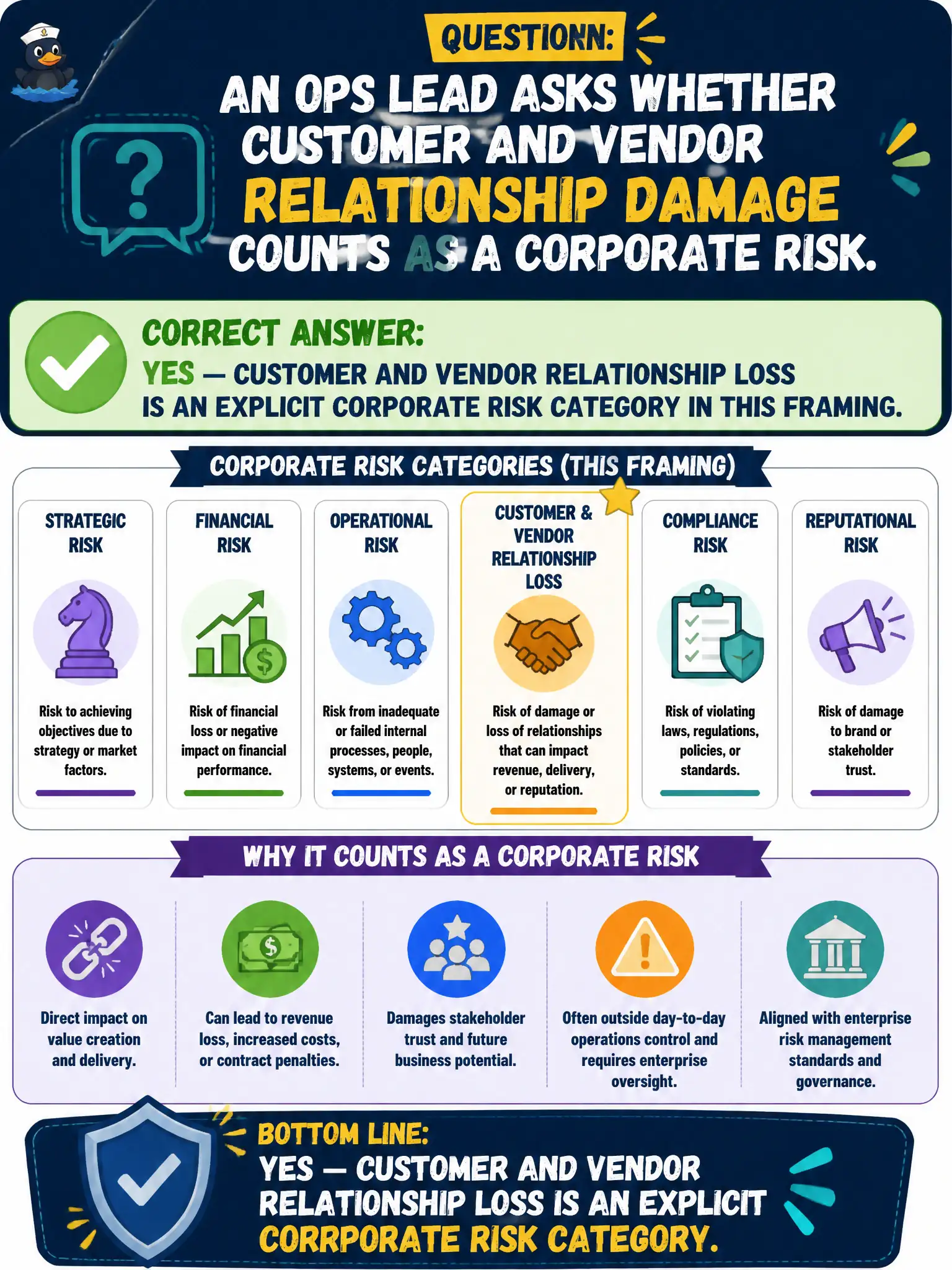
An ops lead asks whether customer and vendor relationship damage counts as a corporate risk. Which answer is correct?
Select an answer to reveal the explanation.
Short Explanation
Burn a key vendor or a big customer and the operation feels it like a missing hinge on a gate. Relationship loss is not "just marketing" — it is a named corporate risk lane. Treat those bonds as something the risk program can identify and protect.
Full Explanation
Customer and vendor relationship loss is an explicit corporate risk category in this framing: damaged trust, broken supply partnerships, and eroded service relationships threaten municipal objectives even when no immediate invoice posts. Burning a key vendor or alienating a major service user can halt projects, raise costs, and impair continuity. Treating relationship damage as a marketing concern that never enters the risk register hides a named exposure class. Making vendor relationships matter only when liquidated-damages clauses exist confuses contract remedies with risk identification. Counting only customer goodwill while excluding vendor relationships leaves supply-side partnership risk unowned. Exam caveat: multi-category corporate risk includes relationship loss alongside financial, people, and information exposures. Operational check: add a relationship or counterparties field to the city risk register, log one strained vendor or high-complaint customer pathway with an owner and treatment (communication plan, dual source, service recovery), and review it in the next cross-department risk huddle. Verify that procurement and the operating unit both see the same entry. In civic practice, keep the same vocabulary in board minutes, toolbox talks, and the live register so department heads do not reintroduce casual synonyms after training. Re-check the concept during the next quarterly risk review against one real municipal example so the distinction stays operational rather than slogan-only.