
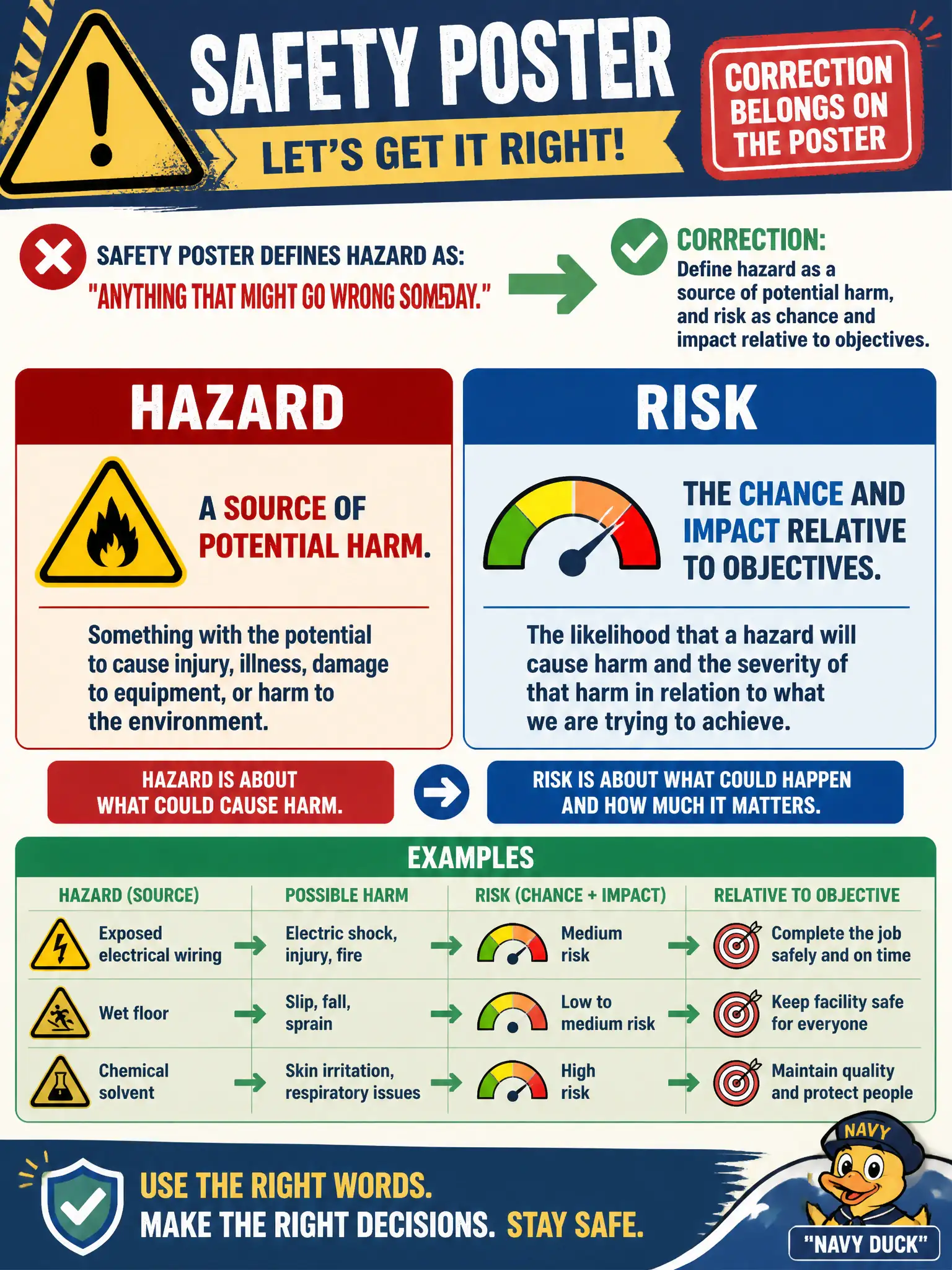
A safety poster defines hazard as "anything that might go wrong someday." What correction belongs on the poster?
Select an answer to reveal the explanation.
Short Explanation
"Anything that might go wrong someday" is so wide it points everywhere and nowhere. A hazard is a real source of potential harm — a wet stair, a toxic drum — while risk is the chance and impact against your goals. Tighten the poster so people know what they are looking for.
Full Explanation
A hazard should be defined as a source of potential harm; risk should be defined as chance and impact relative to objectives. A poster that says a hazard is "anything that might go wrong someday" is too vague to drive inspection, scoring, or treatment and encourages undifferentiated worry lists. Keeping that vague wording because it seems inclusive actually degrades reporting quality. Replacing every "hazard" with "risk" so one word covers all uncertainty erases the source-versus-uncertainty distinction CRMC items test. Stating that hazards exist only after a formal insurance survey makes identification hostage to a financing ritual and excludes day-to-day civic observations. Exam caveat: definitional precision—source of harm versus likelihood/impact on objectives—beats slogan-level vagueness. Operational check: rewrite the safety poster with two labeled lines (hazard = source; risk = likelihood and consequence vs objectives), train one toolbox talk on a wet stair example in a civic building, and audit five recent reports to ensure staff are not filing pure worries without a source description. Update the intranet glossary to match. In civic practice, keep the same vocabulary in board minutes, toolbox talks, and the live register so department heads do not reintroduce casual synonyms after training. Re-check the concept during the next quarterly risk review against one real municipal example so the distinction stays operational rather than slogan-only.