
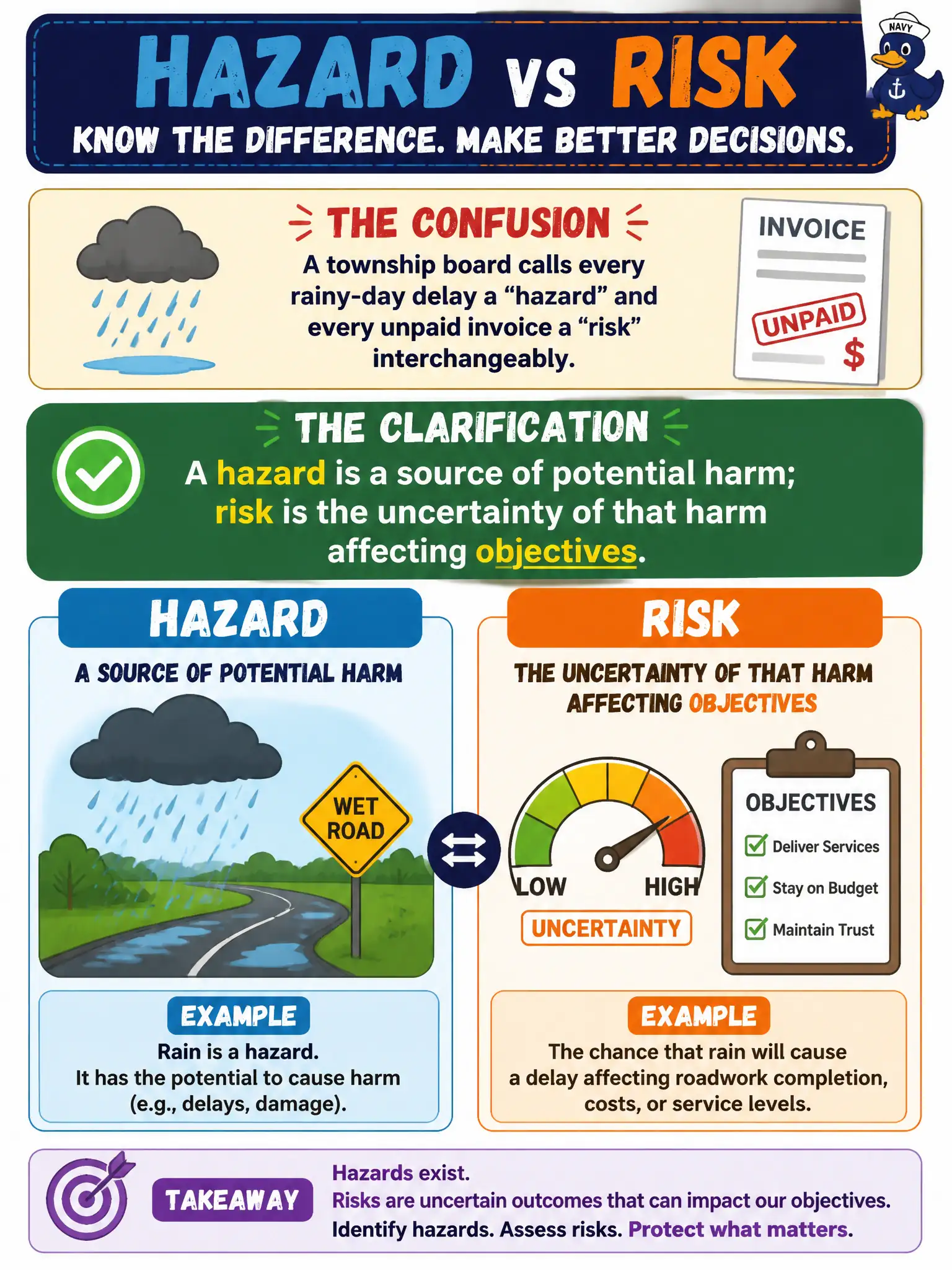
A township board calls every rainy-day delay a "hazard" and every unpaid invoice a "risk" interchangeably. Which clarification should the risk manager give?
Select an answer to reveal the explanation.
Short Explanation
Picture a wet floor versus the chance someone actually slips and gets hurt. The puddle is the hazard — the source of potential harm — and the chance it derails your objectives is the risk. Mixing those labels makes it harder to decide what to treat and why.
Full Explanation
In municipal risk practice, a hazard is a source or condition that can cause harm—wet pavement that delays crews, deteriorated stairs, or similar exposures—while risk is the effect of uncertainty on objectives, usually framed as likelihood and consequence relative to what the township is trying to achieve. Calling every rainy-day delay a "hazard" and every unpaid invoice a "risk" as if the words were interchangeable collapses that distinction and scrambles identification, scoring, and treatment design for board packets and operational registers. Synonym treatment fails because insurance, safety, and continuity programs need separate language for the source versus the uncertainty that source creates for service delivery and budget objectives. Restricting "hazard" to invoices and "risk" only to residual weather outcomes invents a false taxonomy with no analytic basis. Limiting risk to insurance claims and hazard to workplace injuries excludes financial, information, and relationship exposures that cities routinely manage. Exam caveat: textbooks and CRMC-style items expect hazard = source of potential harm and risk = uncertainty affecting objectives; casual synonym use is a common distractor. Operational check: pick one recurring township exposure (for example wet plaza tile), label the physical condition as the hazard, then document likelihood and consequence against a stated service objective on the risk register so governance sees both the source and the scored uncertainty. Record the distinction in onboarding materials so board members and department heads stop swapping the labels in meeting minutes.