
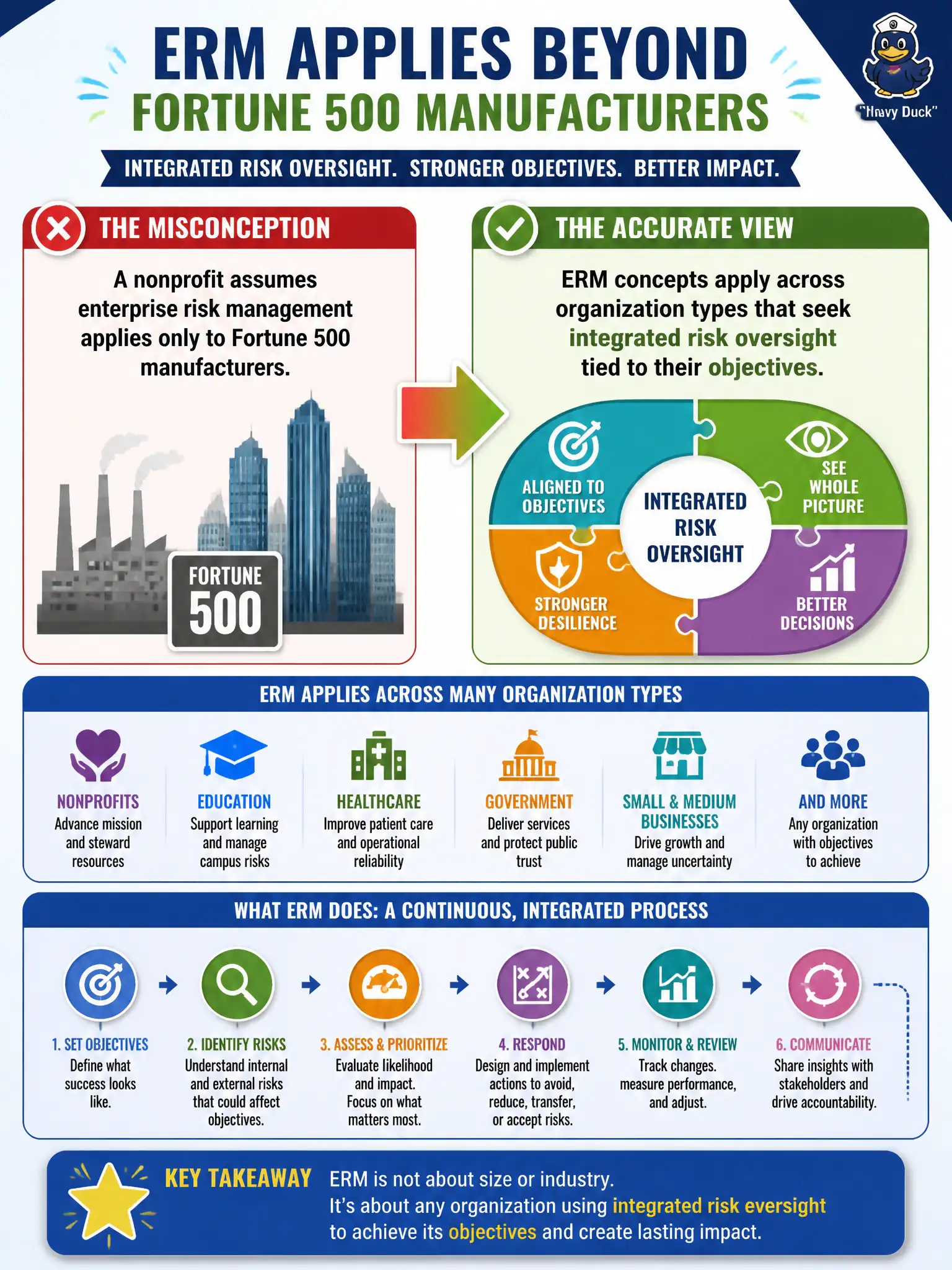
A nonprofit assumes enterprise risk management applies only to Fortune 500 manufacturers. What is the accurate view?
Select an answer to reveal the explanation.
Short Explanation
ERM is not a Fortune 500 club card. Nonprofits, cities, and mid-size orgs still have objectives to protect—and integrated risk thinking scales to fit them.
Full Explanation
Enterprise risk management principles are adaptable across sectors and sizes. Nonprofits and civic entities that seek integrated risk oversight tied to their objectives can apply ERM concepts; they are not reserved for Fortune 500 manufacturers. The accurate view is that ERM concepts apply across organization types pursuing that integrated oversight.
Claiming nonprofits are exempt from any integrated risk oversight concepts invents a harmful carve-out. Declaring ERM frameworks illegal for civic and nonprofit entities is false. Restricting risk registers to manufacturers with more than 500 employees confuses a stereotype with a requirement.
Exam caveat: ERM is scalable and sector-agnostic at the principle level. Organization type does not grant exemption from integrated oversight concepts.
Operational check: scale ERM practices to nonprofit/civic size and mission; tie risks to organizational objectives; start with a right-sized register and governance cadence; reject “only Fortune 500” as a reason to skip oversight. Adopt a right-sized ERM starter set for the nonprofit or civic entity—objectives, top risks, owners, cadence—without waiting for manufacturing-scale bureaucracy. Scale controls to mission complexity.