
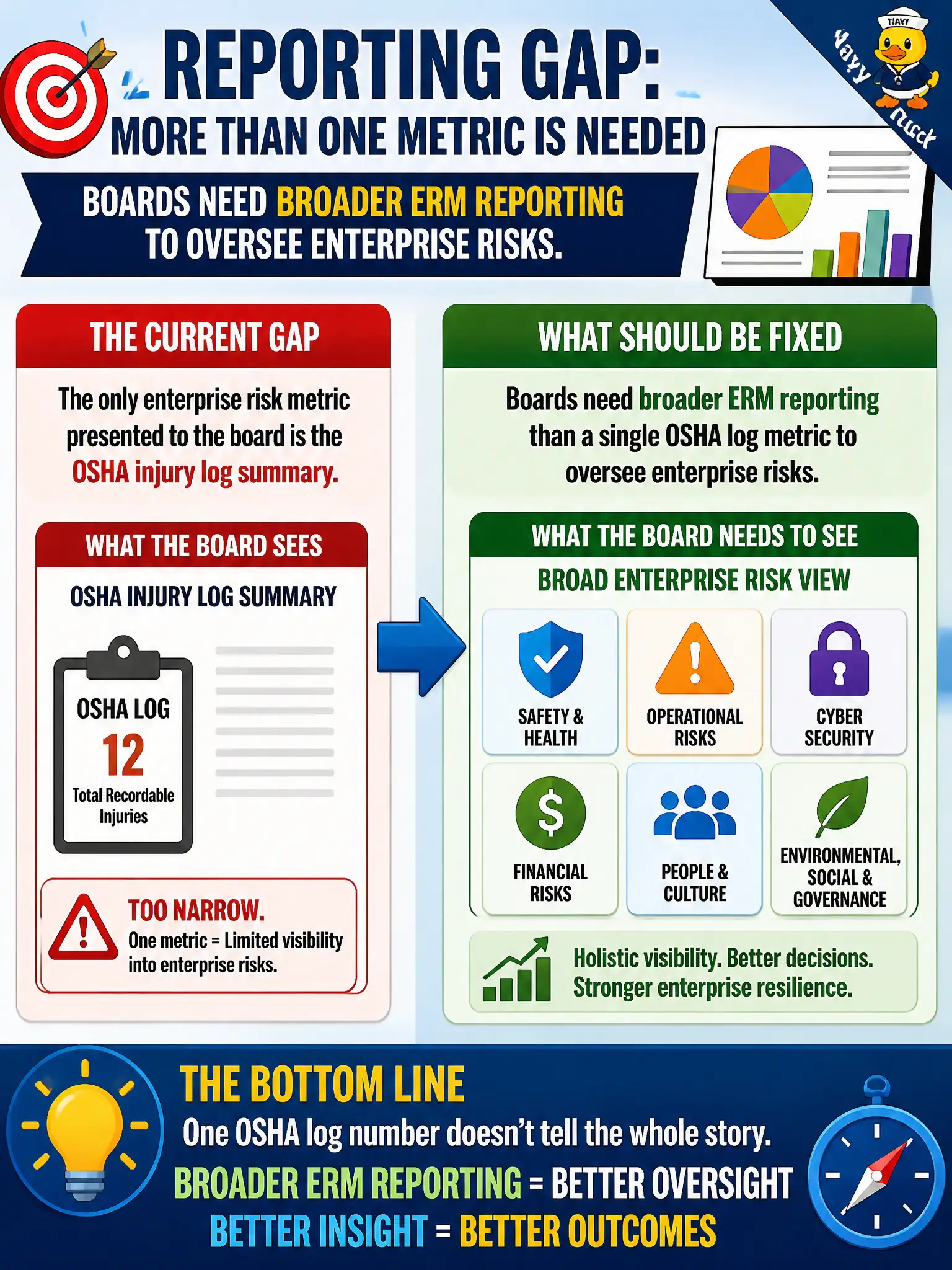
The only enterprise risk metric presented to the board is the OSHA injury log summary. What reporting gap should be fixed?
Select an answer to reveal the explanation.
Short Explanation
Injury logs matter, but they are one dial on a big dashboard. Boards need the wider ERM story—strategy, finance, ops, compliance—not a single OSHA chart pretending to be the whole program.
Full Explanation
Board oversight of enterprise risk requires a portfolio of indicators aligned to material enterprise risks—not a single OSHA injury log summary. Presenting only that metric leaves strategy, finance, reputation, and other domains invisible. Boards need broader ERM reporting than a single OSHA log metric to oversee enterprise risks responsibly.
Claiming OSHA logs are legally required to be the sole board risk report confuses a workplace recordkeeping duty with board ERM information design. Assuming injury logs automatically cover strategy, finance, and reputation without further metrics overclaims their scope. Removing all safety metrics once ISO 31000 is named in policy swings to the opposite error of ignoring workplace harm signals.
Exam caveat: one compliance metric ≠ enterprise risk reporting. CRMC expects breadth in board packs.
Operational check: design a board ERM dashboard with multiple risk categories and leading/lagging indicators; keep OSHA/injury summaries as one safety input; review the pack for missing strategic and financial risk signals. Build a multi-metric board pack covering safety, financial, strategic, and reputational indicators with owners for each. Keep the OSHA log as one safety input among several.