
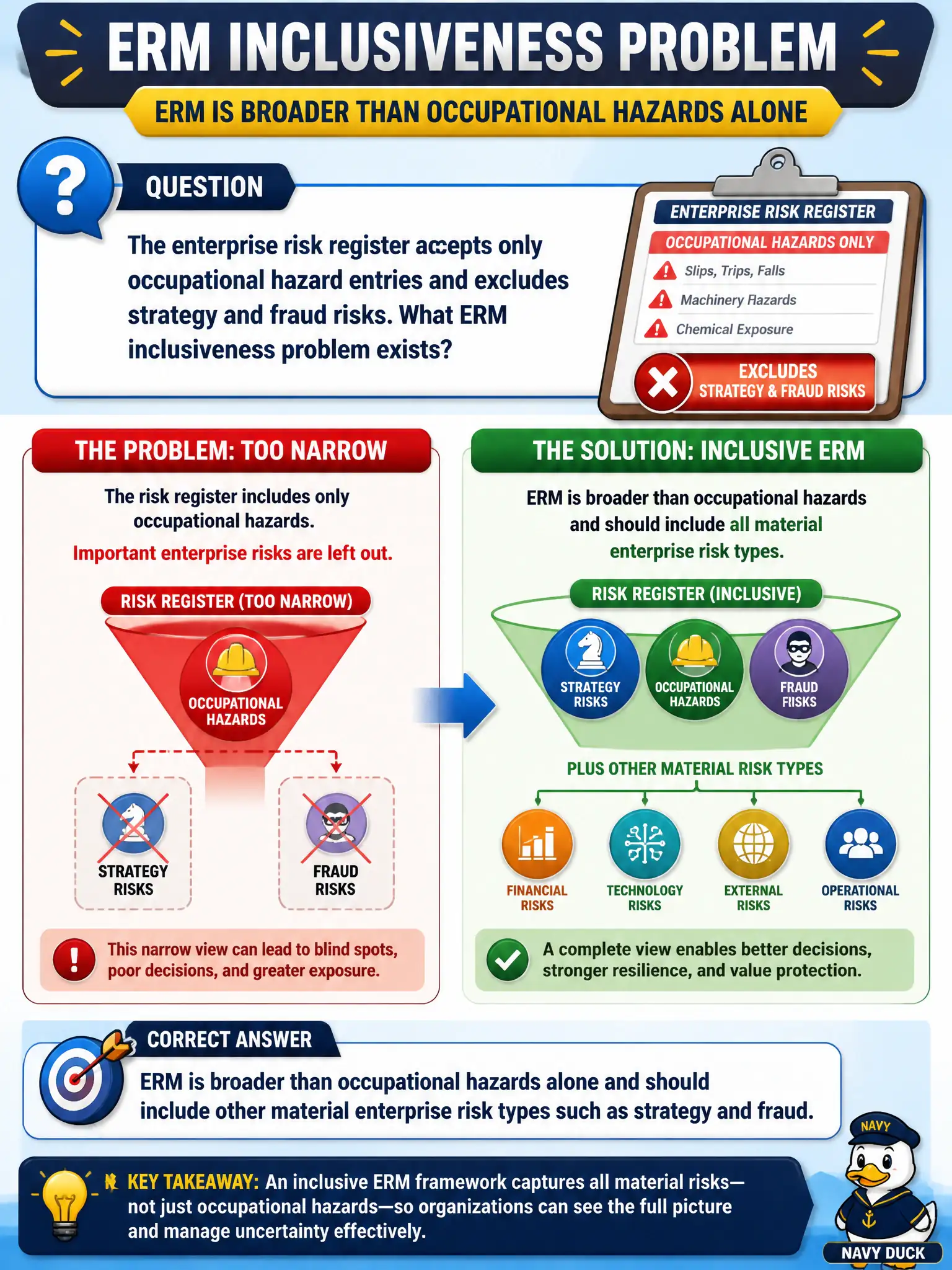
The enterprise risk register accepts only occupational hazard entries and excludes strategy and fraud risks. What ERM inclusiveness problem exists?
Select an answer to reveal the explanation.
Short Explanation
If the register is only slips and trips, strategy bombs and fraud schemes never get a seat. ERM’s job is the whole enterprise risk picture—not just the hard-hat hazards.
Full Explanation
Enterprise risk management encompasses multiple risk categories that can affect objectives. A register that accepts only occupational hazard entries and excludes strategy and fraud risks is too narrow. ERM is broader than occupational hazards alone and should include other material enterprise risk types such as strategy and fraud when they matter to the organization.
Declaring strategy and fraud never risks and keeping them off all registers denies common enterprise exposures. Defining occupational hazards alone as complete ERM scope for every organization confuses one important domain with the whole. Parking fraud risks only in marketing plans misfiles them outside enterprise risk oversight.
Exam caveat: occupational safety is necessary but not sufficient ERM scope. Breadth of material risk types is a CRMC theme.
Operational check: expand register categories to include strategy and fraud where material; assign owners; integrate them into enterprise reporting alongside occupational hazards; review completeness annually. Open register categories for strategy and fraud (or equivalent) and migrate any shadow lists into the enterprise system. Review category completeness in the annual ERM plan.