
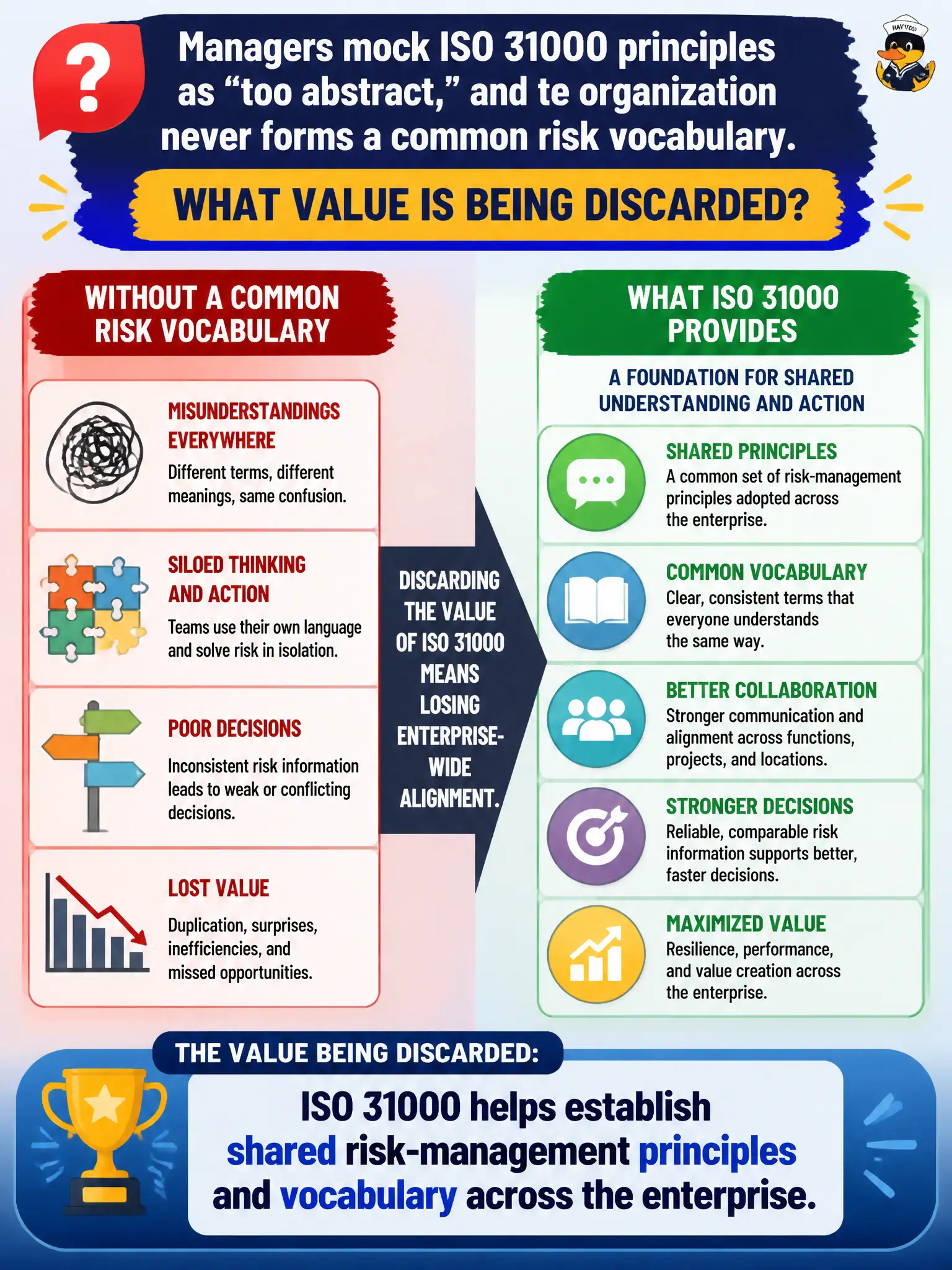
Managers mock ISO 31000 principles as “too abstract,” and the organization never forms a common risk vocabulary. What value is being discarded?
Select an answer to reveal the explanation.
Short Explanation
Shared language is how a city works—stop signs mean stop for everyone. ISO 31000’s principles give that common risk dialect so teams are not arguing over five different definitions of “high.”
Full Explanation
ISO 31000’s principles and framework support a consistent approach and shared vocabulary for risk management across the enterprise. When managers mock the principles as “too abstract” and the organization never forms a common risk language, it discards the practical value of comparable terms for likelihood, impact, residual risk, and treatment. Shared vocabulary enables rollups and clearer civic governance conversations.
Claiming abstract principles have no practical use ignores their role in aligning methods and language. Treating common vocabulary as harmful so each unit invents unique risk terms guarantees incoherent enterprise views. Restricting ISO 31000 to auditors only so it never shapes day-to-day language wastes its coordinating benefit.
Exam caveat: principles and vocabulary are operational enablers, not decoration. CRMC standards awareness includes this use case.
Operational check: adopt a short shared glossary aligned to ISO 31000 concepts; train committees on common terms; require register entries to use the glossary; measure reduction in synonymous conflicting labels across departments. Publish the shared glossary on the intranet and require its terms in register entries and committee packs. Spot-check for rogue synonyms that break rollups and correct them.