
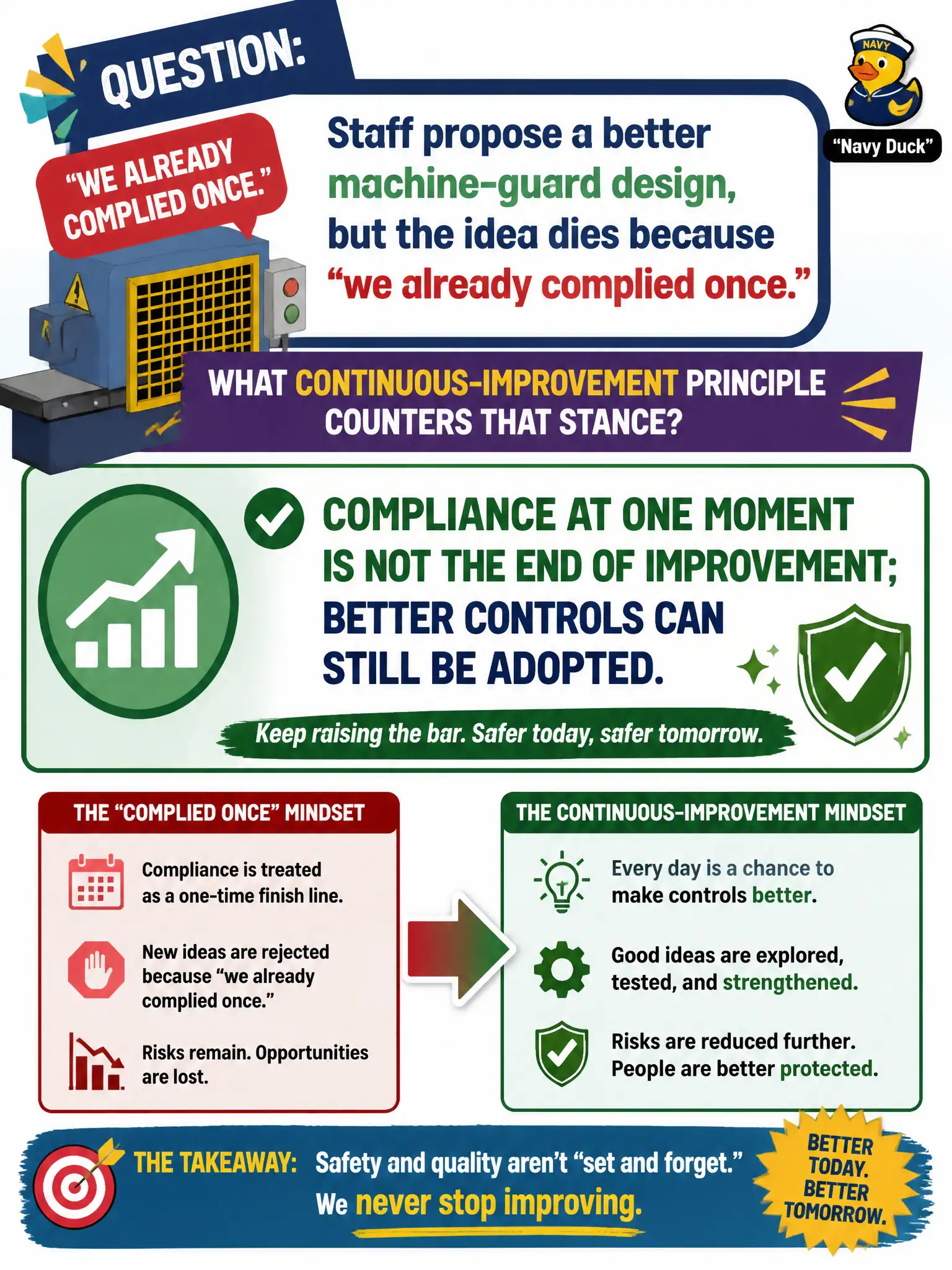
Staff propose a better machine-guard design, but the idea dies because “we already complied once.” What continuous-improvement principle counters that stance?
Select an answer to reveal the explanation.
Short Explanation
Passing an audit last year does not mean stop thinking. Compliance is a floor, not a ceiling—if someone has a safer guard, listen. One-and-done is how good ideas die in the parking lot.
Full Explanation
Meeting a baseline requirement does not prohibit further risk reduction. When staff propose a better machine-guard design but the idea dies because “we already complied once,” continuous improvement counters that stance: compliance at one moment is not the end of improvement, and better controls can still be adopted. Civic safety programs should welcome enhancements that further reduce residual risk.
Claiming one-time compliance forever freezes all future guard designs by regulation misstates most safety regimes, which set floors rather than ceilings on care. Rejecting staff ideas whenever an older control already passed an audit treats past audits as perpetual design locks. Asserting continuous improvement applies only before the first compliance certificate is issued invents an arbitrary end date for learning.
Exam caveat: compliance is a baseline, not a maximum. CRMC continuous-improvement philosophy favors ongoing risk reduction beyond minimums.
Operational check: route improvement ideas through a simple evaluation for risk reduction, feasibility, and cost; pilot better guards where justified; document residual-risk change; avoid shutting ideas down solely because prior compliance existed.