
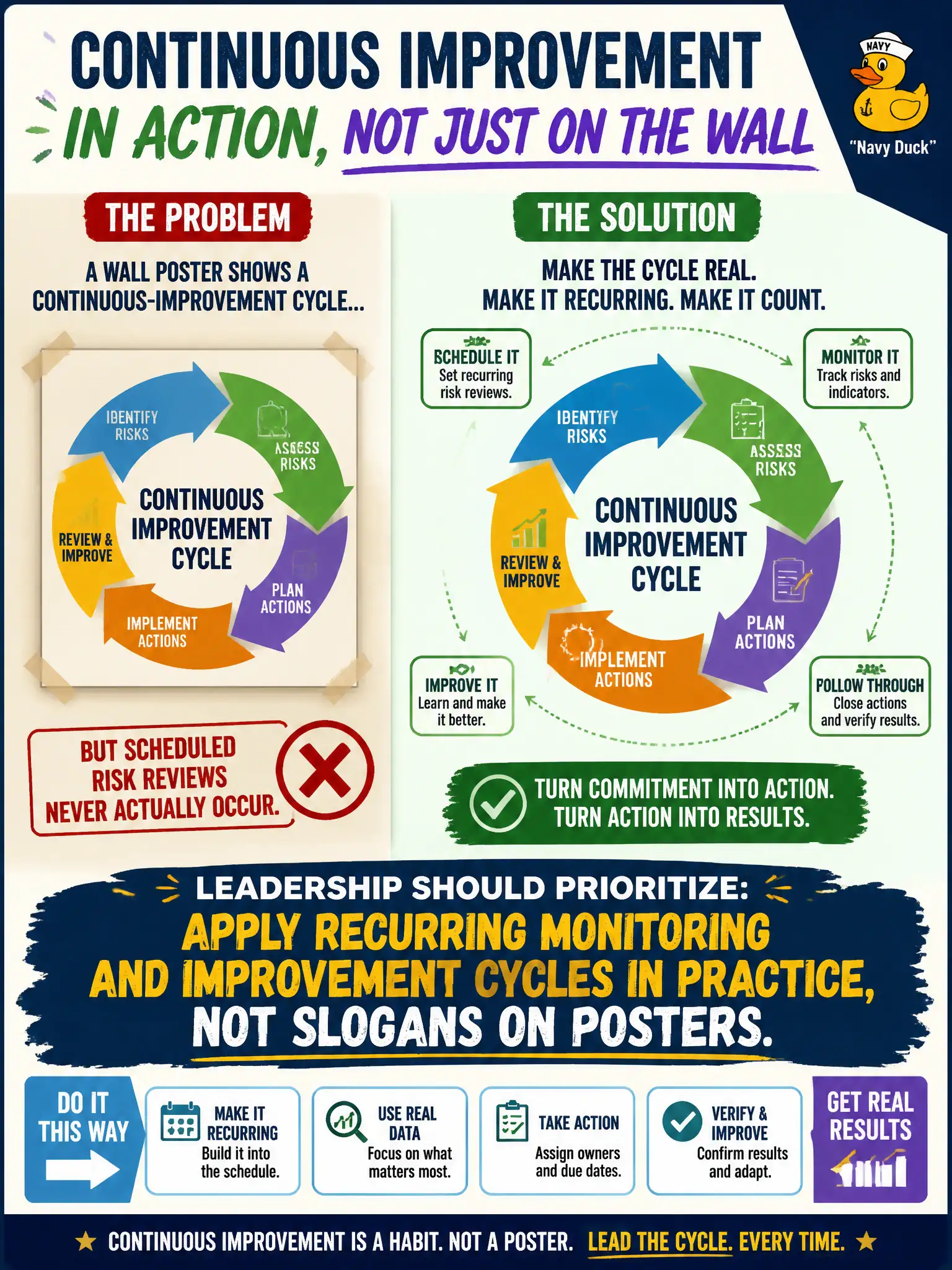
A wall poster shows a continuous-improvement cycle, but scheduled risk reviews never actually occur. What should leadership prioritize?
Select an answer to reveal the explanation.
Short Explanation
A pretty PDCA circle on the wall does not review a single hazard. Improvement is calendar time, owners, and decisions—not decoration. Run the cycle; do not just hang it.
Full Explanation
Systematic improvement requires scheduled monitoring, findings, and follow-through—not wall posters of a cycle diagram. When a continuous-improvement poster exists but scheduled risk reviews never occur, leadership should prioritize applying recurring monitoring and improvement cycles in practice. Civic programs improve through calendarized work, owners, and evidence, not slogan visibility.
Enlarging the poster so the diagram is visible from farther hallways addresses aesthetics, not practice. Replacing reviews with annual pizza parties that celebrate the poster design confuses morale events with risk monitoring. Treating the poster alone as proof that improvement cycles are operating equates display with performance.
Exam caveat: artifacts ≠ operating cycles. CRMC continuous-improvement items test whether reviews actually run.
Operational check: publish a monitoring calendar with owners and due dates; hold the next scheduled risk review; capture findings and actions; retire any claim that poster presence equals program maturity. Replace poster-as-proof claims with a living calendar of completed reviews and open actions visible to leadership. If a cycle step has no owner and date, it is not operating.