
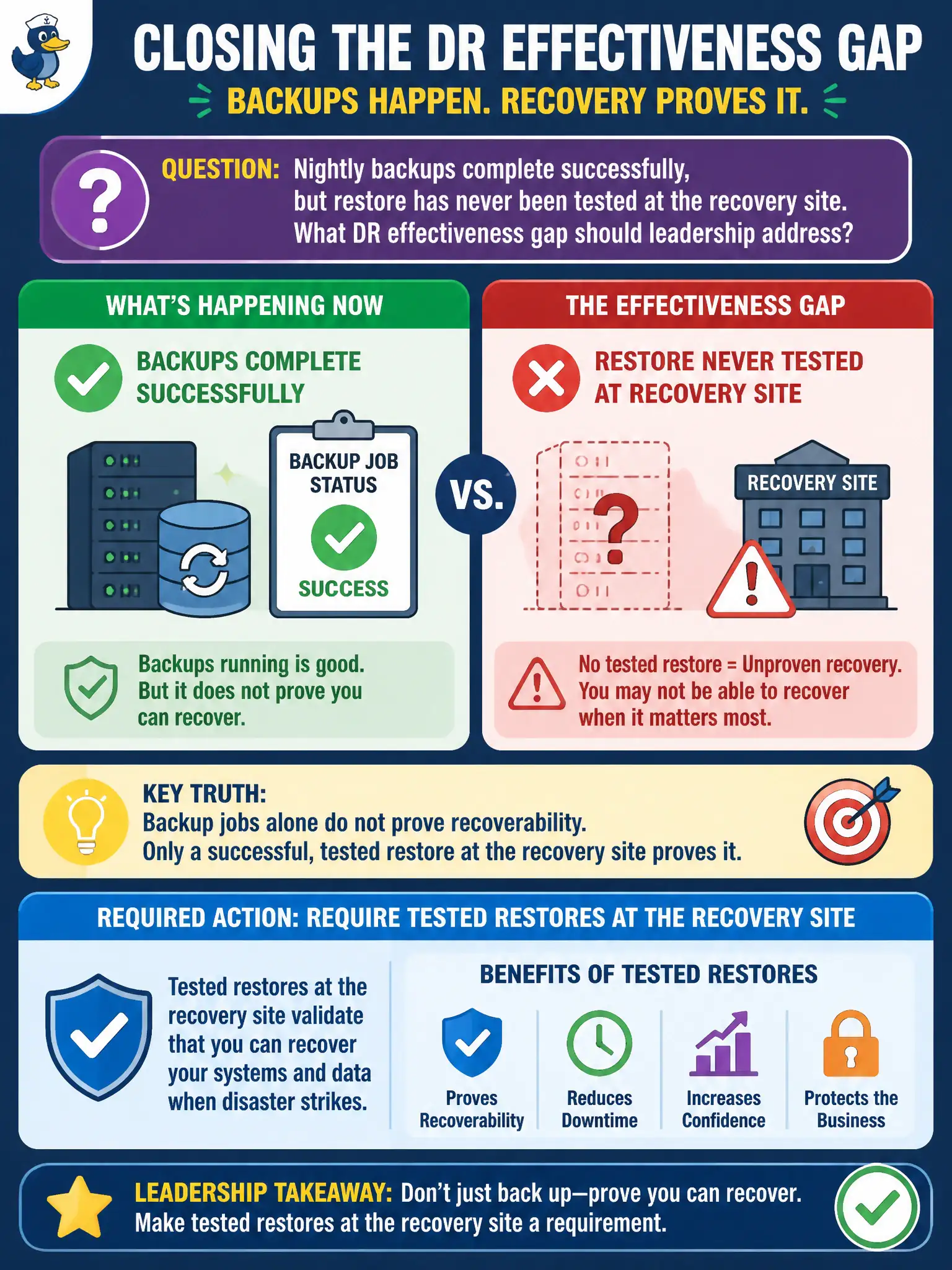
Nightly backups complete successfully, but restore has never been tested at the recovery site. What DR effectiveness gap should leadership address?
Select an answer to reveal the explanation.
Short Explanation
Having parachutes in the closet is comforting until nobody has ever packed and jumped one. Backups without restore tests are unfinished business. Prove the bits come back at the recovery site.
Full Explanation
Backup completion does not equal disaster recovery capability. Restores must be tested at the recovery site to prove that data, procedures, access, and environments actually rebuild civic operations. When nightly backups succeed but restore has never been tested at the recovery site, leadership should require tested restores because backup jobs alone do not prove recoverability.
Treating successful backup job logs as complete proof of recoverable operations confuses job success with restore success. Stopping backups because untested restores make backups unnecessary discards protection instead of validating it. Testing restores only in production during peak load to maximize realism without a recovery site can endanger live services and still fails to prove alternate-site recovery.
Exam caveat: backup ≠ restore ≠ recovery. CRMC repeatedly tests this distinction for DR effectiveness.
Operational check: schedule restore tests at the designated recovery site on a defined cadence; document success criteria for critical municipal datasets; remediate failures before claiming DR readiness in audits or board reports. Retain restore-test evidence with date, dataset, site, and pass/fail notes suitable for audit. Untested backup success should never appear alone as proof of disaster recoverability in board materials.