
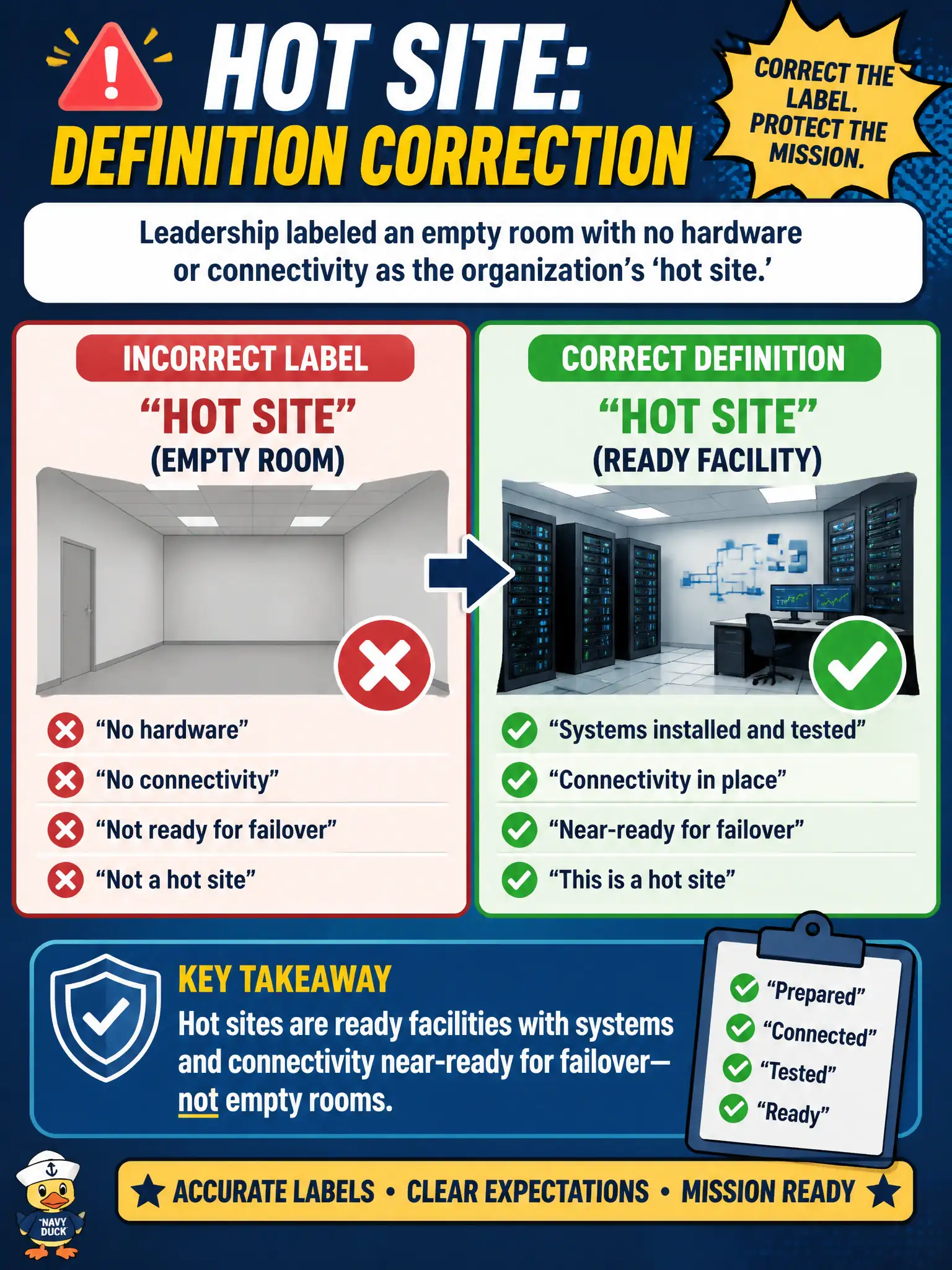
Leadership labels an empty room with no hardware or connectivity as the organization's 'hot site.' What definition correction is required?
Select an answer to reveal the explanation.
Short Explanation
Calling an empty garage a 'fully loaded race car' does not make it lap-ready. A hot site needs gear and connectivity close to failover, not just square footage. Fix the label before someone trusts a vacant room.
Full Explanation
In disaster recovery taxonomy, a hot site is a standby facility maintained with systems, data access pathways, and connectivity near-ready for failover—not an empty room. Leadership labeling unused space with no hardware or connectivity as a “hot site” misstates readiness and creates false confidence about municipal recovery speed. The definition correction is to recognize hot sites as ready facilities with systems and connectivity near-ready for failover.
Claiming any unused closet qualifies as a hot site if the door can lock confuses spare space with recovery capability. Treating hot sites as marketing names that need no systems or network readiness empties the term of operational meaning. Preferring empty rooms to equipped sites because they cost less to brand optimizes labeling cost over recoverability.
Exam caveat: hot versus warm versus cold readiness is a standard CRMC DR vocabulary item. Empty space is closer to cold than hot.
Operational check: inventory what is actually pre-positioned at the alternate facility (compute, network, data, desks); classify the site using standard readiness definitions; align RTOs and executive messaging to that class, not to aspirational labels.