
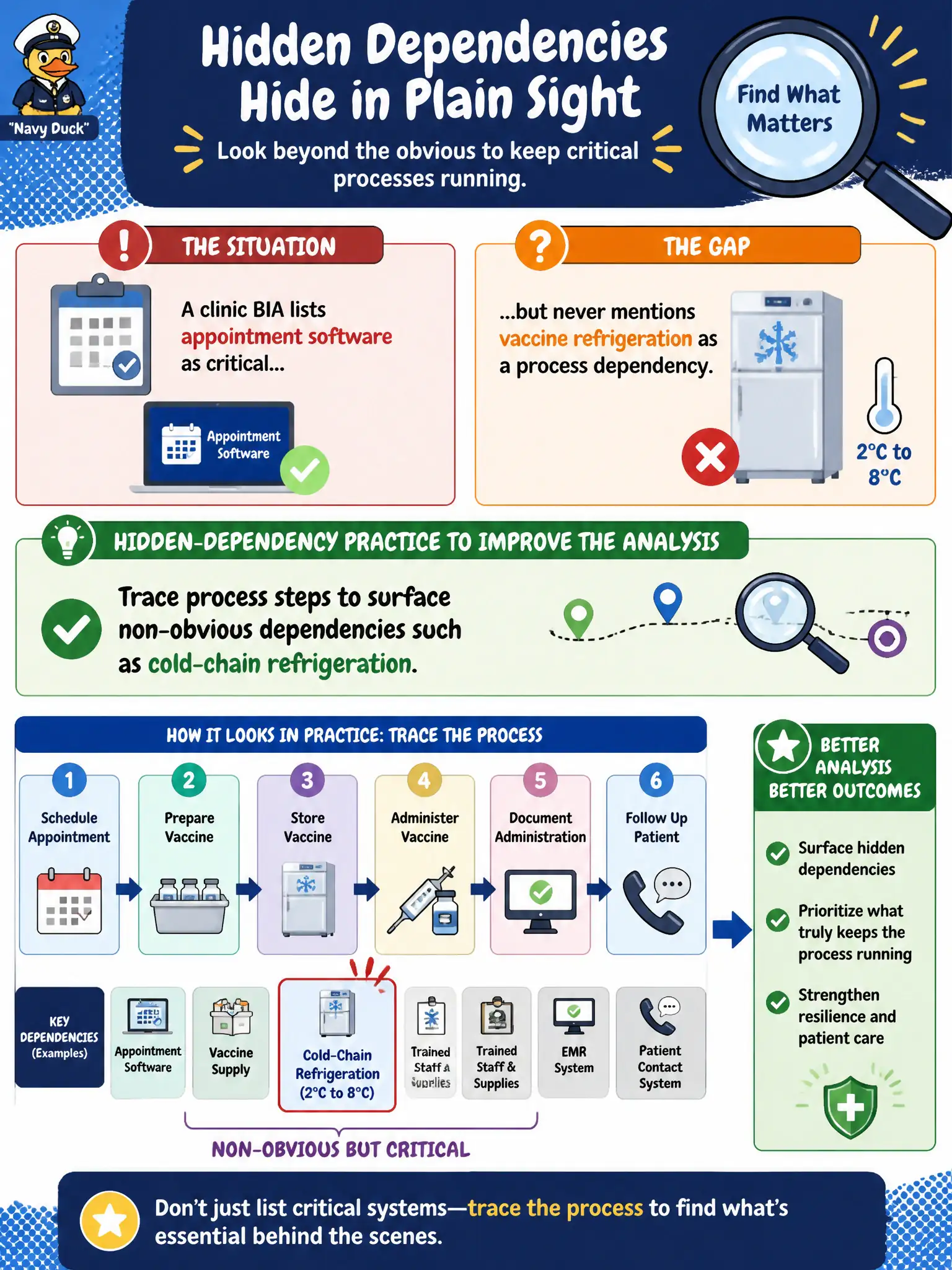
A clinic BIA lists appointment software as critical but never mentions vaccine refrigeration as a process dependency. What hidden-dependency practice should improve the analysis?
Select an answer to reveal the explanation.
Short Explanation
The booking app can be perfect while the vaccines cook in a warm fridge. Dig into the real process steps—not just the logo on the login screen. Hidden dependencies like refrigeration belong in the BIA.
Full Explanation
Process-level dependency analysis reveals supporting assets that application inventories miss. A clinic BIA that lists appointment software as critical but never mentions vaccine refrigeration overlooks a dependency that can destroy clinical capability even when the booking app is online. Tracing process steps to surface non-obvious dependencies such as cold-chain refrigeration improves completeness of municipal health continuity analysis.
Stopping at application names and never walking process steps for physical dependencies systematically misses facilities and environmental controls. Assuming refrigeration is always available whenever software systems are online confuses IT uptime with process viability. Scoring only front-desk tools because clinical storage is “outside business continuity” invents a false boundary around the real clinical workflow.
Exam caveat: BIA dependency work follows the process, not only the application catalog. Hidden physical dependencies are a frequent exam trap.
Operational check: for each critical clinical process, walk steps from intake to delivery; list power, refrigeration, specialized rooms, and suppliers; add missing items to the BIA; assign recovery owners and alternate procedures where cold chain must survive IT-focused failover.