
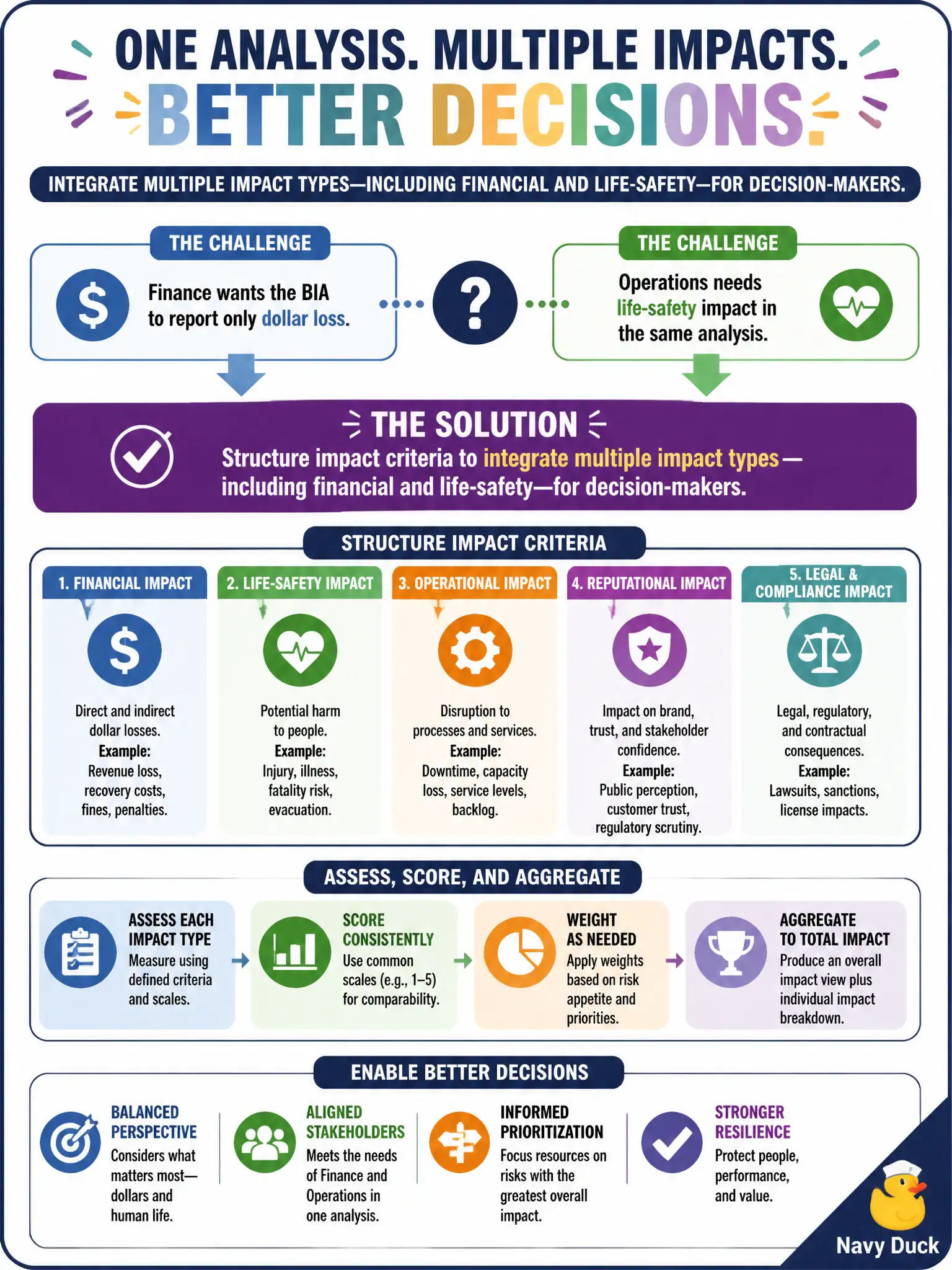
Finance wants the BIA to report only dollar loss, while operations needs life-safety impact in the same analysis. How should the risk manager structure impact criteria?
Select an answer to reveal the explanation.
Short Explanation
A hospital outage priced only in lost billing misses the patient in the hallway. Money matters, and so does life safety—leaders need both lenses. Build a multi-criteria BIA so tradeoffs are honest.
Full Explanation
Effective BIAs present multiple impact dimensions so decision-makers see financial, operational, reputational, regulatory, and life-safety consequences together. When finance wants only dollar loss and operations needs life-safety impact, integrating multiple impact types—including financial and life-safety—gives municipal leaders honest tradeoffs for recovery investment. Single-metric approaches can undervalue harm that dollars alone do not capture.
Using dollar loss alone because nonfinancial harm cannot influence recovery priorities systematically underweights life safety and public trust. Running separate unrelated BIAs that never appear together for leadership fragments the decision package. Dropping life-safety scoring so finance dashboards stay simpler optimizes reporting aesthetics over civic duty.
Exam caveat: multi-criteria impact is a core BIA competency at CRMC depth. Financial metrics matter; they are not the whole story.
Operational check: define an impact criteria set that includes at least financial and life-safety dimensions; score critical functions on each; present a combined view in the BIA readout used for budget and recovery prioritization. For civic leadership packets, present the multi-criteria scores side by side on one page so finance and operations see the same decision object. Revisit weights when mission priorities change, but do not collapse back to a single dollar column.