
An administrative office writes into policy that minor theft of low-value office supplies is accepted, with monitoring thresholds and an owner. When is this approach appropriate?
Select an answer to reveal the explanation.
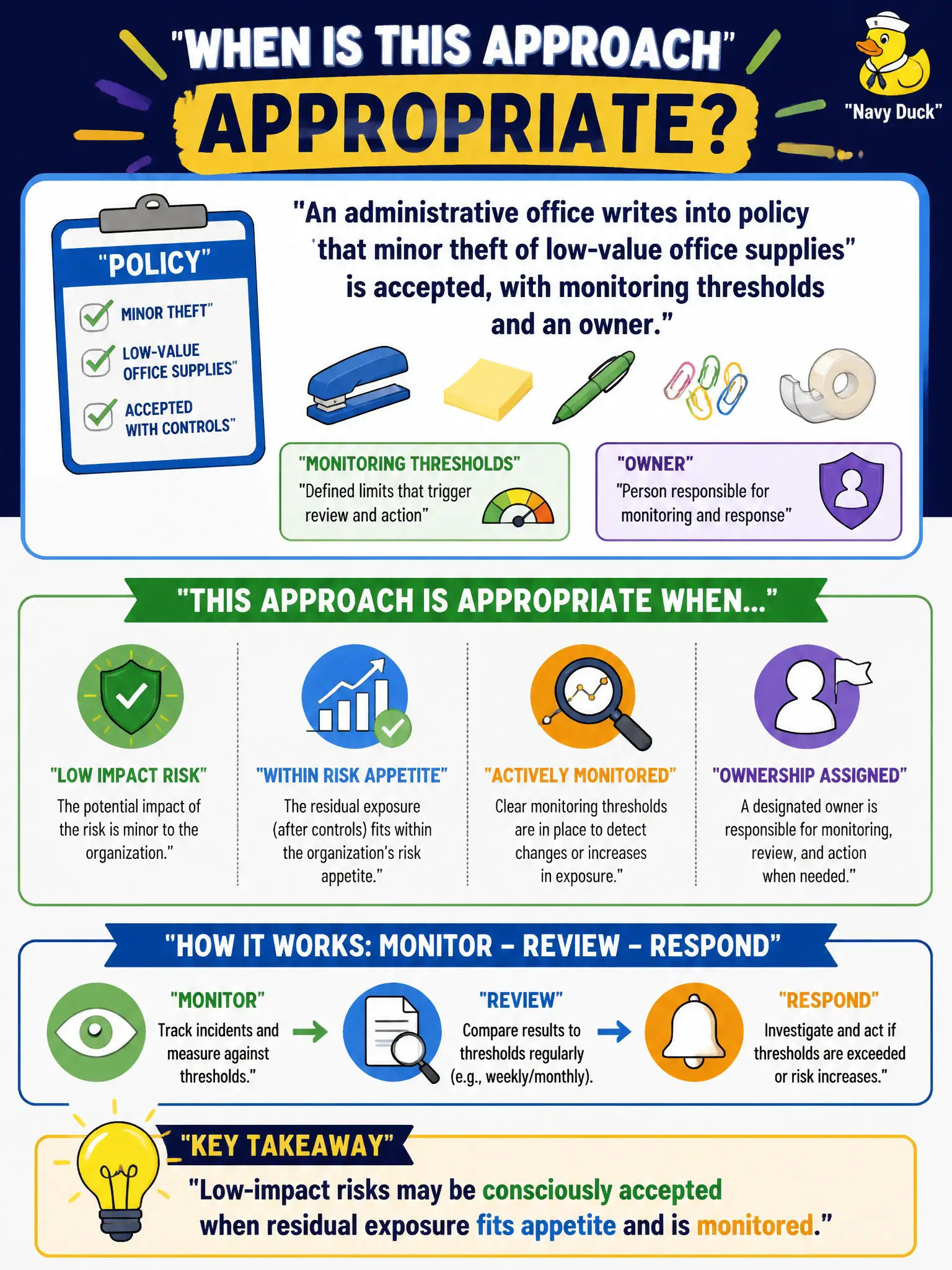
Short Explanation
Not every missing stapler deserves a SWAT team. For small, watchable losses, saying "we'll live with this and keep an eye on the numbers" can be a honest, documented acceptance — as long as it stays small.
Full Explanation
Low-impact risks may be consciously accepted when residual exposure fits appetite and is monitored is appropriate for an administrative office policy that accepts minor theft of low-value office supplies with monitoring thresholds and an owner. That pattern matches valid acceptance: small impact, deliberate decision, oversight. Civic offices need not over-treat trivial supply shrinkage with disproportionate avoidance.
Requiring all theft risks to be avoided by closing every supply closet permanently fails by concept because blanket avoidance of minor supply access can cripple operations relative to the risk. Claiming acceptance is valid only when life-safety exits are also left uncontrolled fails because coupling trivial acceptance to intolerable life-safety neglect misunderstands appetite boundaries. Claiming transfer through insurance is forbidden for any risk that is accepted fails because organizations may still insure portfolios while accepting small retained operational losses; acceptance and transfer can coexist at different layers.
Exam caveat: CRMC acceptance is proper for residuals within appetite with ownership and monitoring—not for intolerable hazards. Minor supply theft is a teaching example of proportionate acceptance.
Operational check: Keep the office-supply acceptance entry with owner, threshold (e.g., loss rate), and review date; escalate to stronger controls if monitoring shows organized theft or rising loss beyond appetite.