
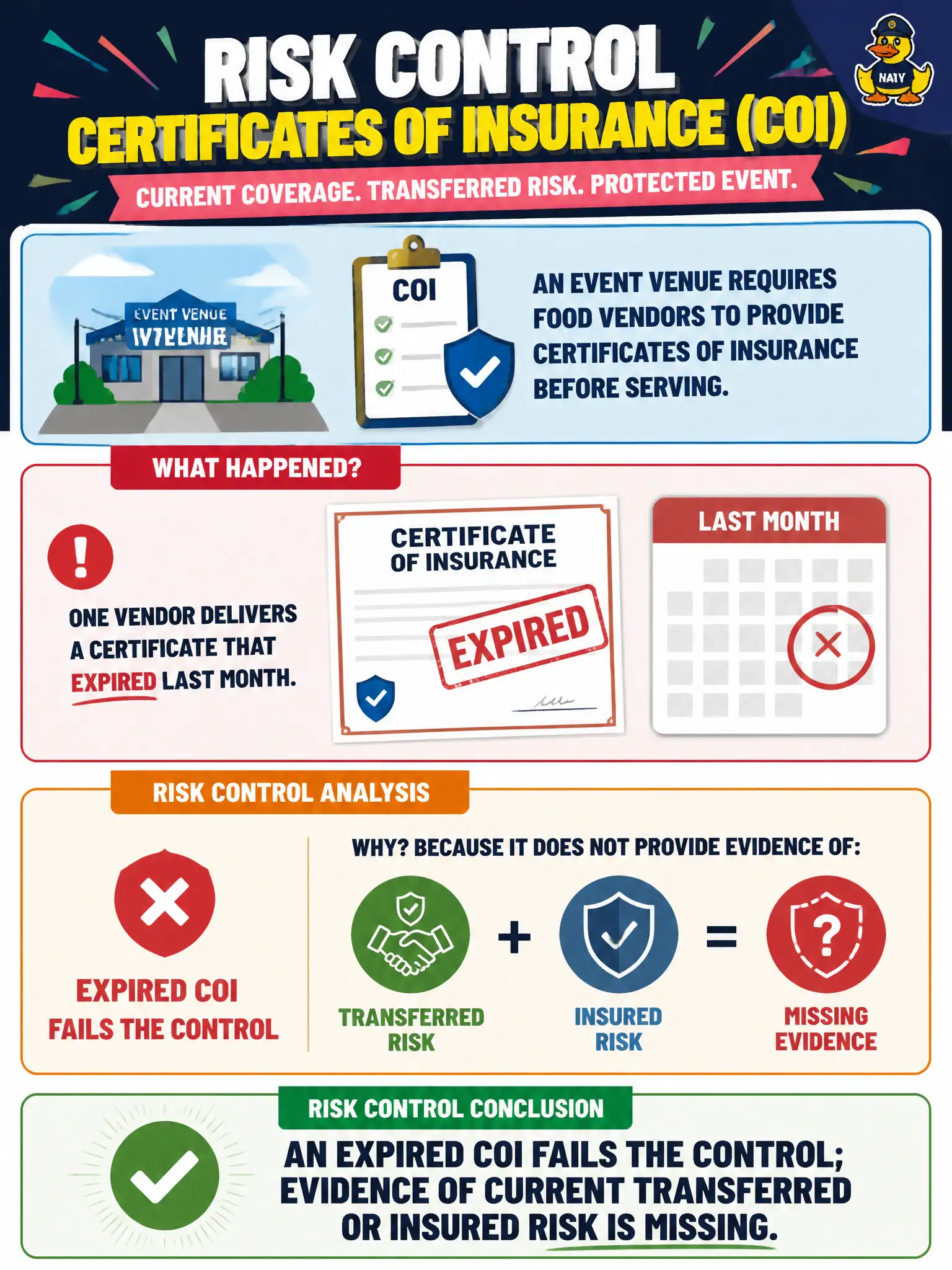
An event venue requires food vendors to provide certificates of insurance before serving. One vendor delivers a certificate that expired last month. What should the risk control conclusion be?
Select an answer to reveal the explanation.
Short Explanation
A COI is proof that the transfer/insurance control is alive — like a passport that still has to be unexpired. Last month's stamp does not get the vendor through the gate today.
Full Explanation
An expired COI fails the control; evidence of current transferred or insured risk is missing is the correct conclusion when a food vendor at an event venue presents a certificate that expired last month. Certificates of insurance are time-bounded evidence. Civic venues must obtain current COIs before service—not file expired paper as if it still transfers risk.
Claiming expired certificates remain valid for ninety days after the printed end date fails by concept because coverage ends at expiration unless renewed; grace myths are not a control. Claiming COIs are optional once a vendor showed insurance in a prior year fails because prior-year evidence does not prove present coverage. Claiming acceptance of food-service risk is automatic when any paper certificate is filed fails because filing expired paper is not conscious acceptance analysis—it is a failed transfer-evidence control.
Exam caveat: CRMC COI controls require current evidence at the time of performance. Expired certificates do not satisfy transfer verification.
Operational check: Block vendor load-in at city events until a current COI meeting limit requirements is verified; track expiration dates and request renewals before festivals, not after food service begins.