
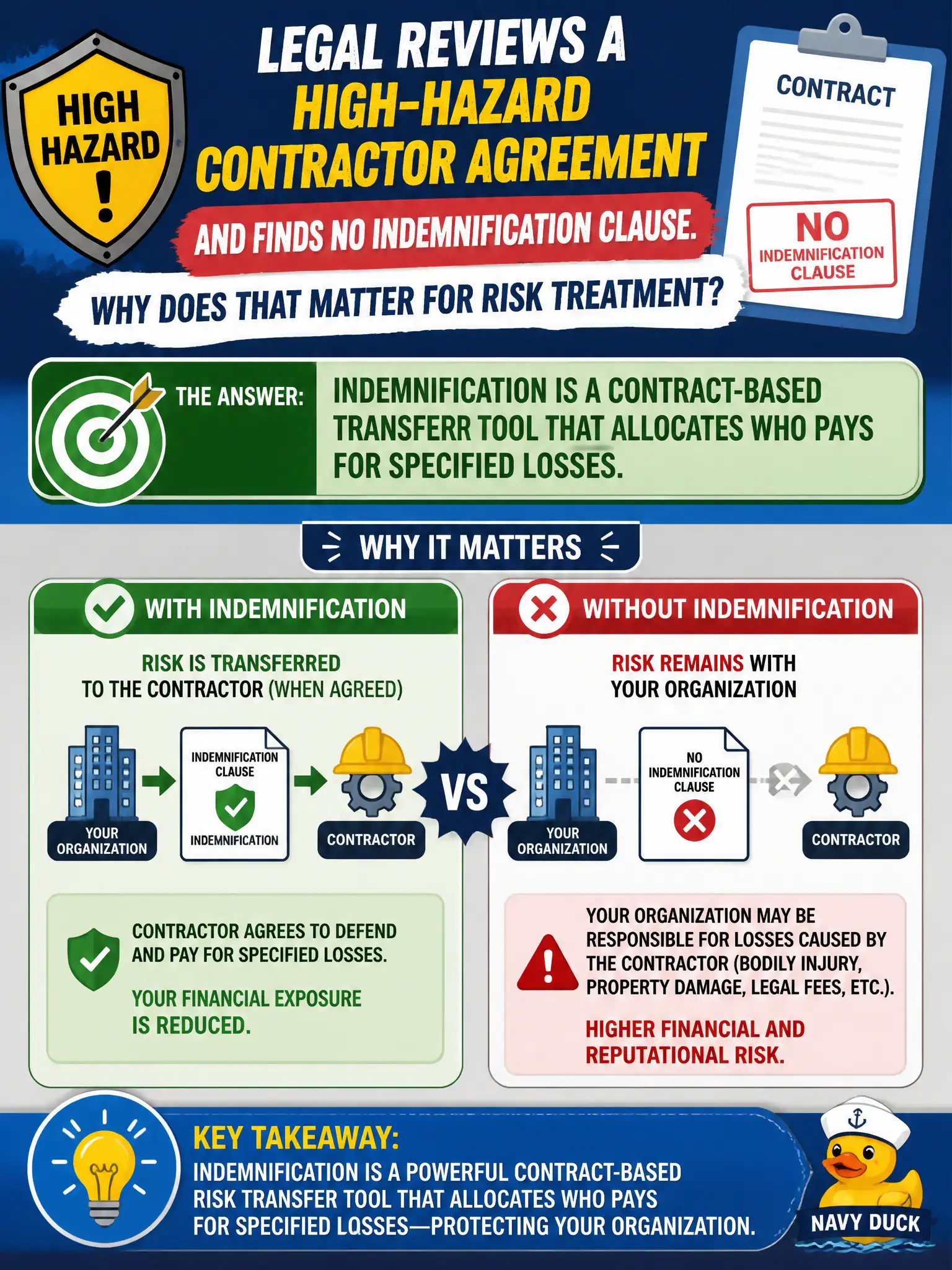
Legal reviews a high-hazard contractor agreement and finds no indemnification clause. Why does that matter for risk treatment?
Select an answer to reveal the explanation.
Short Explanation
Indemnification is the contract's way of saying "if this goes sideways, here's who writes the check." It doesn't stop accidents, but it is a core transfer tool — missing it on high-hazard work leaves that financial allocation fuzzy.
Full Explanation
Indemnification is a contract-based transfer tool that allocates who pays for specified losses, which is why a high-hazard contractor agreement without an indemnification clause matters. Missing allocation language leaves default legal outcomes and weakens intentional transfer design. Civic procurement and legal review should align indemnity with insurance requirements and the hazard profile of the work.
Claiming indemnification guarantees hazardous work will never produce an incident fails by concept because indemnity addresses financial consequences after loss; it does not prevent occurrence. Claiming indemnification replaces certificates of insurance and safety controls fails because COIs evidence funded transfer capacity and safety controls reduce probability/severity—indemnity alone is incomplete. Claiming indemnification is only for office-supply vendors, never high-hazard work, fails because high-hazard work is precisely where clear loss allocation is most needed.
Exam caveat: CRMC treats indemnification as a transfer mechanism for loss allocation, not as hazard elimination or a substitute for insurance evidence and site controls.
Operational check: In legal review of high-hazard municipal contracts, confirm indemnity scope, defense obligations, and alignment with required insurance; escalate agreements that omit allocation for significant third-party and premises exposures.