
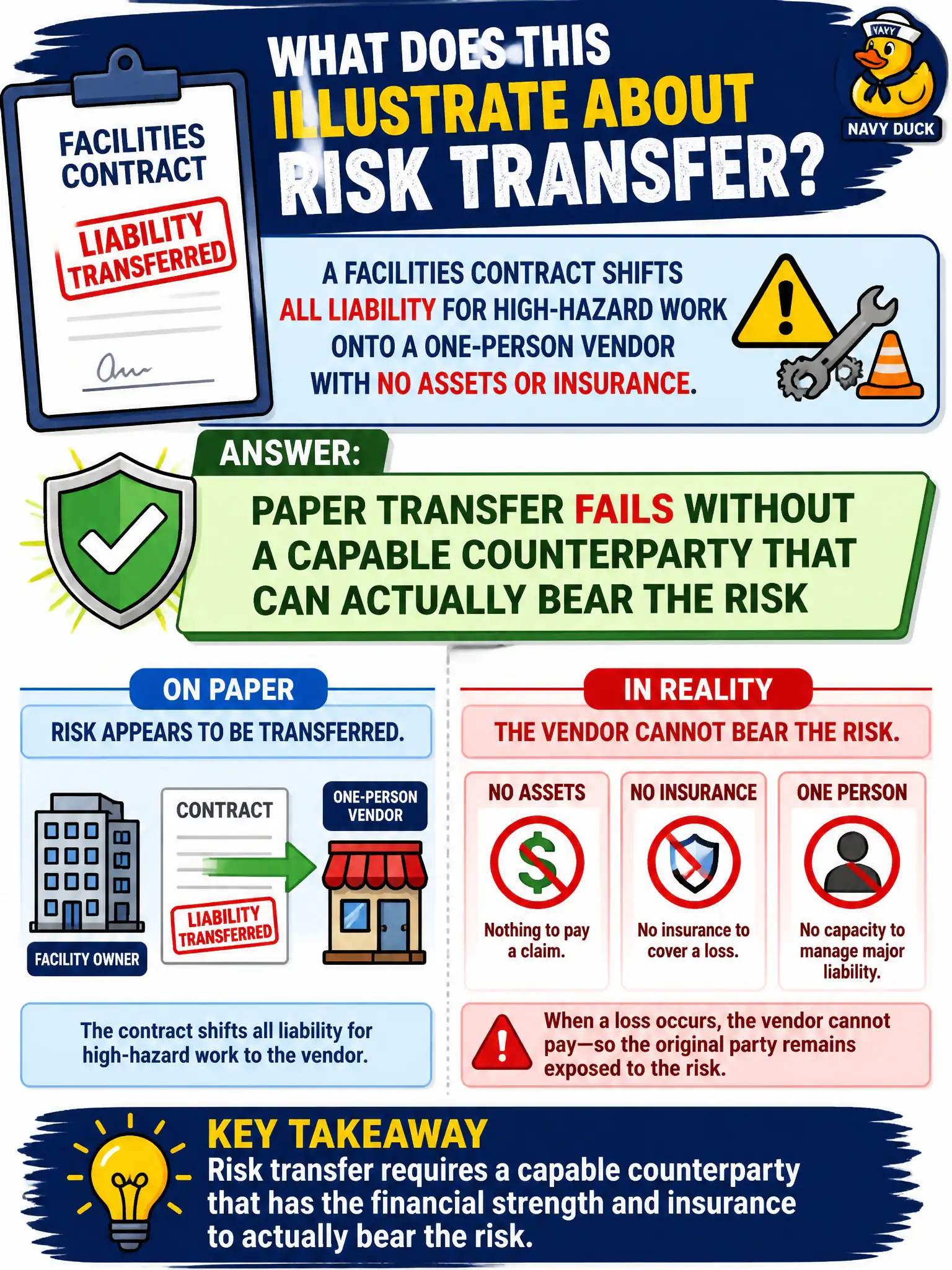
A facilities contract shifts all liability for high-hazard work onto a one-person vendor with no assets or insurance. What does this illustrate about risk transfer?
Select an answer to reveal the explanation.
Short Explanation
Handing a million-dollar problem to someone with empty pockets is theater, not transfer. Real transfer needs a party that can actually pay or perform when things go wrong — capacity matters as much as the clause.
Full Explanation
Paper transfer fails without a capable counterparty that can actually bear the risk is illustrated when a facilities contract shifts all liability for high-hazard work onto a one-person vendor with no assets or insurance. Indemnity language against an empty counterparty leaves the civic organization holding practical loss. Effective transfer requires financially and operationally capable parties—insurance, capitalization, and performance ability—not merely signatures.
Claiming any signed liability clause fully eliminates organizational exposure forever fails by concept because unenforceable or empty transfers rebound; courts and practical recovery still matter. Preferring tiny vendors as transfer parties because they charge lower rates fails because price without capacity is false economy when high-hazard liability lands back on the host. Claiming transfer is complete once legal inserts the word indemnity anywhere fails because magic words without substance, limits, and insurance backing do not create real transfer.
Exam caveat: CRMC risk transfer evaluates counterparty capability, not just contractual wording. Transfer to judgment-proof parties is ineffective treatment.
Operational check: For high-hazard county contracts, require adequate COIs, limits matched to exposure, and financially responsible counterparties; reject sole reliance on indemnity from undercapitalized one-person vendors.